


Is email dead?
For personal conversations between friends and family, yes; social media and chat have taken over that arena. But in the business world—for companies, clients, or prospects—email marketing campaigns are still very much alive.
The majority of consumers (63%) prefer that companies contact them by email instead of on social media.1
The email address has become the digital identity card of the customer journey. With new regulations in place to protect privacy, targeting consumers with paid media is becoming difficult. Primary data (zero-party and first-party data) are therefore your best allies, and email addresses are at the top of that list.
It’s time to let go of received ideas and return email marketing to its rightful place as a strategic pillar of the marketing mix. Let's bust the 7 most common myths, one by one.
- Relevance of email
- Conversion
- Consumer preference
- Control of channel
- Costs and ROI
- Knowing the customer
- Targeting and personalization
- Conclusion
Myth #1: Email marketing is outdated and less effective than other marketing channels
While some people expected that contextual targeting on social media would lead to the disappearance of email, the latter has resisted this encroachment and is holding its own. Why? Because the email address is the main reference point for consumers in the digital realm.
Although email has been around for decades, the way it is used has evolved. The best marketing specialists are those who have adapted their strategies to better respond to current norms.
In e-commerce, email is an excellent way to guide consumers through the various stages of the buying journey: product discovery, transaction, purchase confirmation, and order status.
Almost 73% of marketing managers surveyed in the fourth quarter of 2020 (CMO Council) put email at the top of a long list of communication channels. Email is therefore preferred over social media, web forms, online notifications, and personal interactions with sales teams and customer service.
Myth #2: Social media and other tactics in the marketing mix generate more leads than email marketing
As opposed to ads, email marketing ensures consumers are followed throughout the buying journey, which allows you to:
- transform prospects into customers
- ensure follow-ups on customer satisfaction
- offer a sales incentive
Email is what brings your customers to your website—the place where conversion actually takes place. Email is what allows you to offer sales incentives and share news about the company or your latest product updates. It’s email that enables you to ask your customers to share their opinions or send in their questions. It’s email that encourages customers to return to their shopping cart after they have abandoned it.
In short, email accompanies the consumer throughout their experience. It intervenes at the right moment to turn a prospect into a customer, and can even play a key role in their loyalty.
Myth #3: Consumers are inundated with email and don’t want to receive any more
It’s true that people get a lot of email. But this doesn’t necessarily mean it’s unwanted.
Can you remember the last time you saw an unwanted email in your primary inbox? Email filters work really well now. Mail doesn’t land in your inbox just by luck: It’s almost always email you have consented to receive.
When a consumer subscribes to your mailing list, they are granting you the privilege of appearing in their inbox. Even more significantly, they are indicating that they’re interested in your company and want to hear further from you.
As proof, here’s a statistic: 69% of consumers worldwide prefer to communicate with brands by email.2 SMS/MMS comes in a distant second, with 53%.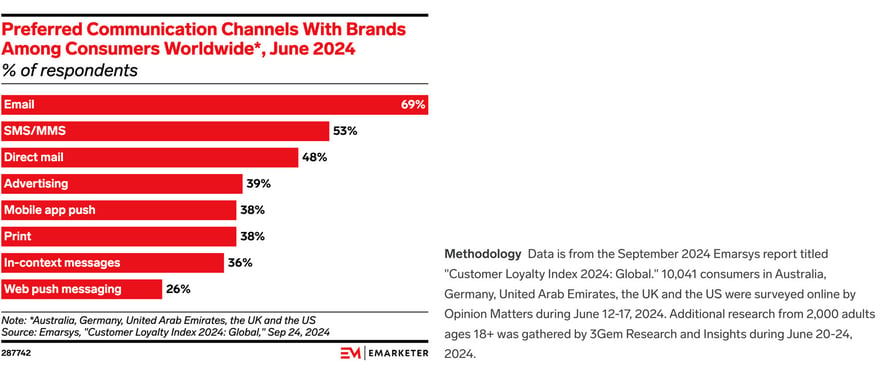
The idea that your contacts don’t want you to send them emails is therefore completely false. If they didn’t want to receive your emails, they wouldn’t have subscribed to your mailing list. 86% of consumers state that they want to receive updates from the businesses they frequent.3
A communication channel used daily
Not only is email appreciated by consumers, it’s also a channel that is used daily and anchored in our routines... not merely a trend.
Checking their inbox has become an everyday reflex for almost all consumers.
- 96% read their personal emails every day according to a report by the Data & Marketing Association (DMA).4
- Almost 9 out of 10 Canadians stated they have used email in the past three months according to Statistics Canada,5 which makes it the main digital activity across the country.
A less intrusive marketing tactic
Email is also a lot less intrusive than many other forms of marketing. Consumers choose when to consult their email based on their own schedule, and they can decide whether to open a message or not.
This freedom is diametrically opposed to tactics like annoying pop-ups, which disrupt people’s online experience, or even ads on social media, which interfere with their personal feed.
When consumers give you their email address, they expect that you will be respectful of their time and their inbox. Here’s a good rule to keep in mind: Only send emails if you are offering added value and have a clear objective.
Myth #4: Companies don’t have a lot of control over email marketing
While 98.5% of emails reach consumer inboxes,6 organic posts on social media only reach a fraction of your audience. Only 1.25% of followers on Facebook and 3.2% on Instagram actually see a company’s content.7
These platforms exert a kind of opaque control over how often your content and ads are seen and who sees them. And they are constantly changing the rules: Facebook, X (formerly Twitter), and Instagram often change their algorithms without any warning. Their priority is to keep users in their ecosystem and avoid having them leave the platform. Customer experience (CX) is secondary.

Email, however, prioritizes a sustainable customer relationship. What’s more, as opposed to social media, email marketing platforms offer you full control over your strategy.
- Your mailing list belongs to you
- Messages are sent on the day and at the time of your choosing
- Personalization is possible and accessible
A way to guide the customer journey and create engagement
In B2C sales, or in other sectors with direct sales to the consumer (D2C), email is the main vector for secondary purchases and engagement.
Email accompanies the customer throughout their experience: from customer acquisition through to re-engagement after abandoning a shopping cart and including sales incentives, cross-selling, and retargeting. This channel alone covers many key stages of the buying journey and can activate relevant actions at decisive moments.
Email marketing also lets you do a better job of introducing your brand (values, history, team) and remain relevant in the minds of customers, notably through personalization.
Email marketing and privacy protection
The Canadian legislative framework is progressively getting closer to the principles embraced by Europe’s GDPR. A major modernization of the laws concerning privacy protection is now underway in Canada, particularly through Law 25 in Quebec, which is already in effect.
These new requirements strengthen:
- transparency
- consent
- management of personal information
These regulations can also foster better performance in email marketing. Remember that the application of Canada’s anti-spam legislation (CASL) in 2014 resulted in an improvement in the quality of emails and the engagement of subscribers.
Given this context, email platforms offer increased control over the personal data of your subscribers. Beyond the regulatory requirement, this approach strengthens transparency, inspires trust, and above all attracts readers who actually want to hear from you.
Myth #5: Email marketing is expensive
When email marketing is executed correctly, its return on investment (ROI) is higher than for other direct marketing channels.
For every dollar invested in email marketing, most marketing specialists receive a return of between $10 and $36.8 A minority (5%) even obtain over $50!
Unsurprisingly, the return on investment for email marketing varies based on the sector of activity. Some sectors lend themselves better to closer follow-ups or frequent communications, thereby achieving higher performance. But the fact remains that email is still a profitable investment, in every sector.9
Myth #6: I learn a lot more about my customers from their social media profiles
When you sign up for Facebook, another social media platform, or even an app or website, you generally use your email address to create your account. This means that all the data about you in these channels are connected to your email address.
Email plays a central role in the marketing mix. It tracks your customers and prospects around the web; it is their piece of digital ID. This is what puts it at the heart of the targeting and re-engagement journey.
The personalized audiences you create on Facebook—the ones that allow you to precisely target your consumers—are only possible because the platform tracks the browsing history of users on the web. And then what does it do? It connects these data to an actual person… thanks to their email address!
Email addresses are identifiers that persist over time
Email addresses are generally more reliable than other forms of identification, such as third-party cookies. Cookies can be erased or blocked and you cannot collect them across different devices (computers, tablets, and smartphones). Email addresses, on the other hand, consolidate traffic from all devices.
Marketing automation treats the email address as a fundamental analytic unit, irrespective of the platform you are using to target your audience. Plus, consumers keep their email addresses for years, which means that your database of email addresses will have a long and reliable lifespan, no matter what channels you are using for marketing.
Myth #7: Email isn’t as targeted as other channels
In a context in which consumers are bombarded with ads—both online and offline—the personalization of email marketing campaigns becomes your best tool to achieve “the right message to the right person at the right time.”
The old mass-marketing approach of “batch and blast” is outdated. What is called “spamming” has been replaced by the extremely sophisticated possibilities of personalization.
With email, you can be a lot more targeted and personal than with other channels. If your email automation platform is integrated into customer relationship management (CRM) software, you have access to a wealth of information about all of your contacts:
- the products and services they are interested in
- their purchase history
- the websites they’ve visited
- the ads they’ve clicked on
- their demographic data
- their interests
Companies looking to personalize their email marketing campaigns can employ targeting and list segmentation. The more precise the segmentation, the more relevant the message. And the more relevant the message, the more it converts.
Why is email marketing essential to the growth of businesses?
Email is not only an essential component of the marketing mix, it’s also a driver of performance and results that greatly exceeds the capacities of most other communication channels.
With the emergence of new marketing channels, many people (wrongly) believed that email marketing was a thing of the past. In fact, it is one of the most effective and underestimated tools for small, medium and large businesses.
Email follows the consumer throughout their buying journey. It converts, it’s appreciated, it’s profitable (big ROI), personalizable, and perfectly controllable. And with the end of third-party cookies, it’s now a more relevant and reliable channel than ever before.
To make it a full-blown marketing tool, adviso can help you build your email strategy step by step, including data collection, analysis, activation and optimization. Start accelerating your email campaigns today.
REFERENCES
1Square, The Future of Commerce: 2025 Edition, February 4, 2025. The report is based on two surveys conducted by Bredin in September and October of 2024 among respondents in the United States, Canada, the United Kingdom, and Australia: One was conducted among 6,000 business owners and managers in the beauty, retail, and restaurant sectors, the other among 4,000 consumers.
2Sara Lebow, “7 in 10 Consumers Worldwide Prefer Emails from Brands,” eMarketer, October 2024. The data were obtained from the Emarsys report Customer Loyalty Index 2024: Global, published in September 2024.
3Maya Rollings, Consumers Want Email from Brands — Here’s How to Do It Well, Square, The Bottom Line, March 21, 2023. The data were obtained from the Square report 2023 Future of Commerce.
4Data & Marketing Association (DMA), Consumer Email Tracker 2021, March 2021.
5Statistics Canada, Table 22-10-0137-01 Selected online activities by gender, age group and highest certificate, diploma or degree completed. Survey performed among Canadians aged 15 and over who had used the Internet in the past 3 months.
6Validity, 2023 Email Deliverability Benchmark: An Analysis of Worldwide Inbox and Spam Placement Rates, March 2023.
7Elena Cucu, “[What Data Says] Social Media Reach Has a 14% YoY Decrease on Instagram,” Socialinsider, September 2026.
8Litmus, in partnership with Datalily, The State of Email 2025. Survey conducted among 692 marketing professionals in the United States, the United Kingdom, Canada, Australia, and Ireland from December 30, 2024, to January 16, 2025, using Centiment.
9Lindsey Hiner, The ROI of Email Marketing [Infographic], Litmus, July 16, 2025. The data listed were originally presented in the survey Litmus 2020 State of Email.
The article Email Marketing: An Indispensable Element of the Marketing Mix first appeared on adviso.ca. It was originally published in December 2021 and was updated in September 2026. Our content is always designed and validated by our experts, who use AI to optimize it.


What is the ideal width for an email?
When you design a newsletter, one question quickly arises: What dimensions should an email have?

How to make a marketing plan: goals, strategies, tactics, and KPIs
Before launching marketing campaigns, implementing artificial intelligence (AI), or beginning any pr …

Profit or profitability? Measure the real value of a campaign
“This campaign is bringing a slightly lower return on investment, but it’s a lot more profitable!”