


Before launching marketing campaigns, implementing artificial intelligence (AI), or beginning any project (online or offline), a company must first define its strategic marketing plan. This is the compass that will orient every decision.
“The root cause of failure in most digital marketing campaigns is [...] the lack of structured thinking [...] and a lack of an objective set of measures with which to identify success or failure.” – Avinash Kaushik
Want your company to head in the right direction and avoid any wrong turns? This article will demystify the marketing plan and answer your questions, step by step.
- What is a marketing plan?
- How to make a marketing plan?
- How to start a marketing plan?
- How should objectives be defined?
- What marketing strategies should you put in place?
- What tactics should you choose?
- What KPIs should you track to measure your results?
- Summary and infographic
What is a marketing plan?
The first big question to ask is, What is a marketing plan? It’s a plan in which you have decided exactly where you are headed and how you are going to get there. It identifies what objectives are to be reached and how to reach them using strategies, relevant tactics, and well-defined KPIs.
The aforementioned terms can be conflated by teams on some projects. If they’re not defined concretely enough, they can be hard to interpret and use. As Graham Kenny1 explains, the strategic plan is sometimes confused with the list of objectives. But it should reveal what the company’s or organization’s success is based on and how this can be optimized.
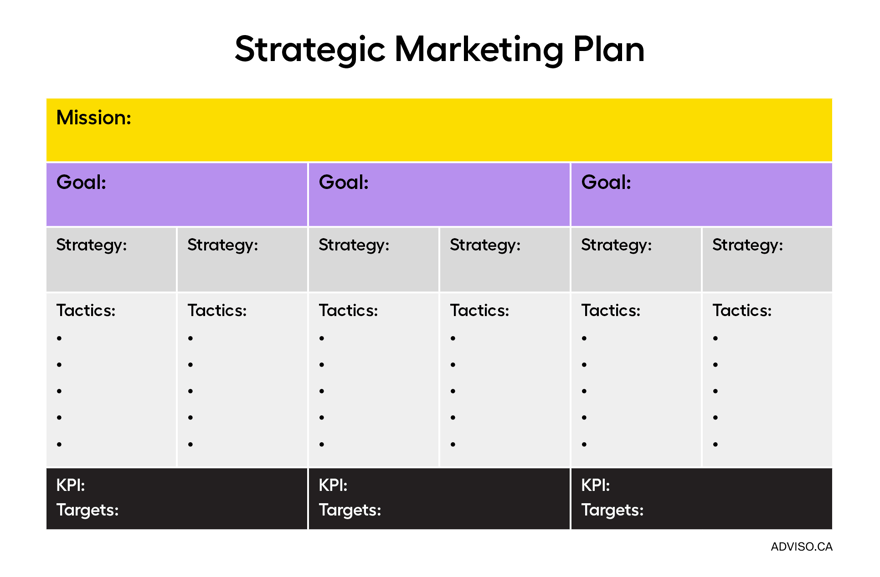
Before getting into the details of each term, here is a framework so you can understand the hierarchy of the strategic plan—from “why” through to “what.”
How to make a marketing plan?
1. Mission: The “why”
Let’s go from the most general to the most specific. We'll start with the mission.
The company mission is an overall vision that responds to the following essential questions:
- Why does the company exist?
- What are its ideals?
- What is it trying to accomplish?
Google’s mission is to organize the world’s information to make it accessible and useful to everyone. The mission of Facebook is to empower people to share and make the world more open and connected.
Understanding and integrating the company’s mission allows you to orient objectives, strategies, and tactics in the long term. The mission is both the heart and the backbone of an organization.
2. Objectives: “Where you’re heading”
The objectives determine the goal to be achieved. The company understands what it’s all about—now where is it going?
Marketing objectives can vary depending on a company’s sector of activity and its size.
- Increase market share
- Improve profitability
- Increase brand recognition in a given region
- Etc.
Tips and tricks: SMART goals
Opt for SMART goals: Specific, Measurable, Achievable, Realistic, and Time-Bound. This method is the best way to transform an intention into a specific, measurable objective.
Specific
Be explicit. If the objective of an army was to win, this would certainly be preferable, but it won't help it to understand what route to take to achieve this! In the same way, an objective to “have a good year” for a home decor shop is too vague and might be completely different for another shop. Aim instead to increase your online sales, your market share, or the frequency of visits by loyal customers.
Measurable
Quantify. Assign an order of magnitude to your goals to be able to verify whether they were achieved. For example, specify “increase share of market by 10%” (or 20%) instead of simply “increase share of market.” This will allow you to determine whether the strategies you put in place were actually effective during the selected period.
Achievable
Target appropriately. Choose objectives that are ambitious, but realistic. To achieve them, take your current resources into consideration: budget, time, team, skills and expertise, etc.
Realistic
Be pragmatic. Analyze your past results and find the numbers for your specific industry in order to evaluate the potential progress you could make in the marketplace. “Achievable” means your ability to attain a goal, while “realistic” evaluates whether the objective makes sense in your particular context.
Time-Bound
Set a reference period. The objective could be yearly, monthly, or quarterly, but it must be integrated into a period of time. This will help you to verify whether the objective was achieved or not.
3. Strategies: The “how”
Each objective is followed by the strategy stage. What approach(es) should you take to achieve the objective?
Tips and tricks
- Consider the three main media categories. 1. The media owned by the organization, such as the website. 2. Results earned from its activities, such as shares on social media. 3. Paid media, such as traditional advertising and paid search.
- Be consistent. No matter the size of your budget, maintain the same logic between strategies to achieve the objective. For example, a company employing paid search campaigns should consider optimizing its site for organic search.
- Use the marketing funnel. Think strategically about actions at the top of the funnel (ex., awareness, new markets), in the middle (lead generation), and at the end (improvement of conversion rate).
- Analyze your results. Study the previous year’s successes. Look at the best practices for your market, or even those for different markets that could be adapted to your business.
- Prioritize actions to be taken. Plan your strategies based on objectives, budget, specific events during the year, or even those areas in which the company performs less well. Identify what absolutely must be done this year as well as what might be interesting, but not urgent.
4. Tactics: The “what”
Tactics are the tools, actions, or operations of strategies. What are we going to do tomorrow in concrete terms to achieve the objective by the end of the year?
Tips and tricks
- Don’t forget about your available resources. Consider your budget, personnel, technical equipment, etc.
Working with many resources and several teams is a big challenge, especially when it’s time to execute. Read our article about managing stakeholders to structure your processes for projects.
5. Key performance indicators (KPIs) and targets: The “how many”
To measure the company’s progress towards achieving its objectives, key performance indicators (or KPIs) are essential tools for any marketer. The target is the numerical value assigned to each indicator. Together, these metrics help determine whether the strategic plan has been effective.
A few examples:
- Conversion rate: 4%
- Task completion rate, such as submitting a form: 80%
- Engagement rate: 5%
Tips and tricks
- Consider effectiveness and quality. “Pick super awesome key performance indicators,” says Avinash Kaushik, a best-selling author.2 While increasing the number of visitors to your website is good, if these visitors don’t correspond to your audience, this will be counterproductive! An indicator like the conversion rate will definitely be of more value than the number of visits to your site.
- Segment. Some markets aren’t at the same level of maturity. This means a target for a performance indicator could be different based on the segment.
The marketing plan: From idea to action
So do those definitions correspond with what you have in mind when you use those terms? If you’re still doubtful, that’s normal. Objectives, strategies, tactics, and KPIs become more distinct once they’re integrated into a marketing plan.
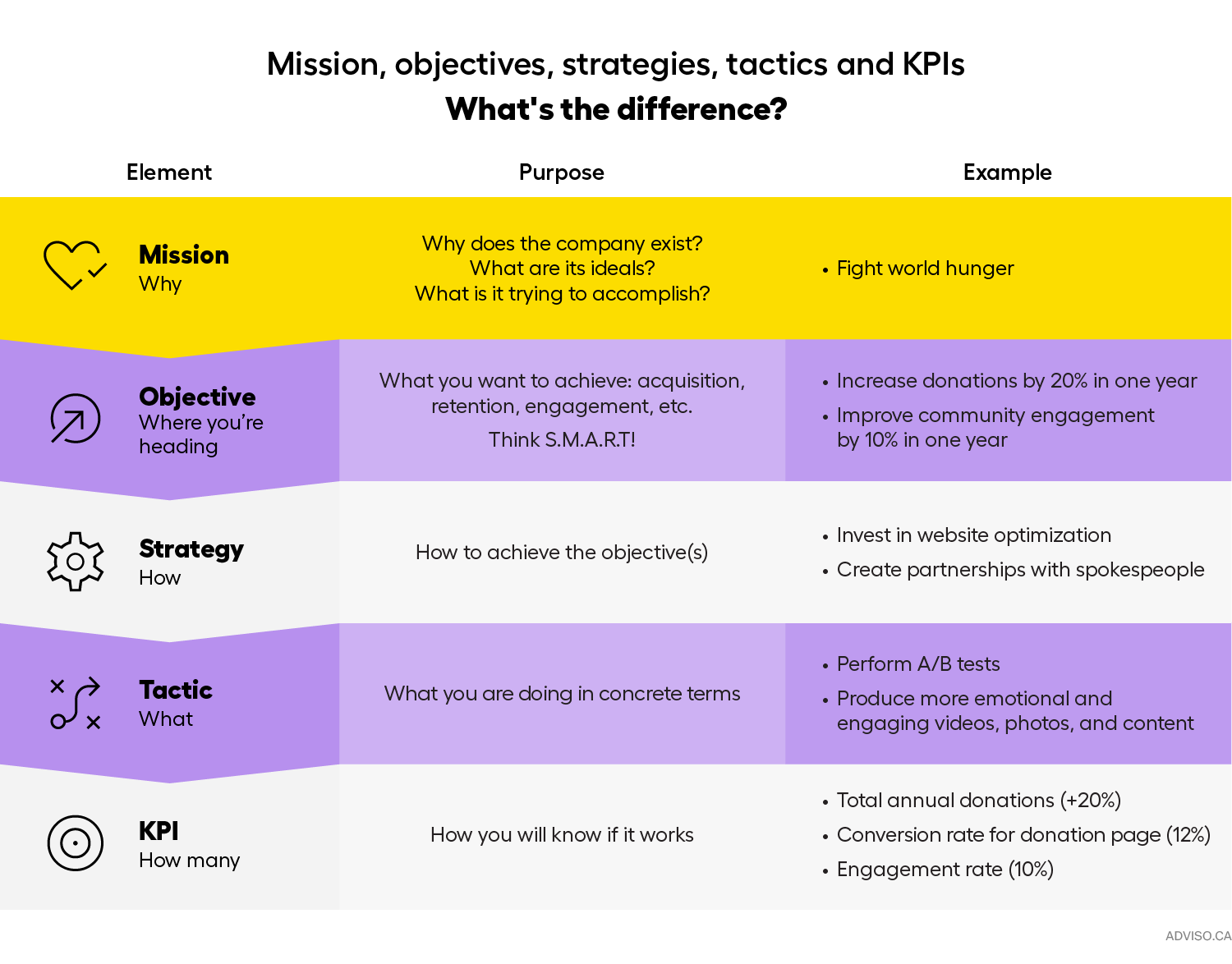
For a clearer picture, take a cue from the strategic plan framework (presented above) our infographic, or the table version below, which uses the example of a humanitarian organization.
From marketing framework to reality
If a marketing plan is still too vague, our business strategy experts can help you clarify it and, especially, take action! Everyone has ideas. What really matters is how you implement them.
For almost 20 years, adviso has helped businesses align their ambitions with real-life strategies. Discover how we make it happen.
REFERENCES
1Graham Kenny, “A List of Goals Is Not a Strategy,” Harvard Business Review, November 19, 2014.
2Avinash Kaushik, “Your Web Metrics: Super Lame or Super Awesome?” June 28, 2011.
The article How to make a marketing plan: goals, strategies, tactics, and KPIs first appeared on adviso.ca. It was updated in September 2026.


Profit or profitability? Measure the real value of a campaign
“This campaign is bringing a slightly lower return on investment, but it’s a lot more profitable!”

Partnerships between loyalty programs: Advantages and examples
Loyalty programs have started to apply a well-known principle: If you want to go far, go together.

What retail can learn from D2C
In retail, creating a house or private brand (also known as a private label) is nothing new.