
Is your mobile application a growth lever... or an expensive technology silo?
For many brands, launching a mobile app today is a natural evolution. After all, consumers spend a large amount of their time on their phones.
But hidden behind any mobile project is a complex reality. An application isn’t just an elegant design. It’s a whole new data layer, a touchpoint to be integrated into customer journeys, and a technology to connect to your martech.
In this article, I’ll be sharing the eight most frequent mistakes you should avoid in an area with very high stakes: your martech foundations and your data.
- Mistake 1: Underestimating data
- Mistake 2: Prioritizing downloads
- Mistake 3: Underexploiting audiences
- Mistake 4: Isolating the app from your martech
- Mistake 5: Neglecting deep links and universal links
- Mistake 6: Replicating the web experience
- Mistake 7: Increasing messaging
- Mistake 8: Creating a siloed mobile app
- Conclusion
Mistake 1: Underestimating the importance of data
In many organizations, discussions about a mobile application start with user experience (UX): design, navigation, features. But while UX is essential, from a martech perspective, the most important questions are:
How does this application integrate into our existing data architecture? How will it enrich our knowledge of the customer?
A mobile app generates a significant amount of behavioural data: connections, browsing, interactions with content, transactions, in-store scans, reward use, etc.
If these data aren’t correctly structured, named, and centralized, they become very hard to exploit. Your mobile application becomes rich in interactions... but poor in strategic value.
The tracking plan as the foundation of your mobile application
You need to define a clear tracking plan starting with your very first line of code. This plan needs to answer the following:
What events do you want to measure? At what points in the customer journey? And above all, for what activation goal?
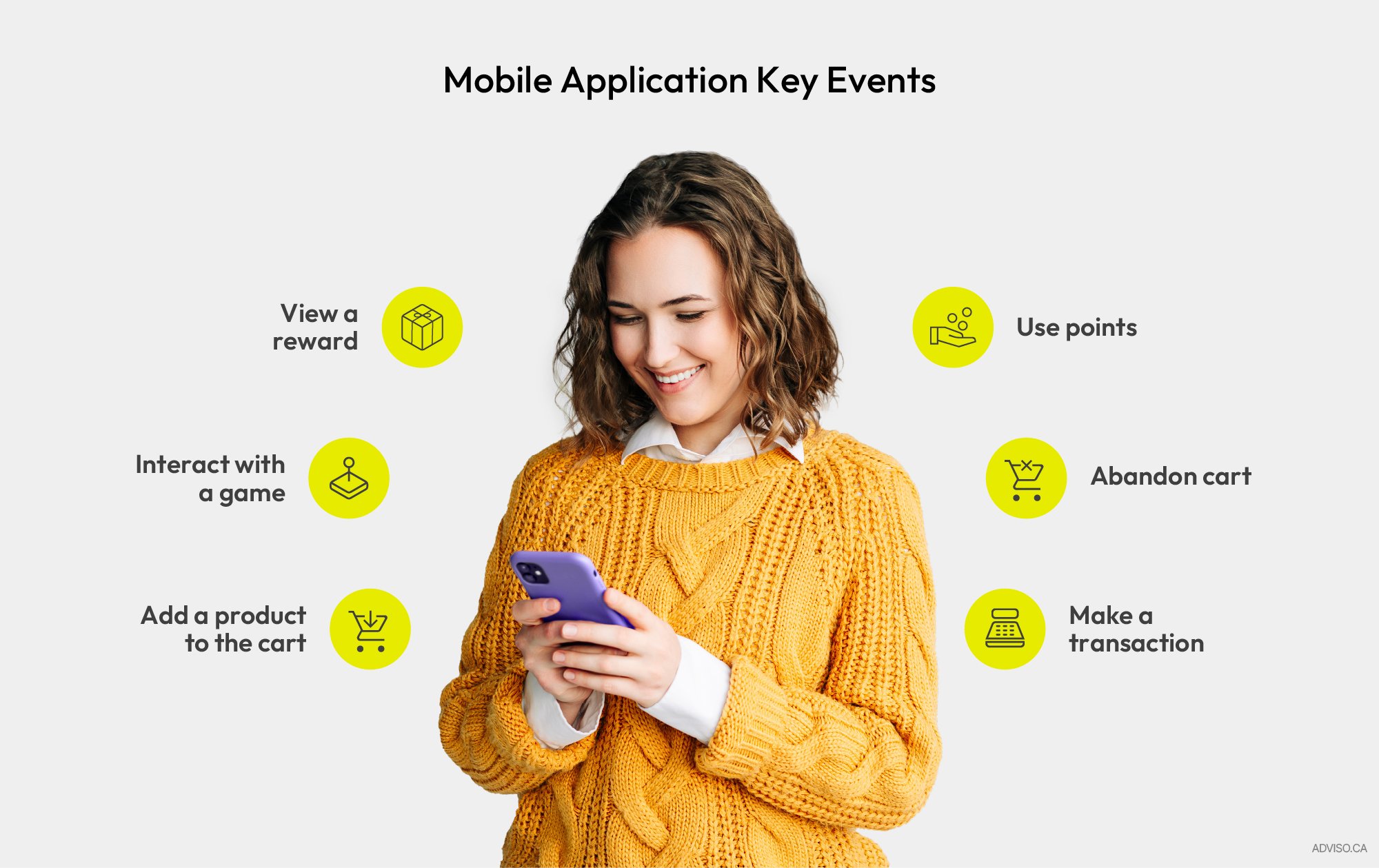
Among the essentials you should plan to include, you will want to know whether a user:
- views a reward;
- interacts with a game;
- adds a product to their cart;
- uses their points;
- performs a transaction; and
- abandons their cart.
These events must be clearly defined, documented, and integrated into the tracking plan right from the design phase. Without this foundation, your data become hard to activate and the app turns into an isolated channel, incapable of contributing to your strategy.
Mistake 2: Basing your strategy on downloads
Downloading doesn’t mean converting. This metric doesn’t necessarily create value for the business, especially when media investments are involved.
I often see brands making massive investments in advertising to maximize downloads of their mobile apps. The result: Users install the app one day... and forget it the next.
So what are the relevant KPIs? High-value actions in the app: purchases, in-store visits, use of rewards, account creation, or recurring engagement. In other words, you have to optimize your ad campaigns relating to the mobile app for events that actually contribute to your business performance.
To accomplish this, mobile attribution tools like AppsFlyer or Branch are essential. These platforms let you go well beyond simple downloads to understand which campaigns, channels, or formats generate active, profitable users.
You can then better allocate your media investments throughout the customer funnel:
- acquisition of new users at the top of the funnel;
- activation and engagement in the middle; and
- conversions and transactions at the end of the funnel.
By optimizing your campaigns around events with added value instead of downloads, you improve your ROAS (return on ad spend) while reducing your CPA (cost per acquisition).
Mistake 3: Underexploiting audience data
Too many brands launch a mobile application without evolving their audience strategy at the same time. However, beyond attribution, a mobile app is an extremely rich source of data for improving audience strategies.
Every interaction in the app (browsing, product consultation, use of rewards, usage frequency) lets you better understand the behaviour of your members. These signals can then be used to build audiences that are a lot more qualified in advertising platforms.
- Retargeting audiences based on the real behaviours of users, such as members who consulted a product or abandoned a cart
- Lookalike audiences made from the most engaged or most profitable users in order to acquire new customers that have similar profiles
- Reengagement of inactive members, for example by targeting users who haven’t opened the application for several weeks or who haven’t used their points
Not exploiting these qualified audiences is like paying for a banquet... without ever taking a single bite of the food.
Another mistake, which is surprisingly common, involves continuing to deliver app install campaigns to users who have already downloaded the application. This is simply a waste of the media budget.
Underutilizing these data means missing out on one of the biggest strategic advantages of the mobile app: the ability to refine your customer knowledge and directly improve the quality of your audiences.
Mistake 4: Isolating the app from the rest of your marketing technology
Hidden behind a high-performance mobile app is a martech architecture that’s often a lot more complex than it seems.
I’ve often seen businesses develop their application as an isolated project, without putting sufficient thought into its integration with other marketing technologies that are already in place. The app then becomes a closed environment that generates its own data, its own interactions, and sometimes even its own communications.
The problem? It quickly becomes a new technology silo.
To make your mobile application an actual relationship tool, it must be integrated into the rest of your martech ecosystem, including:
- the CRM (customer relationship management) platform, to enrich the customer profile with behaviours observed in the app;
- the CDP (customer data platform) or data warehouse, in order to centralize the data and maintain a unified view of the customer; and
- marketing automation tools, to trigger communications based on actions performed in the application.

The SDK as the invisible engine of your ecosystem
The SDK (software development kit) integration is an essential step in connecting your mobile application to your tools. In concrete terms, it lets you automatically connect your users’ actions in the app, such as a sign-up or purchase, with your other systems. Once in place, you can:
- trigger communications in real time following an action in the app;
- segment users based on their behaviours; and
- orchestrate interactions across several channels.
Without this integration, your app remains limited in terms of its relationship capacities and loses a big part of its strategic value.
With or without a mobile application, as marketing trends and martech continue the process of redefining themselves, the robustness of your data foundations and tech is becoming critical.
Mistake 5: Neglecting deep links and universal links
Even when the application is well integrated into the rest of the martech ecosystem, there is another oft-neglected element: the continuity of the journey between different channels.
This is where universal links and deep links come into play. While universal links automatically direct a user to the app, the App Store, Google Play, or a webpage depending on the context, deep links lead directly to a specific section in the mobile application, such as a product page or an offer.
This seems like a technical detail, but it’s often the point at which the conversion is either made or lost. These mechanisms therefore allow you to:
- effectively connect various channels (email, SMS, advertising, push) to the application experience;
- lead the user to exactly the right place; and
- reduce friction and improve conversion.
They are essential for ensuring the continuity of customer journeys between the web, marketing communications, and the mobile application.
Mistake 6: Replicating the web experience
Replicating the web on mobile means reducing innovation to mere copying.
In this scenario, the app basically becomes an extension of the website: same content, same features, same transactional logic. This approach severely limits the strategic value of the application.
Mobile is a very different environment. Users interact within fast-paced contexts, often while travelling, and at specific times during their day. To be successful, your mobile application must therefore be designed around these relevant micro-moments based on your industry.
- Accelerated payment
- Identification in-store
- Order tracking
In a loyalty program, it simplifies access to key features.
- Points balance
- Rewards
- Personalized offers
- Games, quizzes, and challenges (gamification)
When it is truly customer-centric, your mobile application goes well beyond the role of just being a supplementary website. It can become a digital wallet, unifying the member card, offers, and rewards, or even a place for personalized experiences based on behavioural data.

A user receives push notifications from a mobile application
Mistake 7: Increasing messages without an orchestration strategy
The arrival of a mobile application often introduces a new communication channel: push notifications. These messages appear on the user’s device, even when the mobile app isn’t being utilized.
When well used, these can become a powerful lever for engagement and retention. When poorly used, they quickly become intrusive and damage customer experience.
Many have fallen into the trap of simply adding a channel to their arsenal of communications. The result: The same message is sent by email, SMS, push notification, and sometimes even within the app itself.
But every channel has its own role to play in the customer journey.
The right message via the right channel
Push notifications are particularly effective for short, contextual messages. For example: an offer reminder, indication of an impending expiration of points, or invitation to a customer to finish an action in the app. They’re excellent for events in real time and are often an interesting alternative to SMS, which is frequently more costly.
Email is better suited to more detailed or transactional content, such as an order confirmation or list of personalized recommendations.
In-app messages directly guide the user while browsing the app, for example to present a new feature or a promotion.
The real issue isn’t sending more. It’s orchestrating better. Based on the time, the channel, and customer behaviour.
Mistake 8: Creating a siloed mobile application
A mobile application project rarely involves a single team. Marketing, CRM, IT, analytics, and sometimes product teams need to closely collaborate.
Without clear governance, app development advances… but rarely in the right direction. Decisions are fragmented and strategic cohesiveness quickly crumbles. The organizations that best succeed in these projects are those whose teams work together to define:
- UX, UI and user journey design;
- responsibility for the tracking plan;
- data governance;
- an omnichannel communication strategy;
- integration into the existing marketing ecosystem; and
- performance indicators that let you measure the app’s contribution to business objectives.
A high-performance mobile application is rarely the result of an isolated initiative. It’s the product of a holistic view. Make sure you have a collaborative team right from the start.
The key to successfully developing a mobile application
Launching a mobile application is a project that goes well beyond design, marketing, and downloads. When well developed, it becomes a lever for engagement, retention, and conversion.
Exploiting its full potential and avoiding the pitfalls starts with one simple step: See your mobile application for what it really is—a strategic channel for a direct, continuous relationship with your customers.
At adviso, we build mobile applications designed to be levers for business, integrated into your data, martech, and customer experience strategy. Let’s discuss your future growth via mobile.
The article Eight Mistakes Your Mobile Application Should Avoid first appeared on adviso.ca.

%20(1)-1.jpg)