


Canadians are increasingly participating in gamification activities within loyalty programs.1
Whether in the form of games, quizzes, badges, or other variants, gamification is highly relevant to the loyalty field when it comes to engaging members and getting to know them better. It allows you to collect more customer data, the gold mine of modern marketing.
At a time when Canadians are already using close to nine programs on a regular basis,1 it’s also becoming a necessary differentiator.
Let’s take a look at exactly how gamification is being integrated into loyalty programs.
- What is gamification?
- Key statistics
- Why it should be integrated
- Steps for integration
- KPIs to track
- Conclusion
What is gamification in customer loyalty?
Gamification involves adding elements belonging to video games or gaming in general to non-gaming environments.
It can be perfectly integrated into loyalty programs, whether B2C or B2B, because both domains have a concept in common: rewards. Gamification can take many forms and use different types of mechanisms.
- Points
- Badges
- Leaderboards
- Levels
- Challenges
- Progress bars
- Mechanisms based on chance (ex., random draws, spin the wheel)
- Surveys and quizzes
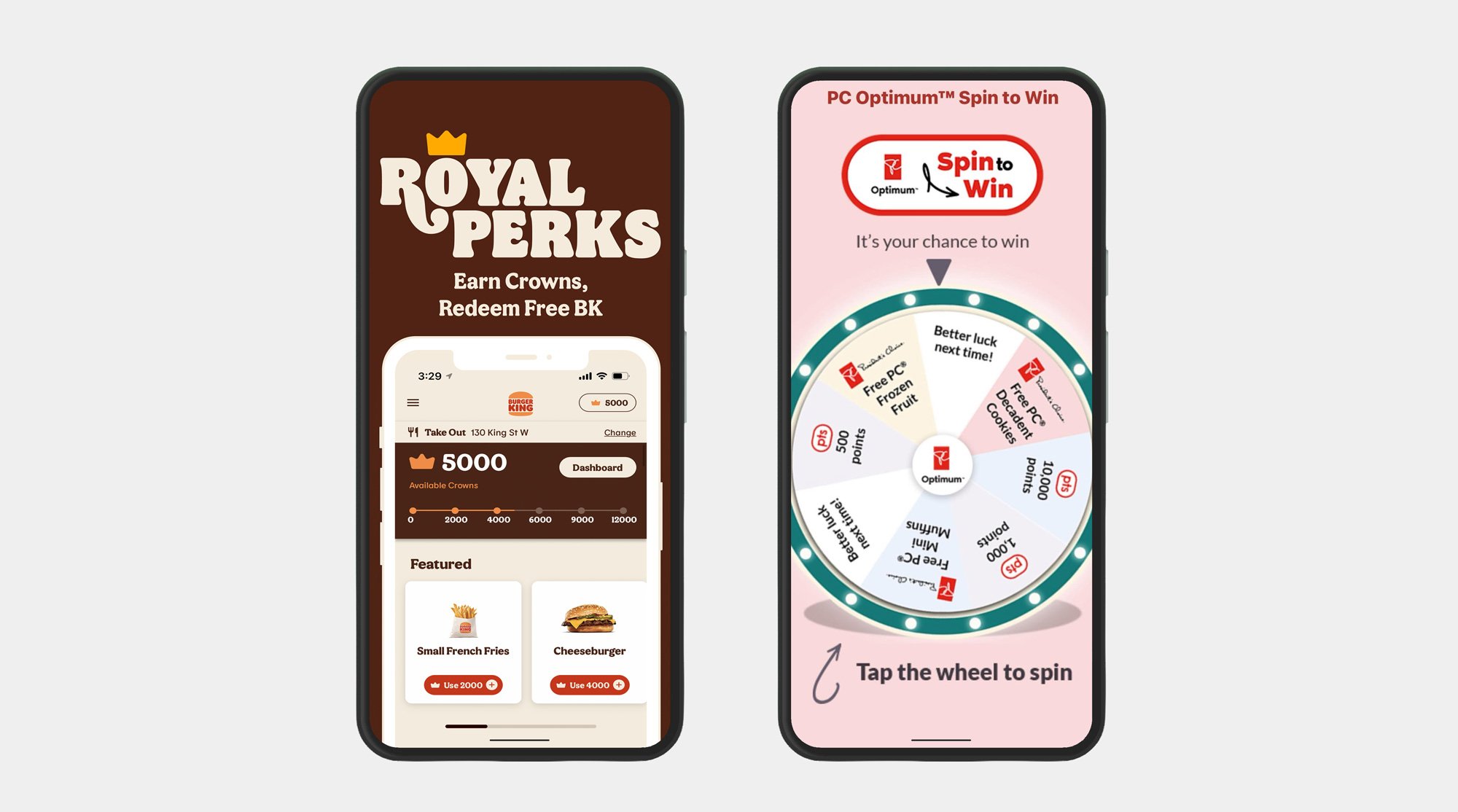
The Burger King and PC Optimum applications integrate gamification into their loyalty strategies in different ways.
Gamification can be discreet, such as when integrated directly into a program’s structure. For example, Burger King’s Royal Perks program displays a progress bar that shows when the next reward level has been reached.
Or it can take the form of a more visible initiative, of a promotional nature, deployed during a specific period. As an example, the Spin to Win campaign from PC Optimum lets members earn rewards by spinning a wheel every Tuesday during the month of December.
Every game element has a specific role to play—but you need to know which one to activate, and why. The purpose of the game is not just amusement: It guides specific behaviours, from engagement through to purchase.
Gamification in Canada: Key stats you should know
Canadians are increasingly adopting gamification according to the LoyalT 2025 Study.1 Over one third of those 18 to 54 participate often or very often in gamification initiatives within loyalty programs. Not surprisingly, this strategy is most popular among young people.
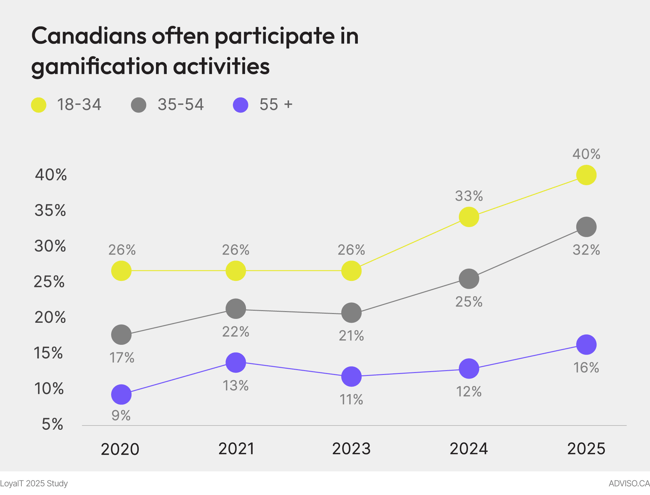
Here’s an interesting fact: Participation rates vary significantly between Quebec and the rest of Canada. In the English-speaking provinces, the rate for the 18 to 34 age group rises to 45% and is 35% for the 35 to 54 group. In Quebec, the rate remains stable at 22% for both age groups.
Irrespective of the market, gamification isn’t just a trend: Participation rates have been increasing for the past three years and its integration into programs is accelerating.
Increased competition in loyalty
In 2025, the number of programs used in Canada reached its highest level.1 Canadians are members of over 20 programs and use nine on a regular basis. Within the same sector of activity, consumers are often members of two or three programs.
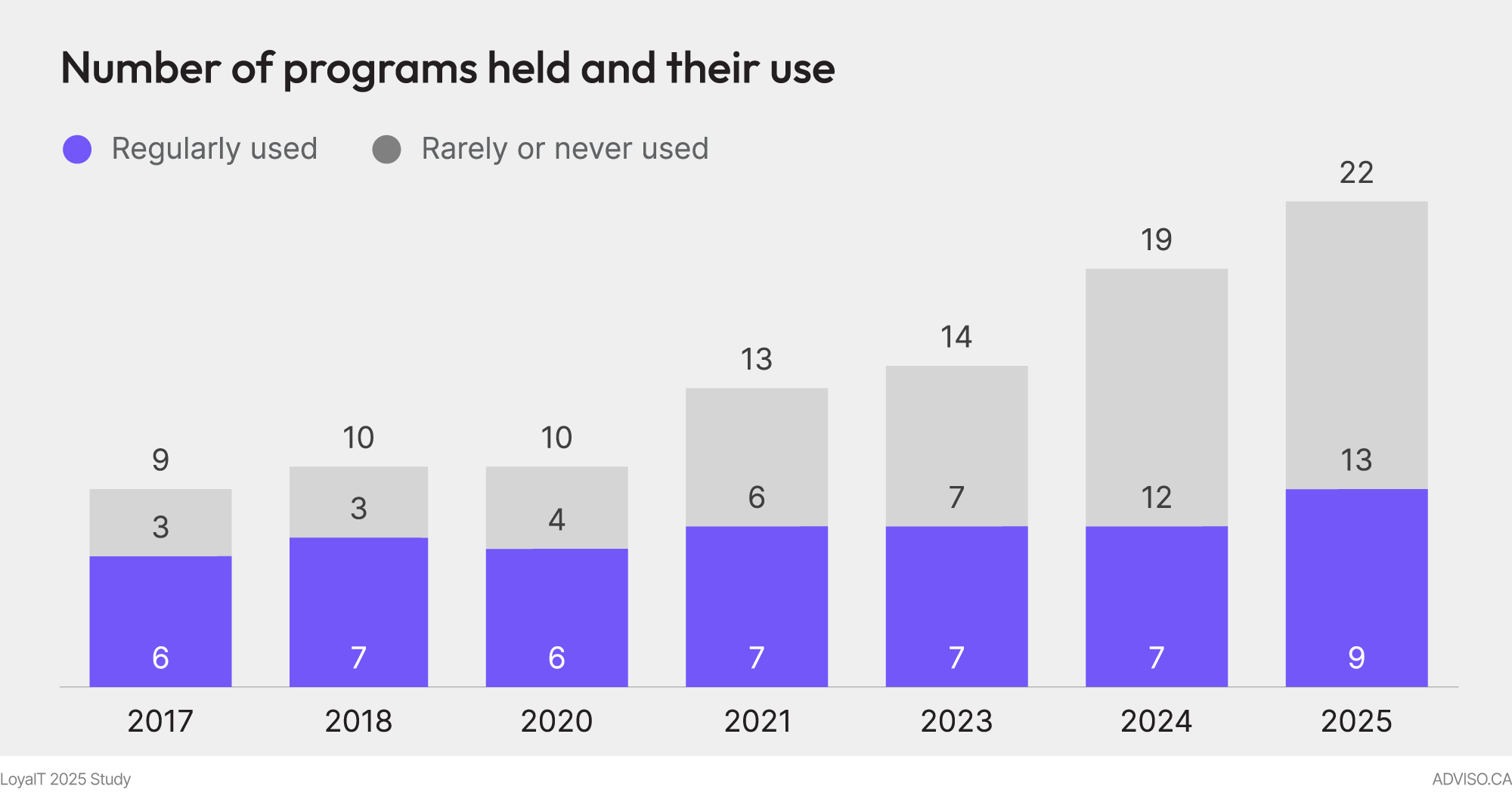
Why are these data important? As consumers join more and more loyalty programs, the battle to win their attention and engagement intensifies.
Your biggest competitor becomes neglect.
I see it every year in the LoyalT study: Loyalty programs are becoming more mature, they’re gradually improving and adopting best practices, including gamification.
A recent report from Forrester also identifies gamification as one of the features that loyalty platforms or solutions offer the most in response to the needs of program managers. These platforms even offer gamification elements as standard features of their solution.
To maintain your good standing among your members, your program can't stay the same—it has to evolve.
Tap into the latest trends to improve your loyalty program. Read our article on the subject.
Why you should integrate gamification into your loyalty program
Beyond differentiation and your ability to rival the competition, gamification generates value both for the program itself and for the brand.
In particular, gamification contributes to loyalty programs by encouraging engagement, creating an emotional connection, collecting customer data, and improving the conversion rates and lifetime value (LTV) of members.
I often say that a loyalty program isn’t a marketing project, it’s a business strategy. When used well, gamification contributes to program performance, supporting marketing objectives and, ultimately, the business objectives of the company.
To promote engagement
Through random draws, quizzes, or challenges, gamification stimulates interactions with the program or brand. Game mechanics, as with visuals or digital animations, aim to be entertaining and appealing. In many cases, they also offer the possibility of winning prizes, which appeals even more to participants and even contributes to brand awareness.
But beyond the rewards, it’s customer engagement that lies at the core of gamification. A well-designed program seeks to incite members to actively and regularly participate in the program. Like a good game, it entices you into playing for the first time... and then to come back and play again and again.
Every year, Starbucks invites its members to participate in the Starbucks for Life Merrython game. By playing once a week, members get a chance to win the grand prize of “Starbucks for life” as well as many instant weekly prizes (such as gift cards and beverages).
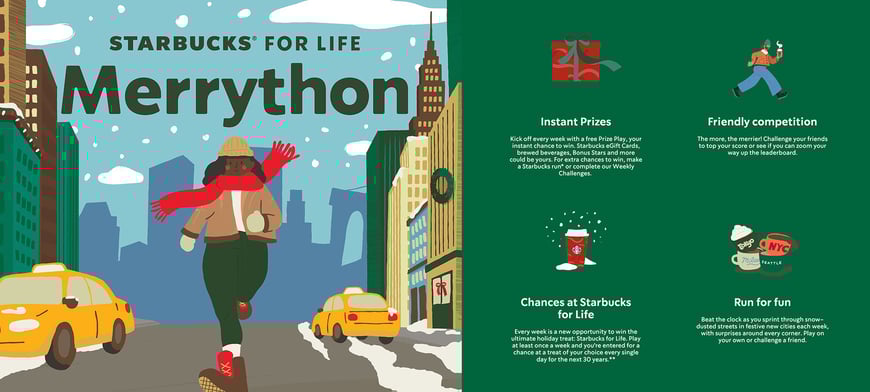 Visuals from the Starbucks for Life Merrython game ︱ Images: Starbucks
To increase emotional attachment
The fun and entertaining experiences produced by gamification promote the creation of positive associations and emotional attachments to the brand that are more memorable, and therefore more deeply felt.
Certain gamification elements, such as badges or leaderboards, encourage social sharing (the ambassador system) and strengthen this emotional connection.
The best loyalty programs don’t just offer discounts to their members—they develop a strong sense of gratitude. Get inspired by looking at Walmart, Lululemon, or even Panera Bread, whose programs are greatly appreciated by their members.1
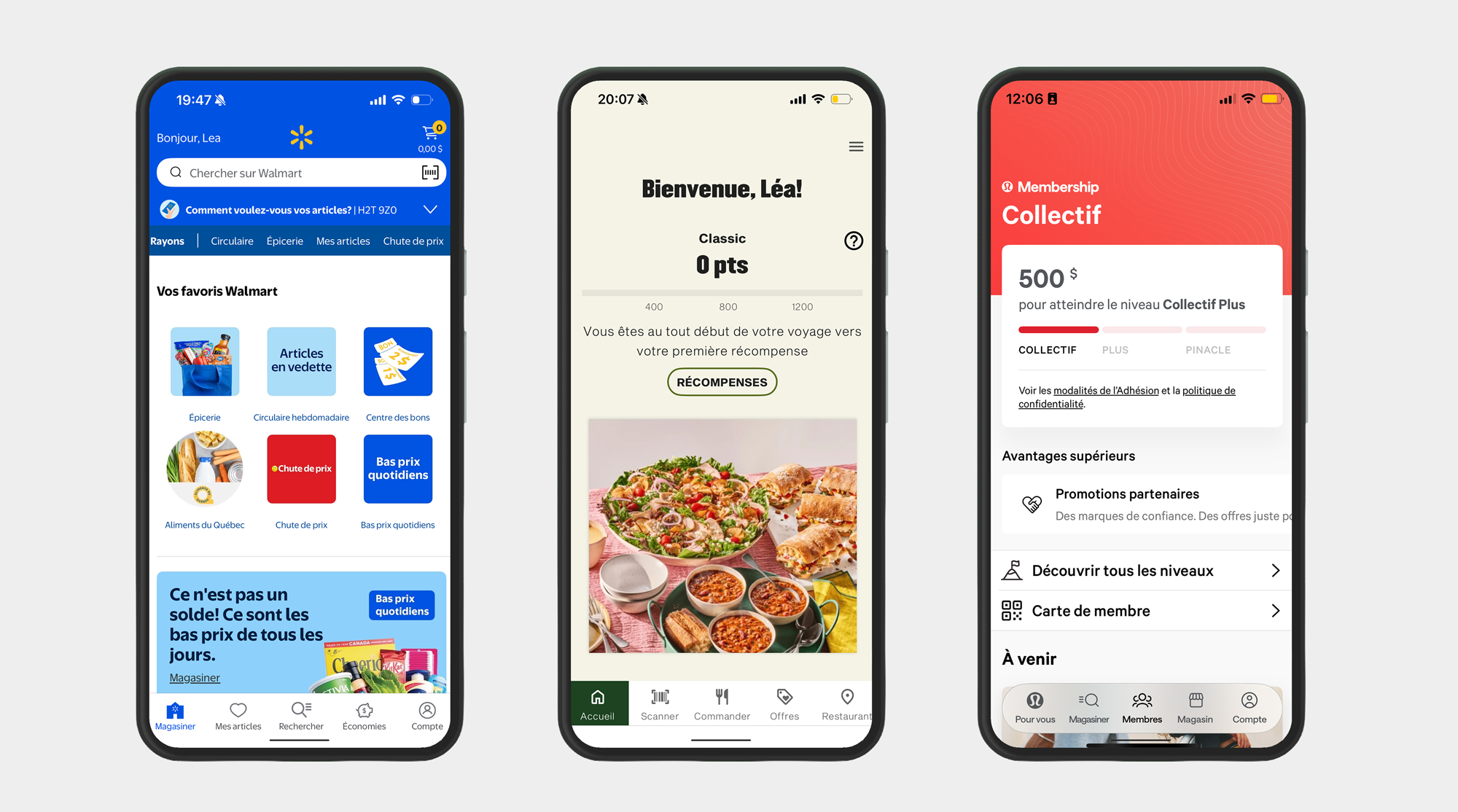 Walmart, Panera Bread, and Lululemon mobile applications
To collect invaluable customer data
Gamification lets you collect distinctive information about your customers in a way that is enjoyable instead of annoying. By participating in a game or completing a challenge, your members organically share details about their behaviours or preferences.
Read next: Data, the beating heart of relationship marketing
Quizzes
Quizzes are an effective method for obtaining relevant data that can be added to customer profiles, which can then be used to personalize their experience. This information serves to activate relevant, targeted communications among high-potential customers. For members, completing a quiz usually lets them obtain reward points or the chance to win a prize.
The questions can be about:
- the lifestyle of members
- their favourite product categories
- the other brands or retailers they patronize (often used in B2B)
For example, a chain of hardware stores could ask customers if in the coming months they are planning renovations and what type they are (bathroom, kitchen, shed, etc.). For companies, these answers are very useful for identifying customers with high purchase potential in the short term—they become a business signal.
To increase the conversion rates and lifetime value (LTV) of members
In the short term, gamification improves the conversion rates for initiatives by stimulating participation and purchase frequency. In the longer term, it contributes to growing the average cart value, diversifying purchases (from several departments or product categories) and, ultimately, increasing members’ lifetime value (LTV).
Challenges and progress bars are very effective at encouraging specific behaviours. They make targeted actions or the achievement of the next reward level more visible and motivating.
Sephora’s Beauty Insider challenges are a great example. For a limited period, members can earn bonus points by performing certain actions, such as activating text alerts. These points are added to those obtained for purchases.
This fast activation stimulates purchases during the challenge period while encouraging the adoption of new behaviours, such as buying through the mobile app. The goal is to shift from intention to action, and then to habit.
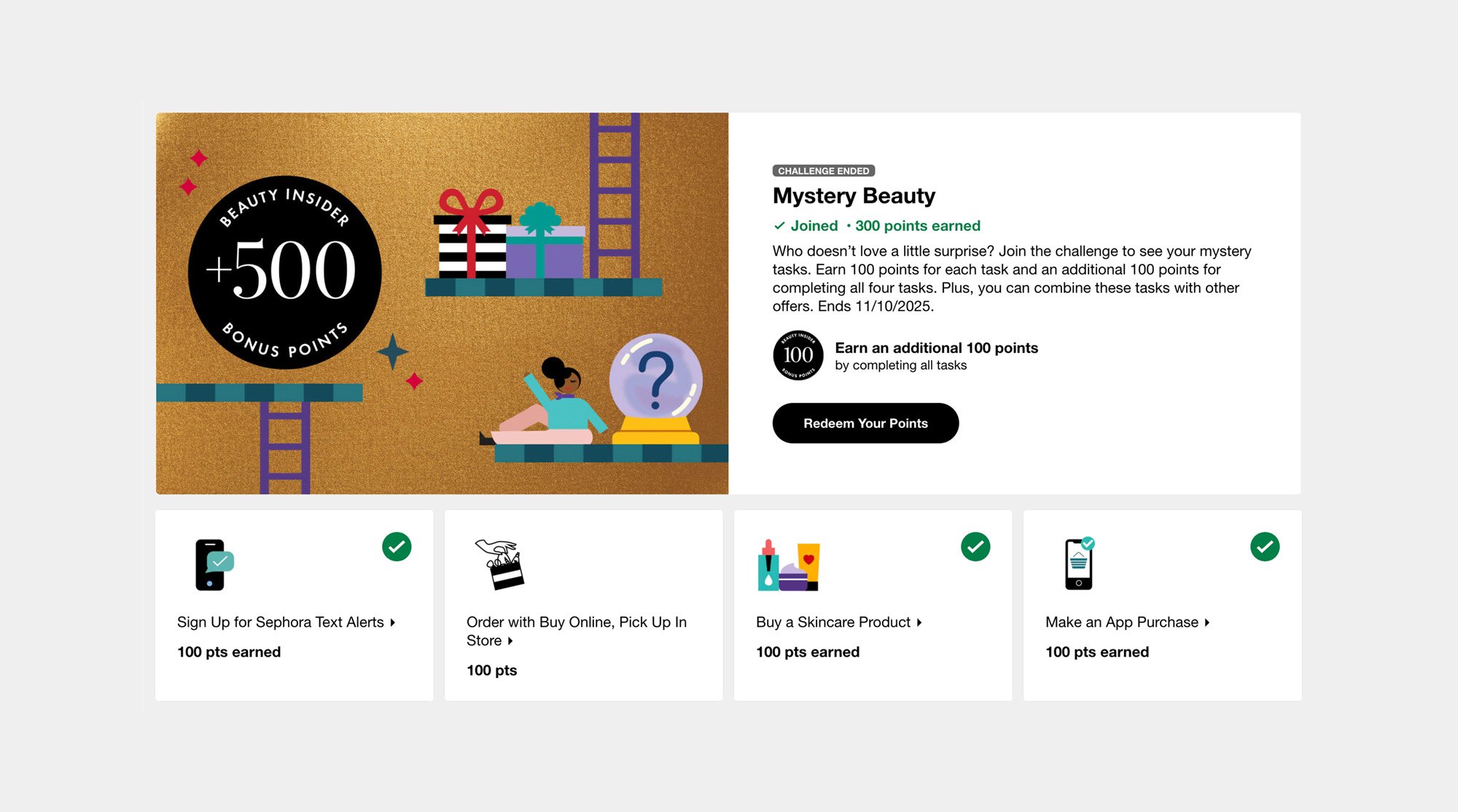 The Mystery Beauty Challenge for November 2025 | Image source: Sephora
How is gamification integrated into a loyalty strategy?
Games, contests, and badges are attractive, but their effectiveness depends on how rigorously they are designed. Your program’s customer experience (CX) and user experience (UX) must never be sacrificed out of overenthusiasm.
Gamification—the goal of which is to motivate, entertain, and engage—can quickly be hampered by bugs, errors in tracking progress, or omitted rewards. Who wants to finish a puzzle that’s missing a piece?
These initiatives have costs that can sometimes be significant, depending on the extent of the mechanics. To maximize your return on investment (ROI), follow our four-step structured approach.
1. Define clear objectives
Before you begin any work on the design, clearly define your objectives. These will guide all of your future decisions, whether in terms of the selection of game mechanics or the structure of rewards.
In general, ask yourself:
- What problem would you like to resolve?
- Which KPI would you like to improve?
These questions will lead you towards more precise objectives. Consider the specific, detailed customer behaviours you would like to encourage.
Customer knowledge
- Encourage completion of the member profile
- Collect data to feed personalization
Engagement
- Increase engagement via more frequent interactions
- Obtain reviews of products and services
- Download the mobile app
Sales
- Increase purchase frequency
- Encourage trial of a new product
- Promote testing of a new service
Once you’ve thought through the above details, don’t hesitate to review them regularly as you are setting up the program. Your goals should be the compass that prevents you from going off course.
2. Understand your customers’ motivations
Survey your customers in order to understand their motivations and preferences as well as their values.
What do they find most motivating?
- Status updates
- Competition
- Collaboration
- The value of rewards
Which reward do they most hope to earn?
- High-value prize
- Discount
- Bonus points
- Access to a more exclusive benefit
As with any customer-centric marketing initiative, your gamification propositions must be relevant and appealing in the eyes of your members.
3. Choose the right technology
If a new technology needs to be integrated to activate gamification, ensure that the selected platform can be effectively integrated into your existing loyalty program. I’ve often seen companies tackle this step too early in the process. The technology should be in the service of your strategy, not the reverse.
4. Launch and optimize
Once you’ve deployed your gamification strategy in your loyalty program, test, measure, and adjust. Ensure you make a list of the KPIs that are relevant to your strategy, and rely on regular analyses to identify what works best and what deserves to be optimized.
Which KPIs should you track to measure the effect of gamification?
In marketing as in business, key performance indicators (KPIs) are indispensable for evaluating performance. Loyalty programs are no exception to that rule.
How is your program performing? We have the answer in over 20 performance indicators. Discover our personalized LoyalT report.
When integrating gamification into your program, make sure you can measure the following KPIs:
|
KPI |
Measures… |
|
Engagement rate |
|
|
Interaction frequency |
|
|
Retention rate |
|
|
Purchases |
|
Gamification and loyalty: Rewarding gaming
Canadians’ wallets are already full of loyalty cards. To remain a favourite among your members, your loyalty program must continue to evolve.
Gamification is therefore an essential tool for differentiation. When well designed, it stimulates engagement, strengthens emotional connection, collects customer data, and increases your customers’ lifetime value (LTV).
And when over one third of Canadians (from 18 to 54) participate in this type of initiative, the message is clear: Gamification is an approach you should integrate starting today.
At adviso, our specialists combine their expertise in loyalty, customer experience (CX), and martech to help you develop or improve your loyalty program. Let’s discuss your goals and see how loyalty can support your business strategy.
REFERENCE
1LoyalT 2025 Study by adviso: Data collection via web panel conducted by Ad Hoc Research from May 12 to June 7, 2025, amongst 15,000 Canadians aged 18 and over who were members of at least one loyalty program.
The article Why Integrate Gamification Into a Loyalty Program? first appeared on adviso.ca.
