


We recently attended eTail Toronto, a leading North American retail conference that brings together hundreds of e commerce, marketing, and technology leaders each year to discuss the transformations reshaping the industry.
Three of our clients took the stage: Mondou and Ren’s Pets from Groupe Legault, as well as Simons.
Simons also received two eTail Innovation Awards, Best Omnichannel Initiative and Best Canadian Growing Brand. Two recognitions that directly reflect the work being done alongside their teams every day.
Over two days, panels and discussions brought together leaders actively shaping Canadian retail. Organizations represented included Loblaws, Reitmans, RONA, Groupe Dynamite, lululemon, Simons, Rains, PC Optimum, Kit and Ace, Sherwood Hockey, Indigo, and many others. Brands of different sizes and operating in very different markets, yet facing remarkably similar challenges.
Here are our key takeaways.
Canadian E Commerce Is Evolving Faster Than Ever
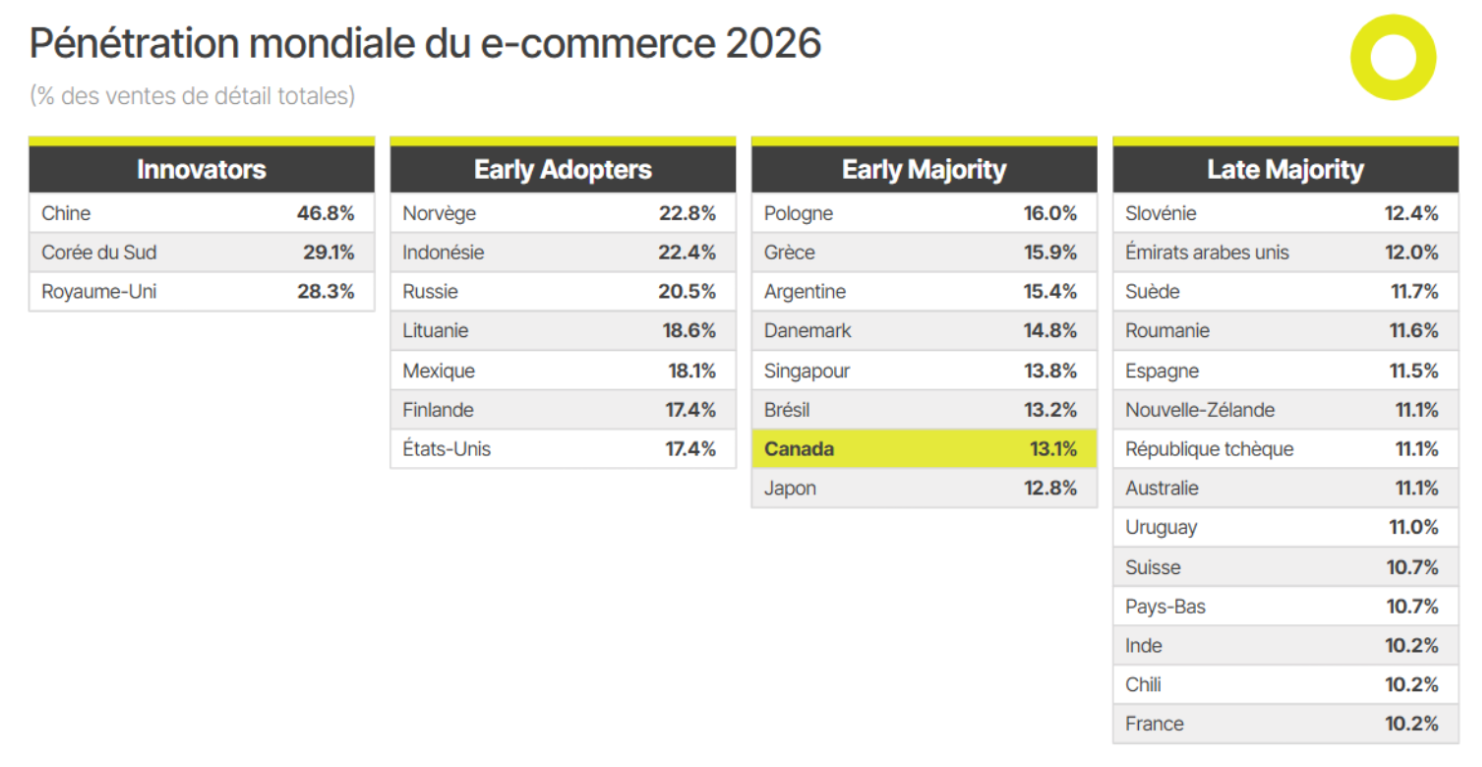
Paul Briggs from eMarketer opened the conference with a clear perspective on the Canadian market. Canada currently sits in the middle of the global pack when it comes to e commerce adoption, neither leading nor lagging behind.
E commerce penetration has grown from 3.3% in 2013 to 13% today, with projections reaching 14% by 2030. Mobile already accounts for nearly half of all online transactions and continues to outpace every other channel.
But the biggest shift is being driven by artificial intelligence. Briggs described three emerging consumer profiles: the traditional consumer, the AI assisted consumer, and autonomous AI agents capable of making purchasing decisions independently.
More than half of Canadians are already using AI tools to research products and discover brands.
“We are living in an era right now called what I call the AI moment of discovery. And there's a big difference between how people search and how they discover products and brands now.” - Paul Briggs, Principal Analyst, eMarketer Canada
The question now becomes: when AI agents begin making decisions on behalf of consumers, how does a brand remain visible, relevant, and memorable?
AI Drives Efficiency. Trust Remains the Most Valuable Asset.
Artificial intelligence was present in nearly every discussion throughout the event. Its efficiency potential is no longer debated. What sparked deeper conversations was its impact on customer relationships and brand trust.
Brenton Arnold from Sherwood Hockey summarized it clearly:
“Fundamentals of brand, trust is your number one asset. If you lose that trust, you lose market share. How can you use AI without losing this valuable trust?” - Brenton Arnold, Sherwood Hockey
Jeremy Soufrir from Indigo added another important perspective: what AI still lacks today is emotion and the ability to create authentic human connection.
“What AI lacks as of today is emotion. And if consumers can see and feel that your content or strategy is lacking emotion, you really need to reassess whether you're using it correctly.” - Jeremy Soufrir, Indigo
We are still in the early stages of this transformation. The tools will evolve quickly, but for now, fully handing over the brand experience to AI is not the answer.
Several speakers also emphasized that trust is not built through digital content alone. It is built through product quality, in store experience, and consistency between what a brand says and what it delivers.
These are precisely the dimensions that Simons and Groupe Legault highlighted throughout their panels.
Data shared during the CRM sessions reinforced the same reality: 18.8% of consumers actively reject brands they perceive as inauthentic.
In an environment saturated with AI generated content, authenticity is becoming a true competitive advantage.
Omnichannel Is About Consistency, Not Technology
One theme consistently emerged across multiple sessions: omnichannel is not about multiplying channels. It is about creating a cohesive brand experience.
Corinne Lalonde explained it this way:
“Omnichannel at a higher level is brand coherence. It's about building the experience for the customer based on what they want to feel.” - Corinne Lalonde, Directrice Commerce et Médias, Groupe Legault
Maintaining consistency becomes even more complex when brands operate across different markets. Mondou in Québec and Ren’s Pets in Ontario represent distinct audiences, customer relationships, and competitive realities.
Bhavik Vyas from Rains reinforced the same point:
“Omnichannel is about how the product appears every single time you see it : on the website, in an Instagram ad, in one of our stores, or at a wholesale partner.” - Bhavik Vyas, Head of Retail Experience, Rains
Matt Dykeman from lululemon also highlighted how physical retail locations create a direct media advantage within Google’s advertising ecosystem.
Strong local brand presence improves engagement, lowers CPCs, and contributes to stronger media profitability.
Data Is Still the Foundation
David Stevens, CTO of Groupe Dynamite, delivered one of the conference’s most compelling presentations from a technology perspective.
His original mandate was clear:
“I want you to use AI to improve the customer experience 10x. Don't worry about what it costs.” -
Fondateur du Groupe Dynamite, rapporté par David Stevens
Before even talking about AI, Groupe Dynamite spent several years investing in data centralization and governance.
RFID technology on every garment, real time inventory tracking, personalization engines, and automated in store alerts for retail teams all became possible because the company had already built a strong data foundation.
David Stevens also shared an observation that closely reflects what we are currently seeing across the market:
“The journey starts online. Whether it ends in-store or online, the discovery begins in social. But what we're finding is a significant shift toward advice, and that advice is shifting from search to AI chatbot discovery.” - David Stevens, CTO, Groupe Dynamite
Physical stores remain essential. But the entry point of the customer journey is changing rapidly.
Brands that are not operationally ready from a data perspective risk missing this transition altogether.
Loyalty Is Shifting From Transactional to Experiential
PC Optimum presented a particularly strong example of how loyalty programs are evolving.
The objective was simple: transform a points based program into an engaging, mobile first experience aligned with the brand itself. The results included 29 million games played, 85 games developed, and integrations across more than 20 banners.
“The games had to look like us. We wanted to make it as easy as possible.”
Eiko Kawano, Senior Director, Digital Experience Strategy, Loblaw
The results were significant: higher customer spending and stronger retention among digital audiences.
Loyalty is no longer driven solely by discounts. It is increasingly shaped by the overall customer experience.
This directly aligns with the findings from our LoyalT 2025 study: younger generations are looking for experiences that feel seamless, engaging, and consistent with the brands they choose.
The Role of the CMO Is Evolving
Frédéric Lecoq from Simons delivered one of the event’s strongest reflections on the future of marketing leadership.
“I'm not a big fan of ROI. What I really want is ROE, return on engagement.”
Frédéric Lecoq, CMO, Simons
As customer journeys become more fragmented and AI agents reduce certain traditional touchpoints, brand equity is regaining strategic importance.
Brand preference, awareness, and trust are once again becoming critical business assets.
Frédéric Lecoq also shared a particularly modern perspective on how marketing teams should operate:
“Don't shoot for perfection, shoot for progress.”
Frédéric Lecoq, CMO, Simons
Building teams capable of reacting quickly to market shifts is becoming more valuable than pursuing perfect but slower execution models.
What This Means for Canadian Retail
Three major conclusions emerged throughout the conference.
First, trust is becoming the most durable competitive advantage. In a market saturated with AI generated content, brands that succeed will be those that have invested in genuine customer relationships.
Second, data is no longer a differentiator. It is now a prerequisite. Without strong governance and clean infrastructure, the promises of AI remain theoretical.
Finally, omnichannel is not a one time initiative. It is an operational discipline rooted in alignment between teams, objectives, and customer experience.
More than anything, eTail confirmed that Canadian retail is entering a new era where brand, trust, and customer experience are once again becoming central growth drivers. The organizations that succeed will be those capable of orchestrating these dimensions with consistency, speed, and authenticity.
