


Loyalty programs have started to apply a well-known principle: If you want to go far, go together.
Partnerships between loyalty programs have been multiplying in recent years. Triangle Rewards joined forces with WestJet. PC Optimum integrated Esso. Starbucks Rewards connected with Aeroplan. In a market in which the average Canadian holds over 20 programs in their wallet,1 forming a partnership with another brand becomes a way of staying visible in the everyday lives of members and creating more value without increasing investments.
Far from being a passing trend, this strategy is reshaping the landscape of loyalty in Canada. Here’s an overview of this approach.
What is an inter-program partnership in loyalty?
Before going any further, some clarification is needed. In loyalty, the term “partnership” is often overused.
In this article, I’m interested more specifically in inter-program partnerships, also called loyalty partnerships or linked loyalty programs.
❌ We’re therefore not talking about coalition programs, a merging of partners that is constitutive of the very DNA of these programs, such as with Scene+, Aeroplan, or AIR MILES. In these models, the multi-banner partnership is the program—there is no “host” brand that is onboarding external partners. It’s mainly a collective loyalty platform.
❌ We’re also not talking about co-branded credit cards. While they link one or two brands (including that of the financial institution) and permit the accumulation of points within the ecosystem, their logic is more about financial distribution instead of an integration between two distinct loyalty programs.
✅ The inter-program partnership instead involves private loyalty programs. These programs belong to a single brand (or brand family) and strategically choose to integrate one or several external partners to enrich their value proposition. Their union enables the creation of gateways for accumulation, redemption, or mutual benefits while preserving their identity and independence in terms of their own members, currencies, and objectives.
Why create a partnership between loyalty programs?
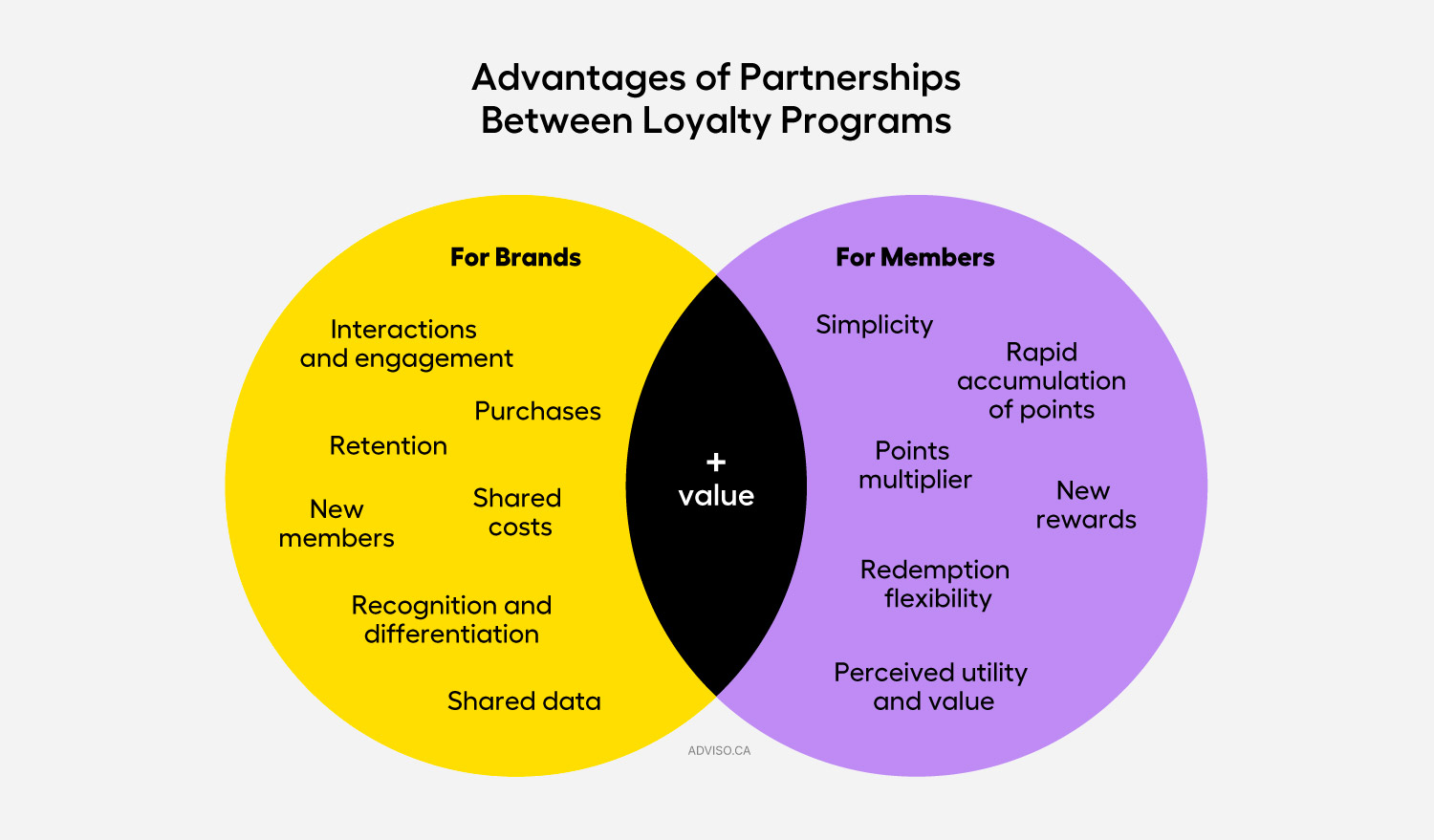
Among other notable advantages, an inter-program partnership can strengthen brand recognition, differentiate brands, and enrich their customer knowledge thanks to cross-buying behaviours.
But a partnership can’t stop at visibility or a mere collection of logos. To create value, it must be aligned with a clear business need and provoke a change in behaviour among members. It must therefore target at least one of these five objectives:
- Increase the frequency of interaction and engagement with the brand
- Improve retention or reduce churn
- Recruit new members
- Increase the frequency and concentration of member purchases
- Offer members financed monetary advantages that the brand could not be able to offer alone
If a partnership doesn’t contribute to any of these objectives, it may well constitute an attractive advantage for the member, but this isn’t strategy. It’s a promotion with a logo attached.
In some cases, the appeal of funding the program (through selling points to a partner) is often a major consideration, but not a very relevant one if it doesn’t correspond to any of the objectives listed above.
A strategy adapted to all stages
This partnership strategy could fulfill several objectives, depending on the stage of development of the loyalty program.
For a growing program, the partnership acts as an acquisition accelerator. The member bases of both partners intersect and can generate mutual enrollments at low cost.
For a mature program whose natural recruitment pool is starting to plateau, the partnership becomes above all a lever for engagement. It multiplies opportunities to earn for existing members, increases their interaction frequency with the program, and contributes to reducing churn.
In both cases, access to new behavioural data constitutes a non-negligable benefit.
What members gain
For members, a good inter-program partnership enriches customer experience (CX) without adding complexity. It makes the program more useful, more often.
- Simplicity: The same loyalty card or mobile application lets members earn points with several brands.
- Faster earning: With the addition of new points of contact, points can be earned faster.
- Points multiplier: One purchase can generate points in two distinct programs.
- Utility and perceived value: The program gives the impression of understanding members better and facilitating their everyday lives.
- Access to new rewards: The partnership opens the door to advantages that the program wouldn’t have been able to offer alone.
- Flexibility of redemption: Rewards become usable among more brands, in a greater number of contexts.
 A customer earns loyalty points during their flight thanks to an inter-program loyalty partnership
Why is this trend gaining traction?
The pressure of daily relevancy
In a market in which consumers are juggling twenty or so different loyalty programs,1 being visible, attractive, and relevant every day is becoming a pillar of customer retention. The more a program is part of a member’s daily habits—at the pump, grocery store, or coffee shop, or even on their next trip—the less likely it is to be forgotten.
Network extension without acquisition of fixed costs
For a loyalty program, building its own infrastructure in a new category (grocery, fuel, travel) represents a colossal investment. The partnership allows immediate access by sharing costs and member bases.
The richness of cross-referenced data
Data is the beating heart of loyalty. Each partnership thereby becomes an analytics gold mine that improves customer knowledge. By bringing together purchase data from different categories such as fuel, grocery, travel, or sportswear, brands can build much more precise member profiles. They can then personalize their offers, better target their communications, and anticipate certain behaviours with greater accuracy than if each program were operating alone.
Four keys to success in a partnership between loyalty programs
1. Choose the right partners
Two brands that partner together expose their respective members to the other’s reputation. The selection of a partner is therefore strategic: It must be worthy of trust, coherent with the brand, and capable of strengthening the perceived value of the loyalty program. Here are a few elements to consider:
2. Tally the objective with the agreement
Before signing, every program manager should ask themself this simple, but essential question:
“Will this partnership make our members more loyal while increasing their purchase frequency or concentration, or will it simply give them another place where they can get a discount?”
This question must next translate into tangible points of agreement:
- For which segment of members was this partnership designed?
- Which behaviour are we trying to change or encourage?
- What financial value is offered?
- What data will be shared, and with what consent?
- What conditions would cause us to renew, renegotiate, or end this partnership?
This last question is often neglected in the industry. Too many partnerships are launched with some vague assumptions, then measured solely with numbers that don’t prove actual customer retention. We’ll take a look at how to correctly measure the success of this strategy in the next section.
3. Reduce friction in the customer experience
Complexity is the enemy of engagement.
On paper, partnerships between loyalty programs are appealing. In reality, they’re often hard to understand and even harder to remember for a member. Who’s earning what? At what rate? Do you have to link your accounts? Is it automatic or done manually? Can points be converted both ways? Is there a minimum threshold?
The partnership needs to create value, not frustration. That’s why loyalty program managers must invest in clarity. Good communication, an engaging onboarding strategy, and a seamless mobile experience become just as critical as negotiating the partnership itself.
4. Expect technology expenses and integrations
To offer a friction-free customer experience, technological investment must be expected from the get-go. Systems need to be able to talk to each other, data needs to flow in the right way, and rules for earning or redemption must be applied without a hitch.
The “spend once, earn twice” promise can only be fulfilled with robust data architectures and well-integrated APIs. It’s an often underestimated investment in the negotiation phase.
 A consumer benefits from a partnership between a gas station and a loyalty program to earn points when filling up their gas tank
How to calculate the success of the partnership
KPIs are often the pet peeve of program managers. Many get excited when faced with a large number of members, when hidden beneath is low engagement or even a struggling program.
This reflex also transfers over to partnership strategies.
Too often, a partnership is measured solely by the volume of redemptions: the number of points converted or the number of members who took advantage of the offer. These indicators don’t prove that the partnership strengthened customer retention... they only prove that the member used the offer.
The real impact can instead be found in the behavioural changes: visit frequency, average shopping cart, retention rate, purchase concentration, and customer value.
A practical example
Imagine that Canadian Tire (Triangle Rewards) launched a partnership with WestJet. After six months, the team noticed that 50,000 members had converted their Triangle points into WestJet dollars. Is that a success?
If you only look at the volume of redemptions, yes, it adds up to 50,000 conversions.
But if you want to measure what really matters, which is customer loyalty, you have to take the analysis further:
- Did these 50,000 members make purchases more often at Canadian Tire since they linked their accounts?
- Did the average cart increase?
- Is their retention rate higher than for unlinked members?
- Would they have kept shopping at Canadian Tire even without this partnership?
This last question can quickly become uncomfortable. A member that is already very loyal to Canadian Tire who converted their points into WestJet dollars might have simply taken advantage of a benefit they were entitled to. The partnership didn’t necessarily make them more loyal—they were already. The program therefore incurred a cost without generating new behaviour.
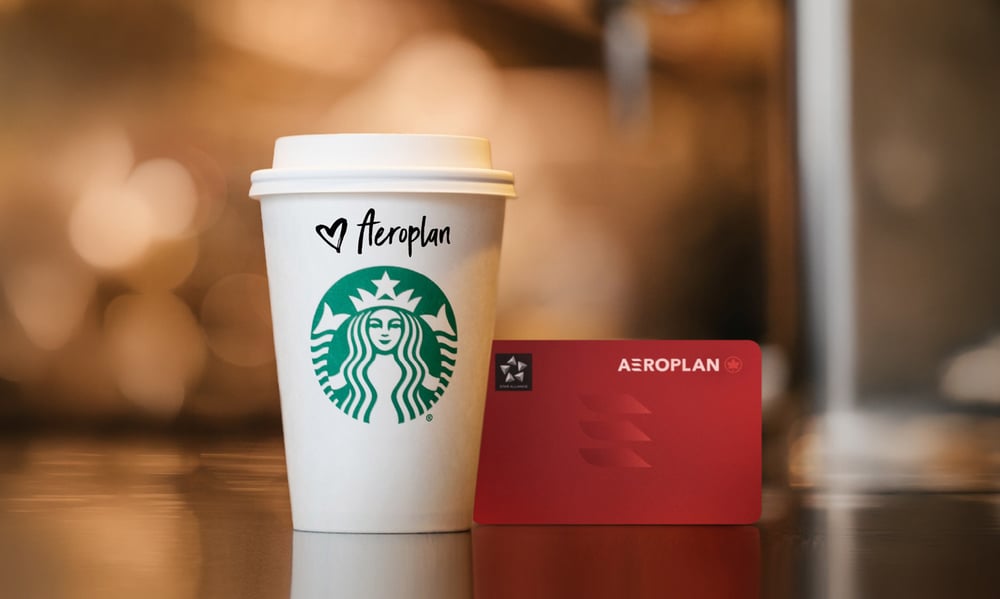
Partnership announcement between the Starbucks Rewards and Aeroplan loyalty programs | Source: CNW Group/Air Canada
Four examples of partnerships between loyalty programs in Canada
1. Starbucks Rewards + Aeroplan
One of the first big examples of inter-program partnerships that garnered attention in Canada is the one between Starbucks and Aeroplan. As briefly explained earlier, by linking their accounts, members could earn points in both ecosystems and access certain exclusives. Incidentally, Starbucks also deployed similar logic in the U.S. with Delta Air Lines.
2. Triangle Rewards + Petro-Points, RBC and WestJet
Canadian Tire’s private coalition program, Triangle Rewards, isn’t limited to subbrands of the parent brand (Sport Chek, Mark’s/L’Équipeur, and Sports Experts). Since 2024, the program has multiplied its partnerships to demonstrate its presence and usefulness in other contexts in the lives of its members, from fuel to financial services to travel.
Thanks to distinct partnerships with Petro-Points, RBC, and WestJet, Triangle Rewards lets members earn Canadian Tire money (CTM) faster. At the pump, members get CTM in addition to 20% additional Petro-Points. With an RBC card linked to their Triangle account, they can earn three times more CTM on certain eligible purchases at Canadian Tire banner stores. And with WestJet Rewards, they can earn both WestJet points and CTM with both brands at their banner stores.
3. WestJet Rewards + TELUS, Skip the Dishes, and Petro-Canada
WestJet was also inspired by this strategy. The carrier built a reward ecosystem that extends beyond travel and touches more moments in everyday life, with partners such as TELUS, Skip, Triangle Rewards, and Petro-Canada.
Members can already earn WestJet points with TELUS and Skip, then redeem them for credits applicable to their bills or orders. At the start of 2027, members will also be rewarded at the pump thanks to a partnership with Petro-Canada.2 This partnership will add new possibilities for earning, conversion, and rewards.
The goal: To evolve WestJet Rewards from being a simple points program for mileage into an everyday loyalty currency.
4. PC Optimum
PC Optimum, Loblaws’ private coalition program, offers an interesting variant. Instead of multiplying external partnerships, it’s betting on consolidation.
In 2018, Shoppers Optimum and PC Plus merged to create the internal mega-program that is PC Optimum. With the addition of an external partner, Esso and Mobil, the program covered several high-frequency categories: grocery, pharmacy, gas, and even financial services with PC Financial.
The vertical integration model contrasts with the external partnerships of certain competitors, but aims at the same objective: Multiply opportunities to earn and make contact with members.
A true fixture in the everyday lives of many Canadians, PC Optimum appears year after year in the rankings of the top 10 best programs in Canada.
How can you create more value with your loyalty program?
The question isn’t “Should we form partnerships?” anymore, but rather “Who with, how, and when?” The competition in loyalty is no longer only playing out in the choice of rewards or the generosity of the earning rate. It lies in the capacity of a program to be present and relevant in a larger number of everyday moments in the lives of its members.
The programs that play their cards right won’t be those that increase the number of partner logos, but those that build alliances with real added value, offer a seamless member experience, and intelligently exploit cross-referenced data.
This new era in loyalty opens up an avenue towards many possibilities, on condition that stakeholders understand how to take advantage of them. That’s where we step in. For 30 years, adviso has helped organizations identify their most promising levers and transform them into measurable value. Discover our optimization approach for loyalty programs.
REFERENCES
1 LoyalT 2025 Study by adviso: Data collection via web panel conducted by Ad Hoc Research from May 12 to June 7, 2025, amongst 15,000 Canadians aged 18 and over who were members of at least one loyalty program.
2 WestJet, WestJet and Petro-Canada™ Connect the Road to the Runway with New Loyalty Program Partnership, April 2026.
The article Partnerships Between Loyalty Programs: Advantages and Examples first appeared on adviso.ca.

What retail can learn from D2C
In retail, creating a house or private brand (also known as a private label) is nothing new.

Retail: 4 questions to ask yourself starting today
Is your retail business really ready for what’s coming?

How organizational culture influences project management
No project exists in a vacuum. Project management is always embedded within a company culture that i …