


Stakeholders play a major role in a project’s success. At every stage, their decisions and actions directly influence its trajectory.
Depending on the project type (digital, analytics, artificial intelligence or some other) contributors may vary:
- project team
- agencies
- data scientists
- programmers
- department heads
- strategists (marketing, UX, CX)
- editors
- designers
- media providers
- customers
- users
- etc.
In an industry in which everything moves very fast and projects launch with rapidity, managing stakeholders at the start of a project sometimes gets neglected... or even forgotten. However, defining that process from the very beginning is one of the best ways to keep a project on track. By identifying key players early, you clarify their needs, expectations, and roles and avoid any detours, delays, and last-minute surprises.
Keep reading to master the four essential processes for successful stakeholder management: identification, planning, management, and monitoring.
Four processes for managing stakeholders
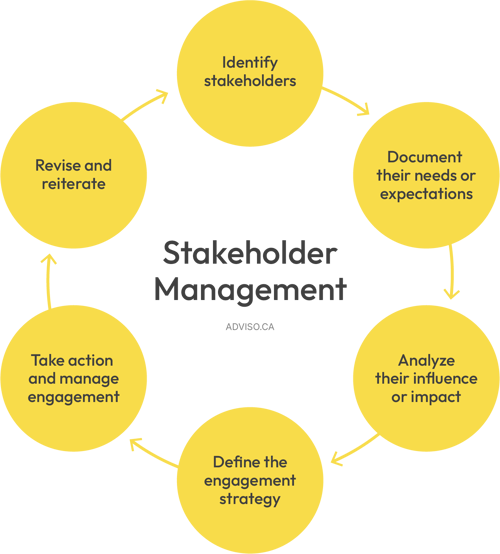
Managing stakeholders isn’t limited to simply creating an organizational chart. This is an established field of study described by the Project Management Body of Knowledge (PMBOK)1 guide as consisting of four processes:
- Identification of stakeholders
- Planning stakeholder engagement
- Management of stakeholder engagement
- Monitoring stakeholder engagement
Identification of stakeholders
For this first step, identify any individual, group, or organization that may have a direct or indirect impact on the project. Think beyond internal stakeholders and include the users and consumers of the final product.
User research is a good way to take the user into account in the decision-making process. Including the opinions of your users lets you see your strategy from a long-term perspective instead of limiting yourself to the current project.
Document and share information with every stakeholder and ensure that each person is comfortable with the responsibilities included in their role. You could also let team members choose their roles and then review them later.
Whatever the nature of the project—digital, analytics, or AI—there are often differing levels of knowledge within teams. These gaps aren’t an obstacle... so long as they’re identified early. Equip teams quickly in order to balance the realities of your resources with the desired output.
The RACI chart
A RACI chart is a structured framework to help identify the roles of project members. Each member knows exactly what to do, which reduces confusion and strengthens collaboration.
Taking an implementation of an AI solution as an example, the company president could be an I, since they will not necessarily be involved on a daily basis in advancing the project, but will be informed at key decision-making moments.
Planning stakeholder engagement
After identifying the key roles of each participant, establish strategies for effectively managing the involvement of identified stakeholders for the duration of the project. Based on each participant’s role, ensure important information is made accessible to them at the right time using predetermined channels of communication. The right information at the right time to the right participant.
Plan the schedule of meetings and identify who will be involved in each meeting. This will let you avoid continual requests for follow-ups and progress updates as well as personal requests for updates which reduce the efficiency of the project. Clarify the expected level of reporting from the start.
Additional reading: How Organizational Culture Can Influence Project Management
Management and monitoring of stakeholder engagement
After the first two steps, many may feel like the project is finished. Surprise! This task is iterative.
- Comprehensive and continuous monitoring with stakeholders
- Updating documents
- Adjusting management strategies, if needed
The plan is worthless if the team doesn’t follow it. Foster the team’s involvement from the start to ensure that each person plays their role in ensuring the project’s success.
Managing stakeholders isn’t only about planning, but also involves operationalizing and thoroughly communicating your approach throughout the entirety of the project.
Managing stakeholders = managing expectations
Above all, managing stakeholders involves predicting, aligning, and managing expectations—not only for stakeholders, but for end users as well. There is a dual objective: to reduce negative impacts and strengthen support for a project.
The scope of a mandate, whether concerning digital, analytics, or AI, affects the time, resources, and tasks required. But one thing remains the same: The earlier key stakeholders are involved, the more you reduce a project’s risk of delays, cost overruns, unexpected events, changes in scope... or even complete cancellation.
With a clear framework, each person can focus their energy on what really counts: making your project a success.
Do you need help steering your project in the right direction? Adviso can help you get a clear perspective and mobilize the right stakeholders. Tell us about your project.
REFERENCE
1Project Management Institute, A Guide to the Project Management Body of Knowledge (PMBOK Guide), Sixth Edition, 2017.
The article Guide to Effectively Managing Stakeholders first appeared on adviso.ca. It was updated in September 2026.
.gif?width=40&height=40&name=Sophie-Anne_Theoret_Web-150x150%20(1).gif)