


Performing A/B tests isn’t enough to create a culture of experimentation.
In many organizations, conversion rate optimization, also known under the acronym CRO (Conversion Rate Optimization), still remains a half-hearted practice.
And yet today’s marketing teams have available to them more data and tools than ever before for testing their ideas, not to mention artificial intelligence (AI). While technology is no longer an obstacle, culture remains so.
In this article, I’ll explain the importance of a culture of experimentation within a company and how to establish one in a sustainable way to support your growth.
- What is a culture of experimentation?
- Why experiment?
- Is your company ready?
- How is it established?
- Conclusion
What is a company culture of experimentation?
A culture of experimentation consists of testing hypotheses, measuring results, and extracting learnings to make informed decisions. It’s notably associated with conversion rate optimization (CRO).
CRO can take different forms, depending on your goals and sector of activity. For example:
- Website: Optimize landing pages and produce different variants to attract qualified prospects (as in our case study for HydroSolution).
- Ad campaigns: Test different creatives and adjust investments based on the results (that’s what we did for Lassonde, with over 75 pieces of creative!).
- Email marketing: Perform A/B tests of email subject lines to improve the open rate.
A culture of experimentation is not just doing a few tests here and there. It’s assembling the winning conditions to make it a structured, integrated practice. It’s putting hypotheses to the test with data. And above all, it’s learning in order to improve.
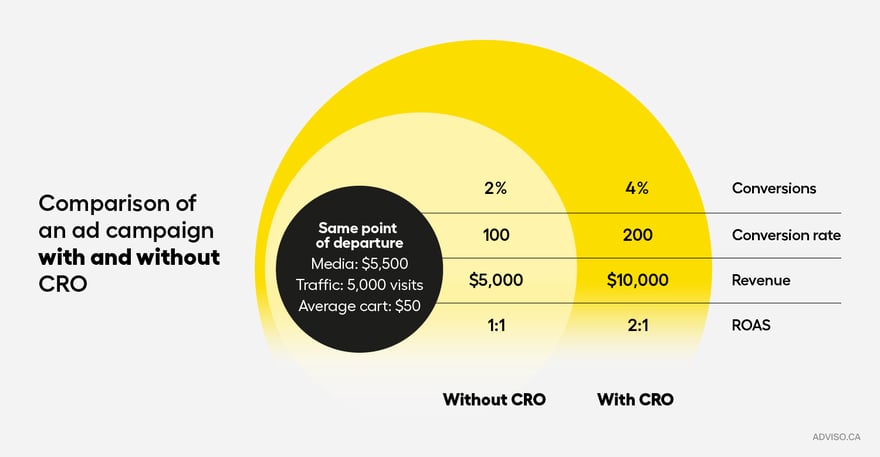
Starting from the same point of departure, CRO can improve the conversion rate as well as, through the effect of momentum, other performance indicators for an ad campaign. | Adapted from BKA Content
Why experiment?
Continuous experimentation is at the heart of the culture of some of the biggest companies, like Google, Amazon, and Microsoft.
Its effectiveness is significant. According to a study published in Management Science, young tech companies that adopt A/B testing see their performance improve by 30% to 100% after only one year1.
Modelling performed by Forrester for the CRO platform Optimizely One estimates a return on investment of 446% over three years, and an increase of 8% in digital conversions thanks to its use2.
Unsurprisingly, these benefits aren’t simply based on performing occasional tests, but on their integration into a long-term strategy of experimentation.
Evolution of internal practices
Behind the performance and ROI numbers are internal practices and processes that make all the difference.
- Understand the impact of actions: Measure the effects of initiatives on business results more precisely and focus efforts on those that create the most value.
- Encourage decisions based on data: Reduce debate based solely on opinion or intuition in favour of informed decisions through measurable results.
- Strengthen team engagement: Let employees observe the results of their initiatives and actively participate in the improvement of practices.
- Promote continuous improvement: Extract learnings from successes as well as failures to better understand the needs of users and adjust strategies.
Together, these benefits make CRO a lever for improving your business results and growth.
A favourable technological context
As early as 2021, an article published in the Harvard Business Review3 proposed that conditions had converged to drive a true “revolution in experimentation” within companies. And that was before the rise of artificial intelligence!
Access to a large quantity of proprietary customer data (first-party data), cloud-based technology, and data centralization tools (ex., Google Analytics 4) is already facilitating experimentation. More recently, tools and assistants based on AI have arrived to accelerate data analysis, hypothesis formulation, and the creation of variants for testing.
The benefits are real, the data are accessible, and so is the technology. And AI can accelerate all of it. So why have so many companies still not adopted a continuous experimentation strategy?
I notice this even within the marketing teams of the clients I advise, who are in theory among the best equipped. They have the data and the capacity, but are afraid to take on a new way of seeing things or challenging the status quo through experimentation.
This is entirely where the challenge lies: evolving company culture to make room for experimentation.
Is your company ready for a culture of experimentation?
Any company can adopt a culture of experimentation, no matter what its size or resources. But certain conditions will allow more value to be extracted.
Experimentation is made for you if:
- you would like to exploit your data’s potential to make informed decisions
- you would like to put your customers at the centre of your decisions
- you have a website, a mobile application, or a digital product
- you generate revenue or prospects directly through your digital platforms
Your volume of monthly conversions then determines the scope of the experiments you can conduct.
- Around 1,000 conversions: You can already begin to experiment by testing changes to your main pages.
- Starting at 10,000 conversions: You can establish a structured culture of experimentation and perform advanced tests on your conversion journeys.
- At over 100,000 conversions: Experimentation should be an integral part of your practices to maximize your performance.
If you don’t yet meet all of these conditions, nothing is stopping you from finding inspiration in experimentation to innovate and improve your internal processes. Progressively adopt an approach based on data by starting with building a data strategy.
How to establish a lasting culture of experimentation: 5 key techniques
The silo is the enemy of the culture of experimentation. It’s the active participation of the entire organization that contributes to establishing this approach, not just the specialized CRO team. Here are five key techniques for developing this company culture.
1. Align experimentation with your business objectives
At adviso, each kick-off meeting with a new client takes the form of a workshop to better understand their business context.
This step is essential, because it lets us understand not only the company’s mission, but also the business objective that it would like to achieve in the coming year, which will become the “North Star Metric” (NSM). Like the North Star, the NSM serves as a compass and indicates what direction to take.
For example, you can aim for a 5% increase in your online revenue. The CRO approach can therefore try to reduce cart abandonment, notably by testing a simplification of the payment process or different versions of the call to action button.
In addition, the goal tree4 proposed by Optimizely lets you connect your business objectives to key performance indicators (KPI) and define measurable targets. For example, do you have a precise objective regarding the number of tests to perform each month? An improvement percentage to attain for a given KPI?
Don’t test for testing’s sake. Connect each experiment with a concrete business issue.
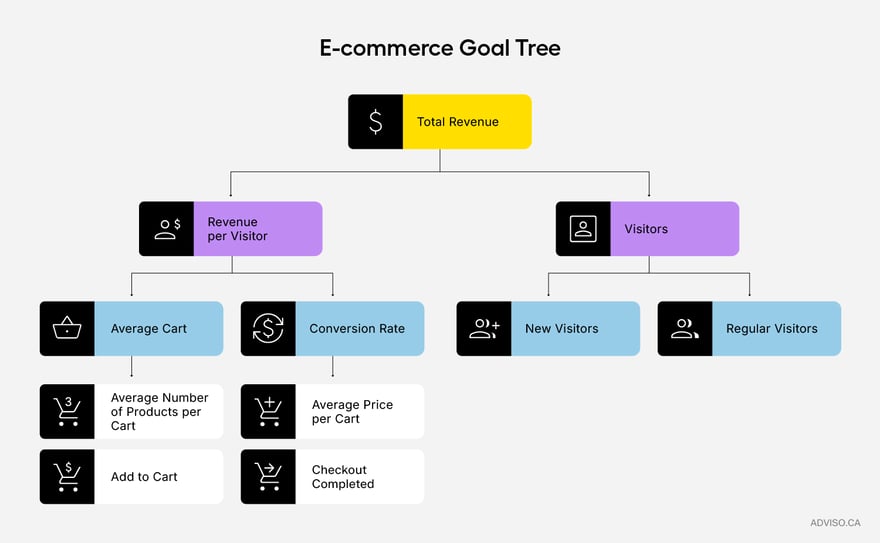 Example of a decision tree in e-commerce
Define the mandate of the CRO team
Once the main objectives are defined, determine the role your future CRO team will play to fulfill them. You should also clarify the benefits you expect from setting up a culture of experimentation.
Every context is different and many questions deserve to be raised. Your mission and objectives cannot be brought to life without a holistic team vision.
2. Put together a multidisciplinary CRO team
As with any marketing project, a leader is essential for coordinating initiatives and ensuring they are rolled out smoothly.
Ideally, entrust this role to a CRO expert. This versatile profile is situated at the intersection of a number of skills: product management, research, analytics, and user experience (UX). This person can therefore lead the entire experimentation process, from research and hypothesis formulation to the creation of variants for testing, analysis of results, and adjustment of the roadmap.
Experimentation squad
One of the first missions of the CRO leader is to assemble the right profiles to form an experimentation squad. The leader should look for people who demonstrate an interest in continuous experimentation, who have already put it into practice, or who have an analytic mindset.
The right “casting” is essential here, because the support of squad members facilitates acceptance and operationalization of the ideas of different departments as well as those of management. Depending on the composition of your CRO team, you can rely on the RACI model to clarify roles and facilitate collaboration.
Minimally, this committee needs to combine skills in web development, design, marketing, and analytics. The good news is that a team of two people can be enough to get started: a CRO expert and a developer at intermediate level or higher. With solid skills in front-end development, the latter can integrate the variants to be tested and ensure that they work properly.
3. Overcoming resistance to change
Once the experimentation squad is established, the CRO leader will be tasked with orchestrating and hosting meetings with specialists from different departments. The leader must not only proselytize for a field that is still complex and little understood, but also create an understanding of how each person can contribute to the company’s culture of experimentation.
Unsurprisingly, not all employees will be equally invested in this transition or equally inclined to participate. You might perhaps face a simple lack of interest or, to complicate things further, fear of change.
The HiPPO challenge
This resistance to change can also come from management. Accustomed to making decisions based on their experience or intuition, some leaders can find it hard to let the data call their ideas into question.
HiPPO5, an acronym popularized by Avinash Kaushik, stands for “highest paid person’s opinion.” In other words, this is when the opinion of a CEO or director carries a lot of weight in a decision simply due to their authority.
In experimentation, the person with the highest salary shouldn’t have the last word. That belongs to the data.
4. Promote leadership and the right to make mistakes
Management plays an essential role in the adoption of a culture of experimentation. They need to allocate the necessary resources, demonstrate their engagement with this approach, and above all encourage the right to make mistakes.
Why? Because experimenting means accepting that not all of the tests will be winners. And that’s normal, even desirable! After all, the goal of experimentation is to learn in order to make better decisions.
If your teams only perform “winning” tests, ask yourself a few questions. Are they testing hypotheses that are sufficiently bold? Are they correctly analyzing their results? As in real life, every mistake is an opportunity to learn and grow.
5. Maintain engagement
The first CRO tests can be launched quickly, but sustainably integrating a culture of experimentation within a company requires patience and engagement from everyone.
To maintain the interest of teams, communicate, communicate, communicate! Keep them informed about everything: upcoming tests, successes, failures, and learnings! The CRO approach is built with every team, one test at a time.
Build a company culture focused on experimentation
A culture of experimentation can’t be measured by the number of A/B tests performed. It relies above all on a continuous, structured process within an environment that promotes learning.
Define clear objectives, bring together the right skills, and ensure the support of management and all departments. Above all, encourage your teams to test their hypotheses, call their own ideas into question, and learn from their failures. This is how your culture of experimentation will truly contribute to the performance and growth of your company.
Need support for your CRO experimentation? Adviso’s specialists can help you establish an approach adapted to your business objectives. Discover our expertise in conversion rate optimization (CRO).
REFERENCES
¹ Rembrand Koning, Sharique Hasan and Aaron Chatterji, “Experimentation and Start-up Performance: Evidence from A/B Testing,” Management Science, January 13, 2022.
² Forrester Consulting, The Total Economic Impact™ of Optimizely One, Forrester Consulting, September 2025.
³ Elizabeth R. Tenney, Elaine Costa and Ruchi M. Watson, “Why Business Schools Need to Teach Experimentation,” Harvard Business Review, June 16, 2021.
⁴ Optimizely, Build a Goal Tree to Improve Metrics That Matter with Your Optimization Program, Optimizely, October 15, 2026.
⁵ Tammy Pearson, The HiPPO Effect on Customers and Product Teams, Atomic Object, May 7, 2022.
⁶ Ed Catmull and Amy Wallace, Creativity, Inc.: Overcoming the Unseen Forces That Stand in the Way of True Inspiration, Random House, 2014.
The article Why Build a Culture of Experimentation for Your Business, and How? first appeared on adviso.ca. It was originally published in February 2023 and was updated in November 2026. Its content integrates recommendations from Roger Kamena, Camille Radzioch, Alexandre Gardé, and Valérie Morin. Our content is always created and validated by our experts, who use AI to optimize it.



Top 10 best loyalty programs in Canada
The best loyalty programs are those that succeed at creating a place for themselves in the everyday …

Everything you need to know about customer data platforms (CDPs)
It's impossible to ignore the dazzling growth of digital channels that has caused an explosion in th …

Email marketing, the essential part of marketing mix
Is email dead?