


Most articles and discussions on the topic of loyalty programs are essentially about their design. Program parameters such as strategy type, reward levels, benefits, etc. are the topics being discussed. Often it is the visible elements of a program that are most often mentioned when it comes to customer experience (CX).
While important, this design aspect does not solely guarantee good performance in a program. Even programs with the best design can produce disappointing results, or even lead to failure, if no attention was paid to their management during development.
In this article, you’ll learn about two indispensable aspects of a high-performance loyalty program: design and management.
Design: Experiencing a loyalty program
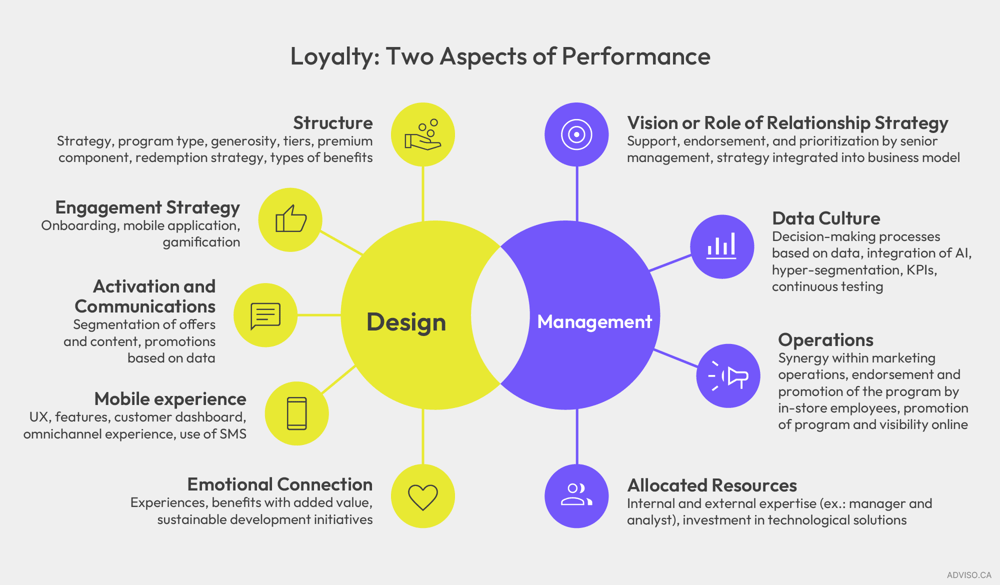
Design encompasses the elements that contribute to program members’ overall experience: structure, engagement strategy, activation and communications, the mobile experience, and emotional connection.
Structure
The structure of a program is key. There are several different types of relationship strategy.
- Points program
- Subscription program
- Premium program (with annual or monthly fees)
- Relationship program (no points, but with benefits)
In addition to the above, there are strategic choices to be made with regard to benefits, accumulating points, redeeming rewards, etc.
All of these options are valuable, but they do not all contribute to business goals in the same way.
Engagement strategy
Given that Canadians can have as many as 19 loyalty program cards in their wallets—of which only seven are used regularly1—an engagement strategy and an onboarding strategy have become essential for ensuring your program doesn’t get forgotten. It’s never been so easy to join a loyalty program, or to leave one…
Learn the best practices for an engaging onboarding email sequence
A good program promotes frequent interaction with members in order to maintain their engagement. It could encourage members to use the mobile app, react on social media, and even participate in gamification activities such as mobile games, contests, and surveys.
Activation and communications
The goal is simple: Present the right content or offer to the right segment at the right time.
To accomplish this, data are indispensable. They facilitate a better understanding of your clientele and the personalization of communications based on their profile, interests, preferences, and purchase behaviours.
Without the right technological tools, resources, and data, it is very difficult to be effective in terms of communication, activation, and conversion.
Mobile experience
Every year, mobile devices become more popular among members of loyalty programs.1 Loyalty program apps have quickly turned into well-designed customer experiences integrating dashboards, useful customer services and/or features, payment integration, etc.
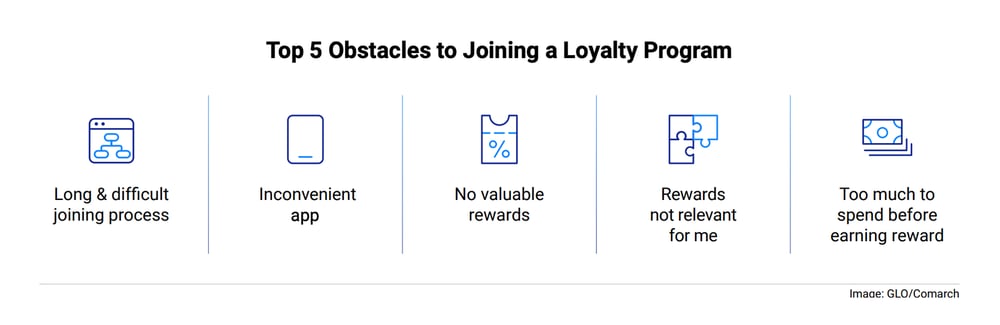
A poor user experience (UX) can quickly become a reason for program abandonment, especially among younger generations. According to a Comarch/GLO2 study, a poorly performing mobile app is the second most common obstacle to joining a loyalty program. Over one quarter of respondents (28%) said that it was their main impediment, well ahead of issues related to rewards.
Emotional connection
All of the elements mentioned so far contribute to creating an emotional connection. Given the large number of loyalty programs available, the relationship today between a brand and its program members is fundamental to their sense of loyalty.
A loyalty program has become a tool to make the lives of members easier, especially with regard to the relevance of its content, personalization, enhanced services (such as free delivery for members), the features of its mobile app, exclusive experiences, etc.
What are the top 10 best loyalty programs in Canada?
Management: The hidden driver behind loyalty programs
While the design aspect is important, the fact remains that it would be very hard to make a loyalty program profitable, to make it a success, without good management. This latter aspect includes the elements that enable the creation of the program and its operation, such as a shared vision, a data-focused culture, operations, and resources.
Over the past 30 years, I have observed that the management aspect is all too often forgotten—an oversight that explains the poor performance of many programs.
Vision and role of the relationship strategy
Aligning the perspective of all the VPs, departments, and upper management should be the foundation of any loyalty program development. It should be seen as the cornerstone of the company’s strategy. I often say that a loyalty program isn’t a marketing strategy, it’s actually a business strategy.
Upper management must understand the implications of this strategy not only on the marketing budget, but also on other business functions such as market entry, brand image, IT, and operations.
This shared vision must be shared for both the medium and long term and should be well understood in terms of the changes it will entail, such as:
- budget transfers
- investments in marketing technology (MarTech)
- relationships and negotiations with suppliers
- required expertise
- additional resources
- market entry
- management of discounts
Data culture
Data use represents the most effective lever for making a loyalty program profitable and improving its performance. While much has been said about it in recent years, especially given the cookie apocalypse and the adoption of artificial intelligence (AI), this aspect is still too often neglected by companies.
Good data culture within an organization indicates there exists a collective approach that promotes data use for making strategic decisions, improving processes, and driving innovation. Certain key elements are supportive of such a culture, specifically:
- generalized access to data
- data literacy
- effective data governance
- ethical use of data
- cross-functional collaboration
- data-driven decision making
- adapted tools and technology
- encouragement of innovation
- tracking and continuous improvement
To effectively integrate data into a loyalty program, companies need to rely on the expertise of data scientists and analytics experts and also ensure their data are properly structured.
Operations
The loyalty program must be not merely integrated into the vision of upper management, but also instilled in every department. The synergy of its integration is key to the program’s success.
In marketing departments with co-existing management (directors or vice-presidents), I have often noticed a lack of cohesiveness when it comes to vision, customer experience, and communications. The highest-performing organizations are those with a director (or CMO) playing a role similar to that of an orchestra conductor.
On-the-ground teams, both online and in-store, must also participate in the program! These employees are, after all, most people’s first point of contact with the program. They must be able to effectively present its benefits to customers and systematically ask customers for their loyalty card.
Allocated resources
To adequately bring the program to life, a variety of human resources are needed. The two most common are managers and analysts.
While managers focus on running the program, analysts (or data specialists) supply managers with their observations. The latter in particular observe any opportunities for activation (visit frequency, cross-sells, up-sells, reactivations, etc.) and track the program’s key performance indicators (KPIs).
The resources needed also includes technological tools. It’s essential to properly define a list of needs to guide your selection of the platform or technological team that is capable of creating the adapted solution. I have already witnessed clients who are dealing with unsuitable technologies because they selected their loyalty platform before precisely identifying their needs.
The ideal combination for higher ROI
To develop a high-performance relationship strategy or loyalty program, both aspects of program performance must be carefully considered.
Developing an effective, high-performance loyalty program with a high rate of return on investment (ROI) is a complex process that affects every business function within an organization. In some cases, a recommendation may be to start off with the management aspect, then take a step back and make sure all the planets are aligned before launching your new business strategy.
My loyalty team and I have developed a coaching process that guides you through these two aspects of loyalty programs. Get in touch with us today to receive an evaluation of your needs. My team would be happy to offer an approach that is adapted to your particular business reality.
References
1 LoyalT 2024 study by adviso: Data collection via web panel conducted by Ad hoc Research from May 22 to June 5, 2024, amongst 10,002 Canadians aged 18 and over who were members of at least one loyalty program.
2Comarch and Global Loyalty Organisation (GLO), Customer Loyalty Predictions 2025 and Beyond: Report on AI, Privacy, and Sustainability, survey conducted among 3,000 respondents in 15 countries in November 2024.
