


Your website is important to your business. In fact, it represents a significant source of revenue. Whether you use it to sell your products, register customers for a service, collect leads or simply to showcase your company, your website is indispensable when it comes to growing your business.
Once you realize how important this tool is, you’ll definitely want to maximize its reach and efficacy—to sell more and gather more leads. In short, you’d like it to perform better.
Many believe that starting all over from zero and undertaking a complete site revamp or redesign is the inevitable solution, which is why many companies immediately, and blindly, turn to this solution. That’s normal. After all, what professional with even the slightest contact with the universe of the web has never heard of a website revamp?
Obviously in some cases this is completely necessary. But there is another approach, one that’s less well known, that enables an increase in website performance that is just as guaranteed, but more gradual: conversion rate optimization, often simply referred to by its acronym, CRO.
Before you do anything, be sure you understand both approaches. Here are two short definitions:
Redesign: A project consisting of reconstructing the foundations of a website in order to make it more flexible and higher performing. A complete revamp usually involves a complete transformation of the site’s code and original design. This solution is particularly effective when, for technical reasons, the technology upon which the original site was based no longer allows a company’s decision-makers to use the platform as they intend.
CRO: A one-time or continuous process that involves optimizing the conversion rates of sites, mobile applications and marketing applications. Very effective for sites with a clear purpose that could translate into more revenue, this approach is based mainly on statistical evaluations such as A/B tests.
To support the community of business leaders and website managers in selecting which approach would work best given the specific needs of their organization, we’ve prepared a chart that provides an overall comparison of a website revamp with a conversion rate optimization.
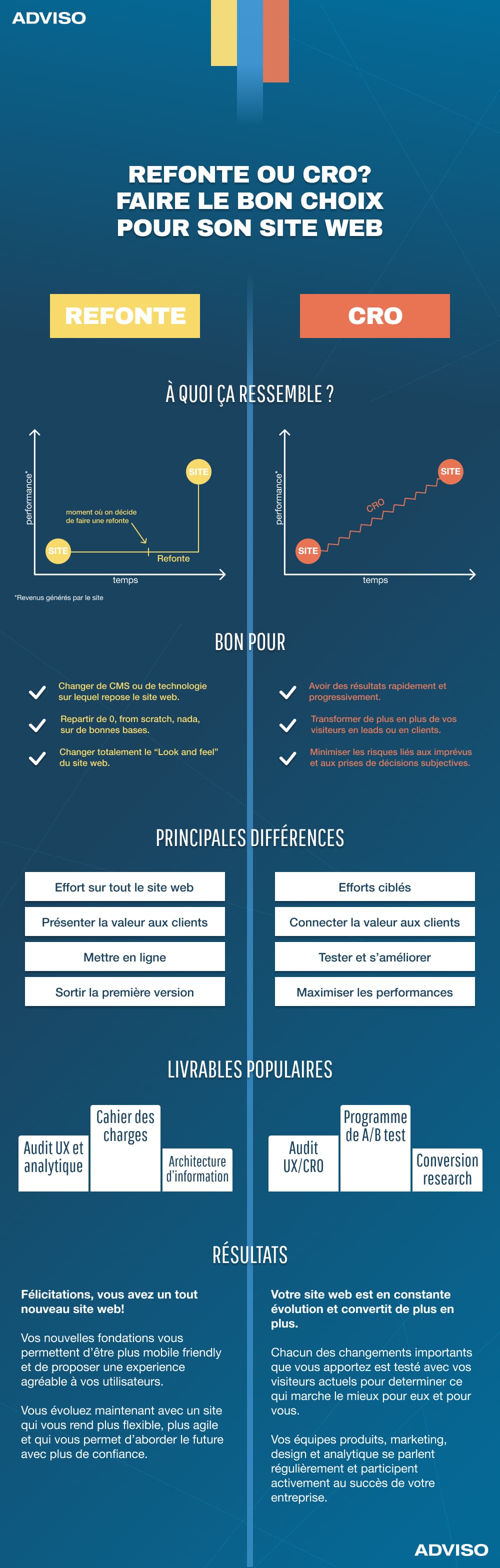
As you can see, a revamp and a conversion rate optimization are two completely different approaches that nevertheless fulfill the same objective: to get more out of your website.
On the one hand, a revamp would be preferred by those who have a website that’s holding them back, one that’s preventing them from being innovative and creative. This choice is often justified by a technological or CMS issue, or in other words by a problem relating to the website’s infrastructure.
On the other hand, the CRO approach is much more agile and would perfectly suit those whose site isn’t preventing them from innovating. The issue to be overcome isn’t related to the platform’s foundations, but rather its design, the UX or the way in which it relays its products/services to users.
Imagine the following situation:
You’re the owner of a store and would like to optimize to achieve more sales. Would you start by pouring brand new foundations to correct the building’s structure, or would it be sufficient to change the interior organization of your business?
The answer is simple: You would choose the solution that best responds to the constraints you are experiencing.
If the current foundation is a major threat to your customers and yourself, you should first establish a new foundation to ensure that the store remains standing and no serious accident will happen in the future. However, if you aren’t experiencing this kind of threat, you should instead go with a coat of fresh paint, knocking down a wall, creating a new door, enlarging a window or even reorganizing the spacing of your aisles.
This example shows that the choice is the same for your website! You only need to rebuild its foundations in case of an emergency. To optimize your site, a CRO approach will enable you to test a range of new changes and parameters without having to demolish the old store and start over from scratch.
Of course, not everything is this black and white. It’s possible, for example, to choose a strategy that’s more oriented towards optimizing your conversion rate, but includes a partial revamp, or the reverse. However, whether your business is brick-and-mortar or online, the idea is the same: Choose the approach that will enable you to get the best possible results as quickly as possible. To accomplish this, the first necessary step is to get to know your options, and we hope this article has been able to provide you with some direction in this sense.
If you’re interested in learning more about the above issues, you’ll find several articles on our blog covering website redesigns and optimization.
