

For quite some time now, digital marketing professionals have become passionate about collecting performance data, which are used to improve decision making and increase the relevance of strategies in the eyes of end users.
Today, we’d like to present the latest arrival in the field of data exploitation: reverse ETL. Positioned downstream from your data warehouses, this tool allows you to exploit your first-party data on a variety of destination platforms.
Life cycle
Here is the high-level architecture of the data life cycle, allowing us to situate reverse ETL within this sequence:
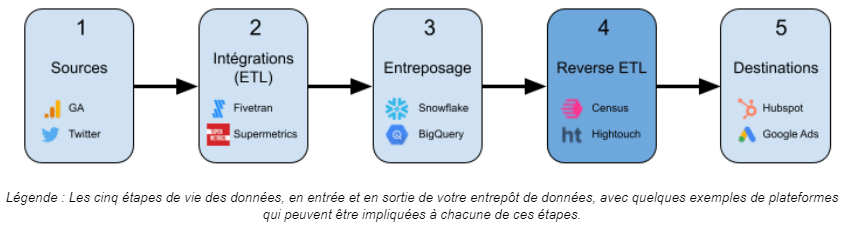
For several years, our team of data architects has stressed the importance of the quality of incoming data and of centralization in order to build a pool of data that can be a crucial asset for many stakeholders within an organization. To this end, integration tools have proven themselves to be very useful for adapting to APIs from many sources.
Conversely, destinations also have a variety of APIs available, and it would be very hard to maintain internal applications that can function optimally in the long term. This is where using reverse ETL comes in. It enables you to analyze your available data and transform them into assets as soon as they’re sent to marketing destinations.
Reverse ETL use cases
Here are a few examples of specific uses of a reverse ETL for data processing. Note that there is a necessary condition to its use, which is that you have a functioning data warehouse at your disposal.
- Your manage your data in the cloud in order to segment customers based on their long-term value (LTV) or their propensity to purchase. The segments will have even more impact when they are transformed into synchronized audiences for the marketing team in Google DV360, Facebook Ads or Adobe Campaign in a single transaction.
- Customer data relating to customers or products are mixed together in your data warehouse, and your analytics experts have developed a product recommendation algorithm linked with the purchase history of the target user and to the behaviour of other users. With reverse ETL, the UX team can activate the experience personalization through the Salesforce Commerce Cloud CMS, and the CRM team will take advantage of product recommendation signals during its automated marketing campaign.
- The sales team is overwhelmed by an increasing number of prospects and it would like to use software that can help it prioritize who it should contact. Using asynchronous enrichment of user data such as identity resolution, reverse ETL will allow you to have lead scoring in the CRM.
- Your company’s NPS (Net Promoter Score) fell recently because users became exasperated with having to repeat the same information over and over again across many channels, and now your customer service department has to pick up the pieces. By being able to access a customer profile, recent behaviour and even inferred metrics (see LTV point #1), the call centre can also raise its level of personalization of the customer experience.
- The data engineering team has been looking to create cyclical data enrichment pipelines for a long time. Reverse ETL offers this possibility, transferring behavioural data coming from the data warehouse (for example, offline purchases) to analytics platforms (GA4, Amplitude, Mixpanel).
Data activation platform
There’s an urban legend that the former engineers of the Salesforce CDP were the originators of a couple of start-ups that are currently emerging in our industry, specifically Census and Hightouch.
Both of these start-ups have the same objective: the quick recovery of dormant data in your data warehouse. They are attempting to distinguish themselves from CDPs (customer data platforms) by offering a smaller, more agile platform than those of their predecessors. To distance themselves even further from CDPs, they are also currently considering giving their technology a different name. For the moment, this platform goes by a couple of monikers, specifically “data activation platform” and “operational analytics.”
For a number of years, reverse ETL was merely one component of the larger CDP solution. But now it’s possible to offer services at a “piece rate.” This means it’s no longer necessary to have a specific budget for marketing to make use of a CDP, an operation that normally requires a concerted strategic effort on the part of many decision makers (in marketing, sales, services, etc.).
However, it should be noted that as opposed to the major integrated CDP platforms (such as those from Adobe or Segment), reverse ETL is not equipped to synchronize sources or destinations in real time.
At Adviso, we design architectures focused on customer data to create 360-degree views of customer intelligence that can become cornerstones for data strategies. We’re confident that reverse ETL will increasingly be added into your technology mix in the future.

CDPs, powerful data orchestration tools [Infographic]
What reality are faced by marketers wishing to make optimal use of CDPs, these powerful data orchestration tools? THE RISE OF CUSTOMER DATA PLATFORMS (CDP) Customer Data Platforms, or CDPs, have experienced significant growth in recent years. If, in fact, digital marketing professionals almost all agree on the importance of this audience management tool, few can say to date that they are adequately equipped to make relevant use of it. CDPS IN FIGURES The following infographic brings together statistics from different sources to paint a portrait of the reality of marketers and their use of CDPs in 2019. FOR FURTHER Find out in this article what role a CDP could play in your marketing stack . Or simply contact us !

Marketing transformation: technology as an accelerator
This article is the last in the series on marketing transformation and focuses on technologies that can support your data-driven marketing transformation. The targeted applications are: Measuring the performance of marketing activities Generating customer and consumer insights ; Using these insights : to acquire new customers and prospects to increase the value of current customers to retain high-value customers Personalization of the customer experience Every marketer needs a 360 ° view of their customers to develop and execute an effective strategy. Obtaining such an overview requires the creation of a Marketing Customer Information File ( MCIF) which contains a list of relevant attributes to support the applications listed above. Creating a 360 ° view of the consumer is not an idea born yesterday. This process has existed for more than twenty years through the marketing data marts that underpin the marketing campaigns of organizations. The growth of digital and the growing accessibi …

The Future of Programmatic: How DSPs and AdTech Are Transforming Digital Advertising
Programmatic advertising has become a driving force in transforming how brands engage with audiences in today’s digital world. What used to be a slow, manual negotiation process between advertisers and publishers is now powered by real-time bidding, using demand-side platforms (DSP, i.e., Display & Video 360 (DV360), The Trade Desk, Amazon DSP) and supply-side platforms (SSP). Think of DSPs as your brand’s ad-buying engine, leveraging data to bid for the best ad spaces. Meanwhile, SSPs, acting on behalf of publishers, sell this ad space in real time, all facilitated by the ad exchange, a high-speed auction house connecting both sides.