
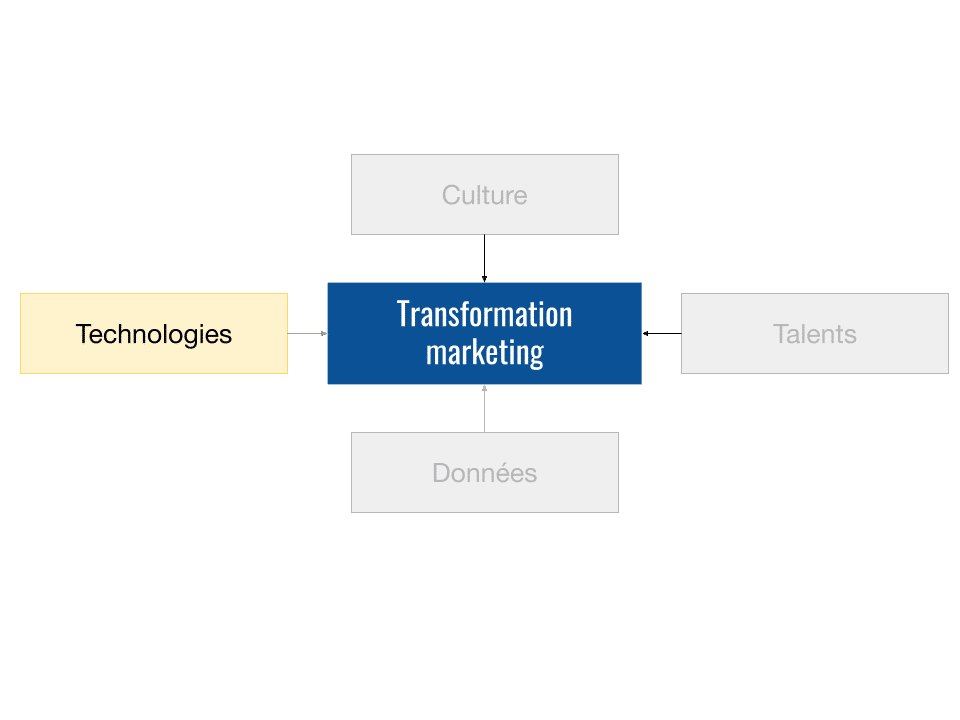
This article is the last in the series on marketing transformation and focuses on technologies that can support your data-driven marketing transformation. The targeted applications are:
- Measuring the performance of marketing activities
- Generating customer and consumer insights ;
- Using these insights :
- to acquire new customers and prospects
- to increase the value of current customers
- to retain high-value customers
- Personalization of the customer experience
Every marketer needs a 360 ° view of their customers to develop and execute an effective strategy. Obtaining such an overview requires the creation of a Marketing Customer Information File ( MCIF) which contains a list of relevant attributes to support the applications listed above.
Creating a 360 ° view of the consumer is not an idea born yesterday. This process has existed for more than twenty years through the marketing data marts that underpin the marketing campaigns of organizations. The growth of digital and the growing accessibility of cloud computing platforms have made it possible to accelerate this type of projects (through data unification). Data from multiple sources (usually existing in silos) must be identified, extracted, stored and analyzed to obtain this 360 ° view . They are then activated to generate value for the organization.
In today's business world, to be able to compete in the digital ecosystem, a technology solutions vendor must provide a platform and not a product (software). The platform differs from the product in that it allows services, functionalities and applications to be built around it, whereas a product generally delivers only one service (application). Platforms are characterized by a catalog of APIs which allow data to be exchanged with other systems or to build services or applications on top of the data in question (there are APIs for importing, exporting, activating, configuring, using ). In reality, all web giants started with products and over time turned them into platforms. As an example, a (non-exhaustive) list of vendors that have made this transition: Google Cloud Platform, Google Marketing Platform, Amazon Web Services, Azure (Microsoft), Adobe, Facebook, etc.
One of the key properties of a data platform is its ease of integration into your current ecosystem. Cloud computing technologies have greatly facilitated this type of integration.
According to Scott Brinker (chiefmartec.com), there are an estimated more than 7,000 Martech technology vendors in the current market. To better understand the role of these technologies, it is necessary to follow the life cycle of the data. This is made up of several phases:
- Collection or ingestion
- Storage
- Analysis
- activation or use
Each of these phases is supported by different types of technologies. It's clear that a single vendor can rarely cover all of an organization's marketing needs. The reality is that many organizations have multiple cloud solutions (combination of multiple Cloud or Martech platforms). It is possible, for example, to combine Adobe and Google, Azure and Google, Salesforce and Google, etc. The notion of best-of-breed often guides decisions regarding technological choices.
The table below is a summary of the types of technologies supporting the data lifecycle:
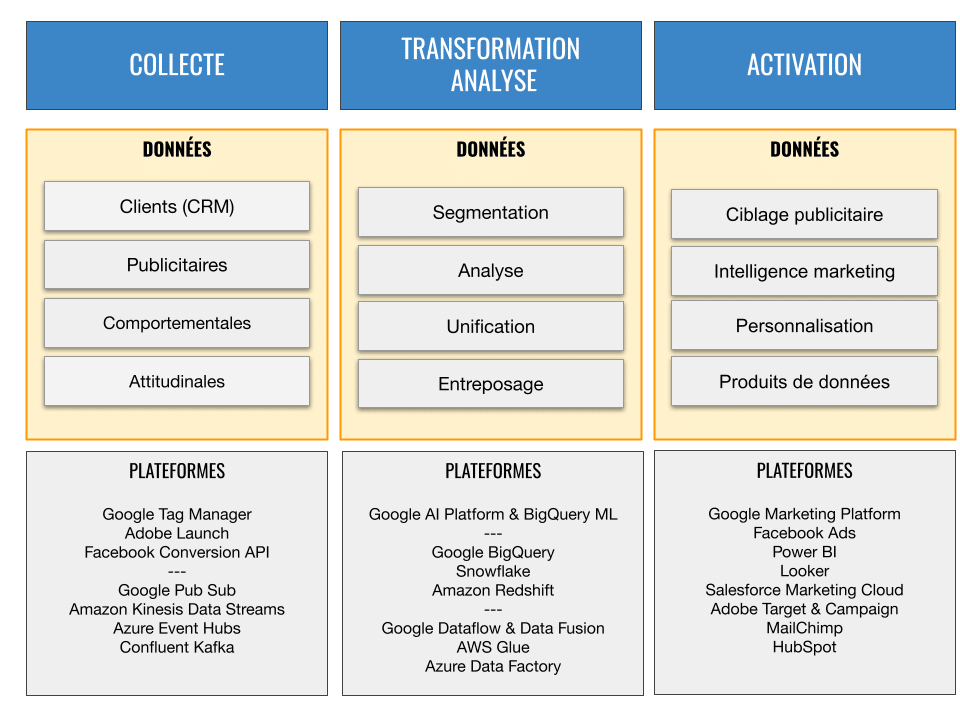
DATA COLLECTION AND INGESTION
Collecting and ingesting data begins the value chain. This step is supported by a measurement plan ( tracking ) that is aligned with the organization's business objectives. The key elements to be collected are identified.
There are two modes of data ingestion: the streaming technique and the batch uploads technique . Streaming is generally linked to the collection of events in real time, while the technique of batch uploads consists of uploading files (CSV, JSON, PARQUET, TXT) to the storage platforms at a predetermined frequency (hour, day , week, month).
A few platforms to keep in mind for this phase:
- Google Tag Manager (GTM) and Adobe Launch, which manage web and mobile event collection tags (focus on digital marketing and analytics);
- Google Cloud Pub/Sub, Azure Event Hubs, Confluent Kafka, Amazon Kinesis Data Streams, which are much closer to traditional event streaming (operational analytics and IoT);
- Supermetrics and Fivetran, for integrating advertising and marketing data into warehousing platforms;
- Google Dataflow and Datafusion, Azure Data Factory, and AWS Glue, which extract, transform, and upload (ETL) data to central repositories.
DATA WAREHOUSING
Storage of different internal and external data is necessary for unification purposes. Generally, unifying keys are required to build the customer's marketing profile. In terms of data warehousing, there are several types of architectures, the most popular being data warehouses, data lakes, and data lakehouses , which are a hybrid between a warehouse and a data lake. Data lakes are composed of unstructured data (images, videos, etc.), data warehouse is composed of structured and semi-structured data (transactions, customer profile, etc.) and data lakehouses can manage both data types.
The most popular data warehouses ( data cloud ) are:
- Google BigQuery, a product of Google;
- Snowflake, a platform that can install on Azure, AWS and Google Cloud;
- Amazon Redshift on AWS;
- Azure Synapse Analytics from Microsoft.
DATA ANALYSIS
This phase is critical in order to be able to transform data into business intelligence ( insights ). The main tasks in this section are to identify valuable customers, their behaviors, their socio-demographic attributes, and their needs and attitudes towards the brand. The end goal is to produce a 360 ° profile of the customer, comparable to the marketing profile of the customer. These profiles materialize into digital audiences that are then sent to advertising, email marketing and personalization platforms. Advanced analytics (predictive and prescriptive) are also used to predict events such as the likelihood of a prospect becoming a customer or a current customer buying again.
Some popular tools and languages for data analysis:
- SQL
- Python
- R
- Google BigQuery ML
- Fashion
DATA ACTIVATION
Value generation cannot be completed without data activation. The main applications of the data have been listed at the beginning of the article.
Here are some technologies supporting data activation:
- Visualization: Tableau, Power BI, Google Data Studio
- Advertising platforms: Google Ads, Display and Video 360, Facebook Ads, Linkedin Ads
- Email Marketing Platforms: Salesforce Marketing Cloud, MailChimp, Adobe Campaign, Klaviyo
- Experimentation and personalization platforms: Adobe Target, Google Optimize, Optimizely
Customer Data Platforms (CDPs)
Customer Data Platforms have been fashionable for a few years. They are touted by many vendors as a solution to all your data unification issues aimed at creating a 360 ° view of the customer (especially with the disappearance of third-party cookies). Some vendors go so far as to suggest that this tool could play the role of warehouse or data lake. Frankly, CDPs are not data warehouses and cannot replace a marketing data warehouse. Embark on a CDP initiative without a data strategy is a risky operation. Like all technologies, they require specific skills, a well-defined strategy and seasoned processes. Do not hesitate to contact the Adviso team to find out more about this.
GA4 and Google Bigquery: new opportunities
By making GA4's granular behavioral data (website and mobile app) available to marketers for free through its BigQuery cloud platform ( before GA4 , you had to spend $150,000 to access this data), Google positions itself as an accelerator of data-driven marketing transformation. Thus, many more organizations can now unify their digital data with internal primary data such as data from CRM, product catalog, call centers, customer feedback, etc. This strategy allows Google to place as a must-have in building a 360 ° view of the customer, essential for a successful digital transformation.
I hope you have enjoyed this series of articles. If you're wondering where to start to accelerate the construction of a 360 ° view of your customers, don't hesitate to contact us .
