

Cookie Apocalypse set the stage for new targeting offers
In a recent interview with AdExchanger, Chetna Bindra, who is Google’s group product manager for user, trust, privacy and transparency, made a statement that marketers should pay close attention to as we near the 2023 third-party cookie apocalypse on Chrome. According to Bindra, “We will not build workarounds for ourselves to continue to track individual people as they browse across the web”. That, still according to Bindra, includes not using Chrome user login data to power their ad platforms.
If that is the case, it means the trend toward blocking access to individual user data is really happening, and it will only intensify over the years. As such, marketers will have less and less options or alternatives to track users and connect them back directly to campaign performance data.
For now, Google offers audience creation alternatives through its FLoC and FLEDGE paradigms, which promises to use a depersonalized cohort-based approach to segmentation and targeting. But that too will probably change and evolve over time. New solutions like using server-side tracking with tag managers is another important mitigation technique to preserve user tracking. However, who knows how long this approach will remain viable. We might be just a few Safari or Chrome releases away from it becoming completely obsolete.
Therefore, it would be wise to not put all eggs in one basket. One safer way to move forward is to improve your own first party data capabilities. Another option is to think about performance measurement differently. Namely, one technique making a comeback these days is ‘media mix modeling’.
Diversify and hedge your risks with MMM
In essence, this approach has been around for decades to measure the global impact of channels like TV, Radio or OOH advertising on sales results. The core of it is using the predictive power of statistics to determine which channels have the most impact on your business results.
With the advent of digital marketing, companies have moved away from this approach in favour of direct attribution tracking methods. For each impression and click served, you know how many conversions can be directly attributed to your various campaign placements, right down to the user-level.
Naturally, the above measurement method is all based on a cookie world, more specifically the third party cookie. As the cookie disappears, this traditional digital marketing analytics framework will become less and less granular.
Furthermore, the scope of this attribution system is limited to the narrow contribution of your digital campaign conversions directly associated to specific clicks (and sometimes impressions). Under that regime, the majority of the credit will go to your low funnel placements, like remarketing or paid search.
By definition, that ignores the contribution of most of your other higher funnel brand marketing efforts, like Video/TV, D/OOH, Podcast/Radio or sponsored content. Yet, those are the placements that often take up most of your media plan budget. How can marketers show the value and contribution of those higher funnel prospection ads?
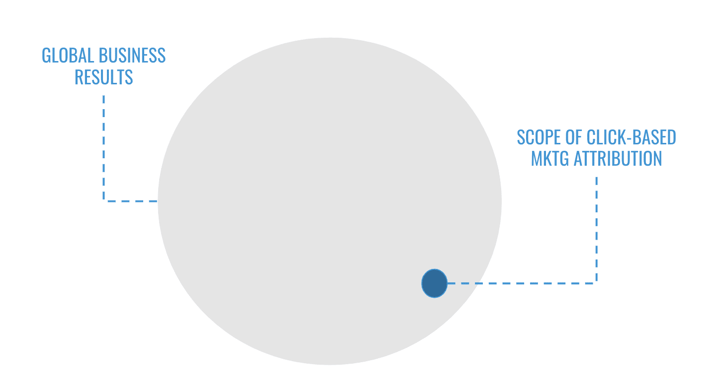
Opting for media mix models (MMM) can be a great way to highlight the value of your marketing strategy by reporting results that cover the global impact of your efforts. That is to say, instead of focusing solely on the narrow one-to-one tracking of one user-click to one user-conversion, you can broaden the scope and measure the overall impact of your campaigns on your overall business performance.
Instead of restricting the measurement to direct attribution on specific click conversions related to your campaign, MMM looks at how your overall advertising efforts contributed to an overall lift of sales or leads or transactions for your business.
In the process, MMM identifies which channels and which combinations of channels (thus the name media mix modeling) will have the most impact on your performance as a whole.
The methods often used in statistics for this technique are multiple regression models. However, with the advances in data science, new approaches are emerging, including more advanced machine learning techniques. Moreover, there is much more data available today for marketers to produce a powerful MMM.
Quality data sets are still a must-have with MMM
Ideally, creating a marketing data warehouse, lake or hub is an ideal way to collect data from various sources that can help you build solid models. But you don’t absolutely need a data warehouse to get started with this approach. Simply working with your reports from ad platforms, along with perhaps CRM or sales data, can allow you to produce viable results.
Moreover, your digital marketing and advertising data can be combined with external data such as search trends, Comscore reports, weather or economic statistics, etc.
If you want a cookie-proof way to continue showing and proving the impact of your marketing efforts in a scientific and time-proven way, you should definitely look into media mix modeling.
Visit our special section dedicated to the Cookie Apocalypse to learn more about it

How Many ($) Millions Are Hiding Under Your Marketing Data?
“Getting numbers is easy; getting numbers you can trust is hard!” – Ronny Kohavi, Head of Experimentation at Bing As one of the data scientists on my team once said, “Marketers need less technology and more data. But also, they need less data and more insights.” This simple statement paints a good picture of what has happened with digital marketing over the last decade. Gradually, over the years, we saw the focus shift from growing a large platform stack to developing better data exploitation capabilities for the existing stack. Naturally, a focus on data will lead to a focus on insights, which leads to actual business value. But the real question behind this evolution is, how did marketing tech stacks become so messy? The Rise and Fall of Platform Hoarders It all started in the early 2010s, when digital and analytics marketers — like myself, admittedly — were basking in the seminal stage of what I’d call the Platformer Age. This was the great technological revolution of digital market …
-2.png)
The coming erosion of your digital revenue
A shock wave is about to blow through the world of digital marketing It’s already been a year since major web publishers and the top web browsers, like Apple Safari, Google Chrome and even Mozilla Firefox, announced a significant change that will lead to major repercussions on marketing activities: the gradual abolition of third-party cookies and a reduction in the abilities of first-party cookies. This phenomenon has been referred to as the cookie apocalypse. What is a cookie? A cookie is a small text file that is copied to a user’s hard drive in order to identify them. There are two types of cookies: first-party cookies, which are generated by the servers of sites that are visited, and third-party cookies, which are generated by servers other than those of the visited site. While this may seem to be a very technical or abstract subject, cookies are actually indispensable to a large number of routine digital marketing activities, such as retargeting a user that viewed a product or ser …

6 steps to building a data strategy
A comprehensive data strategy is essential for guiding an organization’s transition to a data-driven culture. With the rise of analytics technologies and platforms, whether new or updated—such as data clouds, customer data platforms (CDPs), data clean rooms, etc.—it has become more important than ever to remember that a strong data strategy is foundational to all of your undertakings if you intend to become a data-focused business. The size of your company shouldn’t be an obstacle to having an effective data strategy. What’s important is not to rely on intuition alone to guide your business decisions. In this article, I’ll be addressing three classic questions about data strategy: what, why, and how. What is a data strategy? It’s crucial to distinguish a data strategy from mere operational planning. A data strategy is not: a list of analytics tools you are planning to acquire next year; the number of employees you hope to hire as part of your analytics team next year; or an arbitrary l …