
As mentioned by Jean-Philippe Gauthier (Head of Platforms and Digital Marketing Transformation at Google) during his interview with our co-founder Jean-François Renaud, 2021 is a transitional year for Google Analytics. It’s the year users of the current standard version will be asked to transition to the Google Analytics 4 version.
This will be a major change and probably one of the most important in the history of Google Analytics. Given this, and as we explained in our preceding article on the subject, we recommend that you not uninstall your current version, but instead activate GA4 in parallel, the reason being that this new iteration is still under development and therefore not quite on equal terms with the old version.
In a sense, this parallel activation could be thought of as what DJs call a wordplay transition technique. In simple terms, for a successful wordplay transition, a DJ must take a word or line of a song and use it in a successful mix into the next track.

In the context of Google Analytics, it’s about using the current configuration of your program as a reference point for the next implementation. This way it will be possible to compare the two instances and make adjustments while the old version is still online.
What are the incentives for implementing GA4 now?
For some, it’s tempting to say, “Why not wait until 2022 to implement GA4?” If that’s you, then here are four reasons to not be one of the procrastinators and instead get cracking as soon as possible.
#1 Better preparation for the cookie apocalypse
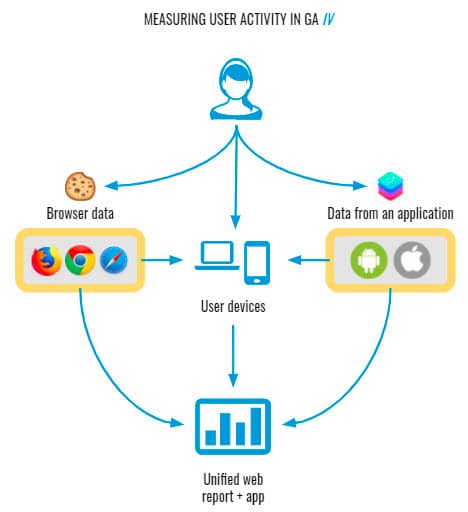
GA4 is not a solution that can directly mitigate the cookie apocalypse. However, the platform was created to make up for the measurement differences and disparities caused by the disappearance of third-party cookies and IDFA. According to Russell Ketchum, Group Product Manager at Google Analytics, the new version will use more and more machine learning to fill in the data gaps caused by the loss of cookies and IDFA. This is in part possible due to the unification of mobile and web data offered by GA4.
# 2 Enriched media audience creation
The unification of mobile and web data brings several advantages, including the possibility of creating audiences that are richer, more granular and more relevant for media targeting. Thanks to GA4, there are opportunities to develop an audience strategy that is not just more advanced, but multi-screen and multi-device. In an economic period when every marketing dollar counts and audience targeting is the lifeblood of media targeting, these functionalities shouldn’t be taken lightly. What’s more, based on all the audience creation options available with the new signal technology developed in GA4, the future looks very promising for marketers thirsty for more advanced segmentation.
#3 More in-depth marketing analytics and e-commerce reports
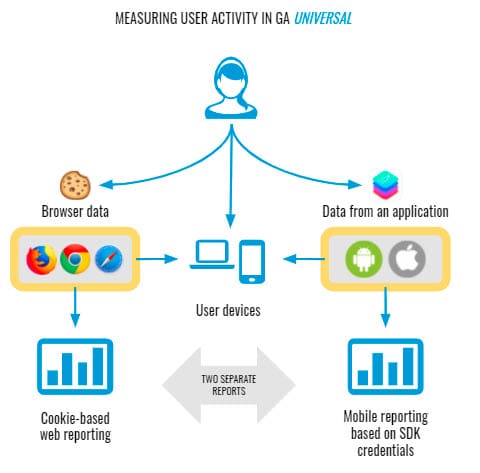
GA4’s approach in terms of performance reports has also be significantly overhauled. The new reports are more in-depth and real-time measurement is greatly improved. Also, the unification of webpage and mobile application data is a major change. This new paradigm will enable us to have an improved, unified understanding of the consumer within one single analytics platform. With the current version, you have to separate the analytics from the web and from your mobile application. This is an outdated approach in a world in which users interact with your brand on several devices and through various media (web + app). Furthermore, for those who haven’t read my article on the subject, remember that all raw data from GA4 can be exported free of charge to BigQuery. This option opens up immense opportunities for in-depth analytics on consumer behaviour, on both your website as well as your mobile app, and especially for the overlap of behaviour between the two.
# 4 A much more granular view of the customer funnel
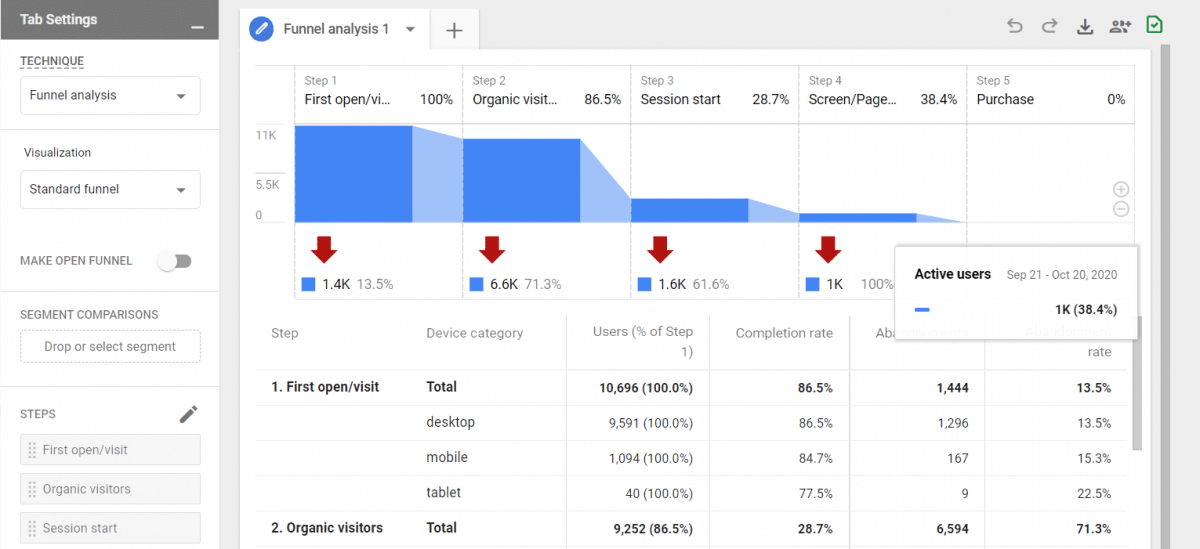
One of the most interesting functionalities of GA4 is the way in which funnel analyses have been reconsidered and remade. With the current version, funnel analysis is very limited and allows for very few personalized reports. In version 4, these reports are more like those of GA 360, the paid version. This means it’s possible to tailor-make a customer journey funnel that’s a lot more specific to the realities of your business. For those who, like me, are familiar with huge licensing and implementation fees associated with platforms specializing in customer journey analytics (such as C3 Metrics), this new functionality is very generous on the part of Google Analytics. But of course, there is probably a reason behind it. It’s likely that Google’s objective in providing this gift is to evolve clients into the paid version, or even to encourage them to invest more in their advertising platforms, given the integration possibilities between the two. On the other hand, for digital marketers that are already invested in the Google Ads platform, this means you will have improved abilities in advertising messages, targeting, segmentation, personalization and customer experience.
One precaution to consider before going any further
GA4 is without doubt the near future of analytics at Google. Waiting for 2022 before making the transition would mean a major delay in your performance measurement. However, GA4 is not just in beta mode, with all the shortcomings that implies, but the platform was created based on a completely new model for implementation and tagging.
That means it’s important to familiarize yourself with the technical subtleties of this new paradigm before making GA4 your main analytics platform. Your first step should be to create a solid transition plan and integrate it into your analytic road map.
Start with an audit and diagnostic of your current implementation in order to create an implementation strategy for the new platform.
If you have any questions or need help with either your audit or the creation of a parallel transition strategy between the standard version of GA and GA4, please don’t hesitate to get in touch with our analytics and data science team.
Visit our special section dedicated to the Cookie Apocalypse to learn more about it
