
Why the performance indicators you use will become unreliable
The challenge of the moment, with the apocalypse of cookies , is to fully understand the repercussions of such a transformation in the digital world. Today, we are going to take a closer look at its consequences on the measurement of data, what we call analytics . Get ready, you will have to question several performance indicators that you observe on a daily basis to measure your effectiveness!
We will therefore focus mainly on the repercussions of the cookie apocalypse on primary cookies. Unlike third-party cookies, which tend to disappear, primary cookies will remain relevant, but will experience major changes:
- the lifetime of primary cookies will be limited to 7 days (or even 24 hours in some cases) on the Safari browser;
- Cookies on Firefox will be deleted daily unless there has been user activity within 45 days.
CHANGES IN YOUR DAILY LIFE
What does this limited lifespan imply? In fact, this means that it will be difficult to recognize a user from one visit to another, which will have repercussions on two elements:
- multi-channel attribution of your consumers' journey across all of your digital marketing efforts and e-commerce activities in general;
- direct (or 1:1) measurement of overall performance on your Google or Adobe analytics platforms (i.e. post-click conversions).
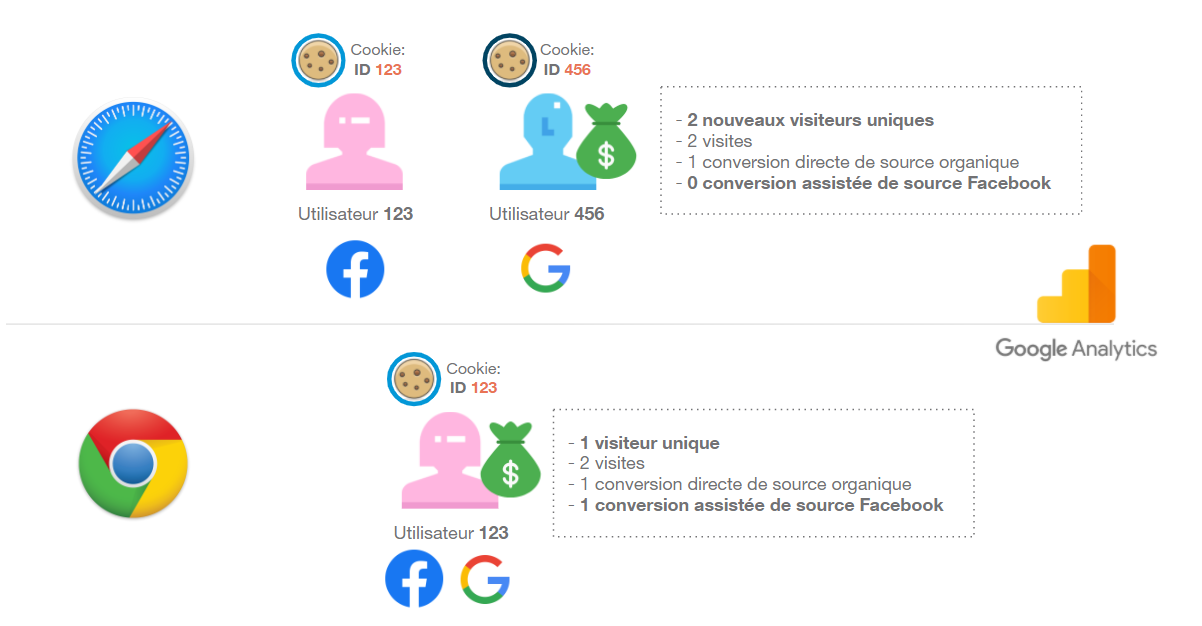
Let's take an example: Isabelle arrives on the site www.monsite.com from a Facebook ad, browses a bit, then leaves the site. She returns there nine days later in organic search to finally make a purchase there.

That's what happens in real life, but what about data collection?
- Day 1: A user 123 is identified, a visit originating from a Facebook campaign is recorded.
- Day 9: A new user 456 is identified, a visit from organic search and a conversion is recorded.
The following data will therefore be counted in Google Analytics, depending on whether Isabelle uses the Google Chrome or Safari browser.
Safari having its limits regarding the lifetime of primary cookies, this has an influence on the following indicators:
- Number of unique visitors
- Number of new visitors
- Number of Assisted Conversions
- Distribution of attributed direct conversions by channel.
- Acquisition cost
-
You get the idea? Now ask yourself these questions when looking at the data:
- Is the volume of new visitors real? You may not have acquired as many new users as you think.
- Are the conversions attributed by channel representative of reality? A declining conversion rate does not necessarily indicate poorer performance!
- Are your CPA and your ROAS representative of reality if you only observe them from the Google Analytics or Google Ads platform? On paper, costs do increase when looking at direct ( last click ) conversions and assisted conversions, but direct last click conversions alone remain the same.
These are reflections to integrate into your daily life before sharing any data related to the performance of your marketing activities. The cookie apocalypse is also affecting all content optimization and personalization activities. Your thoughts on A/B test results should also take this into account. You can also learn more by reading the article written by my colleague Nicolas Duval.
THE FUTURE OF PERFORMANCE MEASUREMENT
What to do in the short term?
- In your reports, consider the margin of error of your analyzes based on the proportion of your traffic that comes from Safari and Firefox.
- Avoid cross-referencing or comparing primary clicks or conversions data in Google or Adobe Analytics with that of your Adtech platforms, which depend on a third party. The margin of error will only increase.
- In Google or Adobe Analytics, consider the margin of error in customer journey analysis, based on the percentage of traffic coming from Safari and Firefox.
- Note that if you add UTM parameters in your campaigns, the lifetime of primary cookies in Safari will be 24 hours instead of 7 days.
- Exclude the Safari browser from your testing experiences (A/B, MVT).
In the longer term, a lot of things are changing and falling into place. The watchword for 2021: adapt! Whether in terms of platforms, processes or people, we will have to be flexible to deal with this upheaval.
PERFORMANCE ANALYSIS WITH GA4, BIGQUERY AND MMM
Google is developing a platform called GA4. With GA4, Google democratizes the analysis of large datasets with the integration of BigQuery. Companies will be able to export their GA4 data to BigQuery for free to perform advanced analyses, or even enrich their CRM data before pushing it to other platforms. To learn more about 4 good reasons to activate GA4 in 2021, it's here ! As far as we know, the new version will increasingly use machine learning to compensate for data gaps caused by the possible disappearance of cookies and IDFAs.
Another trend seen in the industry is the return to statistical inference models ( The Drum & Parker , 2020). More specifically, it is the return of one of the methods most used by marketers before the digital era: marketing mix modeling (MMM). Instead of analyzing the performance of digital media campaigns in silos, it's about analyzing the impact of all marketing activities on sales, both online and offline. As the organization matures from the point of view of data use, it is also possible to add other internal and external factors to have an even more complete view (weather, price indices competition, etc.).
DOWNLOAD OUR PREPARATORY GUIDE TO THE COOKIE APOCALYPSE
WHERE TO START TO PROPERLY MEASURE PERFORMANCE IN 2021?
To navigate this changing industry and enable reliable and robust modeling, it is necessary to properly integrate the tagging platforms to capture a maximum of data points that feed the models of the different platforms.
In order to limit the loss of data captured by your media or analytics platforms on the client side (on the web page), "new" (or old 😉 ) methods for integrating pixels and other tracers are coming back into fashion: we are talking here about server side tracking. Google Tag Manager now allows its server-side integration to enable new tracking methods that are more robust than those on the client side (Google, 2021). Please note that server-side tracing does not give you the right to override legal regulations in terms of managing user data. This type of integration will however prove necessary for a good number of organizations, both from the point of view of measurement and audience creation, because it will make it possible to play on the window of the limited lifespan. for primary cookies.
Finally, we can also maximize the collection of primary data by identifying users who have an online account. User data platforms (CDP) will be more and more interesting to exploit. It might therefore be wise to put efforts in place to build a solid user database.
TRAINING AT THE CENTER OF THE HUMAN
Who says new platforms, new technologies and new processes also says training. Indeed, it will be essential to invest in the training of the people who are at the heart of your marketing activities in order to be able to continue to move forward with confidence in your next initiatives.
These people (you!) will first have to:
- fully understand the challenges of the cookie apocalypse to ensure that you control the use of current data;
- adapt as of today the actions which are posed on the marketing activities;
- think about the medium and long term strategies that could be put in place within the company – GA4, BigQuery, CDP, MMM and so on.
SO WHAT DO WE DO?
Perfect solutions do not exist, or at least not yet. On the other hand, it is important, above all, to understand the changes that affect measurement and to adapt our data analysis according to the new rules of the game. We must therefore constantly adapt and continue to show ingenuity to optimize our marketing tactics.
We are currently experiencing great upheavals. This is a golden opportunity to get ahead and create a competitive advantage. Like what, even in the storm, it is possible to stand out.
Visit our special section dedicated to the Cookie Apocalypse to learn more about it
Expertises évoquées
(SizeLimitingPyList: [Data Science & AI Marketing, Analytics & Tracking, How-To])TechHow-ToBusinessBusiness StrategyPaid Media & SEMAnalytics & TrackingClient experience & UXContent & SEOSocial MediaInnovationDigital transformationE-commerceData Science & AI MarketingAdvisoOpinionsArtificial Intelligence MarketingSeriesCustomer-centric marketingContentProject ManagementUnderstand the impactsAcquiring durable audiencesEmail marketingGDPRAI MarketingCookie ApocalypsePersonalizing the customer experienceRaise awarenessCreating a value exchange programMarTechMarketing AutomationMeasuring and optimizing initiativesPrivate: Cookie ApocalypseBrandingFacebook AnalyticsLoyaltyOne-on-oneCOMMERCECtrl+A | A Podcast About Digital StrategyFacebook AnalyticsFind solutionsInnovationInsiderSecret weaponsTHOMA DANEAUWebinars
You May Also Like
These Related Stories

Why marketer should go back to media mix modeling (AKA MMM)
Cookie Apocalypse set the stage for new targeting offers In a recent interview with AdExchanger, Chetna Bindra, who is Google’s group product manager for user, trust, privacy and transparency, made a statement that marketers should pay close attention to as we near the 2023 third-party cookie apocalypse on Chrome. According to Bindra, “We will not build workarounds for ourselves to continue to track individual people as they browse across the web”. That, still according to Bindra, includes not using Chrome user login data to power their ad platforms. If that is the case, it means the trend toward blocking access to individual user data is really happening, and it will only intensify over the years. As such, marketers will have less and less options or alternatives to track users and connect them back directly to campaign performance data. For now, Google offers audience creation alternatives through its FLoC and FLEDGE paradigms, which promises to use a depersonalized cohort-based appr …

How to ensure a successful transition toward Google Analytics 4?
The world of Google Analytics is about to enter a new era. The free version you’re currently using is on the edge of being replaced by Google Analytics 4 (GA4), formerly known as App+Web. It’s important to grasp the magnitude of this shift, because it’s the biggest transformation ever made to the platform. Rest assured: for the time being, the move to GA4 is strongly recommended, but not required. But once you make the shift, there’s no going back. As a result, marketing and e-commerce teams that rely on data from Google Analytics on a daily basis to measure their business performance need to be sure they have a sound transition plan in place before flipping the switch. For users of the paid 360 version, know that a paid version of GA4 is also coming – though details on this version won’t be forthcoming before 2021. For everyone else, in other words the vast majority of Google Analytics users, you’ll want to start preparing for the adoption of a new measurement paradigm immediately. A …

Demystifying Server-Side Data Tracking: Google Tag Manager Server-Side and Facebook Conversions API
In recent weeks, I have received several questions related to server-side tracking from some of our clients. In this blog post, I will try to demystify this technical concept. The plain truth is that with the end of third-party cookies, the shortened lifespan of first-party cookies (on Safari) and the increased need for privacy, decision makers are becoming more concerned about the accuracy of their advertising data. The release of Google Tag Manager Server-Side and Facebook Conversion API have piqued the curiosity of many marketers.
Repérer et valoriser ce qui compte vraiment.
Recevez nos analyses et conseils pour rester à l’avant-garde du numérique.