
Tools for analysing digital performance are multiplying, and the data we have access to is increasingly vast and complex #bigdata. It used to be that access to this data was reserved to an elite few who had mastered the technology within which the data was held captive. But today, measuring our activities is practically a necessity for survival, and it has never been easier to collect data, especially on the Internet.
But what use is data without understanding? What’s the point of having thousands – even billions – of rows in a database if you can’t make them speak? Today, pulling insights from this data is almost more important than knowing how to collect it. A new career path has even emerged… The famous data scientist!
Not everyone needs an airplane to get to work in the morning. A car, or even a bike, depending on your distance and means, would largely suffice. When you think about it, it would actually be fairly ridiculous to take a plane to go 2 km! The same logic applies to visualization solutions. The market for these products is huge, and has become more and more accessible over the past few years. It encompasses many players, each with their own particularities in terms of functionality, limitations, and of course cost – some tools can cost upwards of several hundred thousand dollars. One of the fastest growing markets right now is unquestionably made up of organizations without the budget, the skill or the time to really benefit from a high-end dashboarding tool.
“NOT EVERYONE NEEDS A PLANE TO GET TO WORK IN THE MORNING. »
This does not mean that you have to be approximate or inexact. You just have to find a shoe that fits. The market is now beginning to make visualization solutions available to small organizations that cannot afford a team of elite analysts and developers to take care of their data visualization.
These organizations need simple and accessible solutions at low cost. This is the philosophy that Google put forward when launching Data Studio Standard and Data Studio 360 :
“ ONE OF THE FUNDAMENTAL IDEAS BEHIND DATA STUDIO IS THAT DATA SHOULD BE EASILY ACCESSIBLE TO ANYONE IN AN ORGANIZATION. WE BELIEVE THAT AS MORE PEOPLE HAVE ACCESS TO DATA, BETTER DECISIONS WILL BE MADE. »
In this regard, one of Data Studio's direct competitors is Microsoft's Power BI tool , the result of the acquisition of Datazen Software by Microsoft in April 2014 .
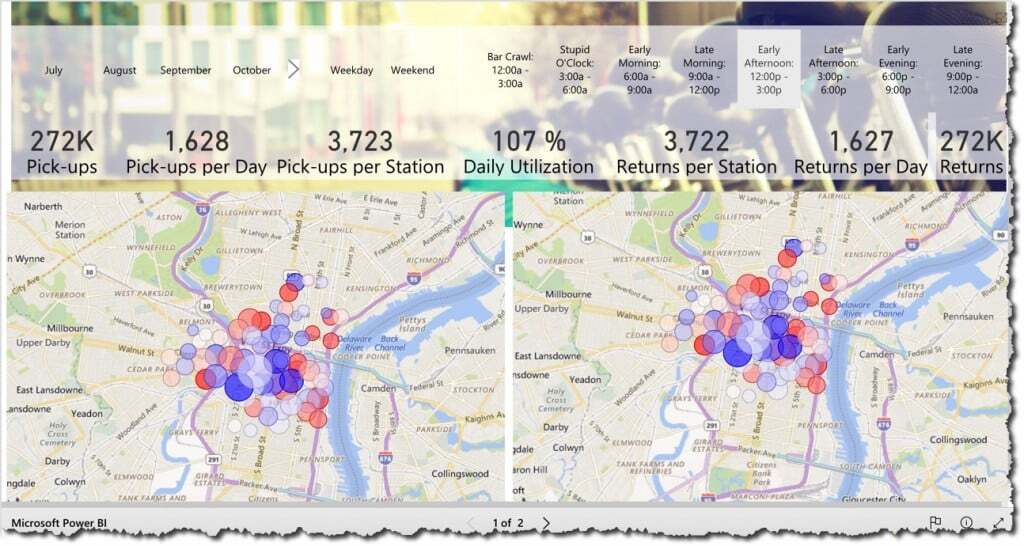
With the launch of Data Studio 360 announced in March 2016 , Google is now playing in the court of data visualization tool providers. But does Data Studio really compete with Microsoft Power BI? At present, a strict comparison would be biased, if not impossible, due to the fact that Power BI is an established tool while Google Data Studio is just out of Beta. Let's do the exercise anyway.
VARIETY OF CONNECTORS
In terms of accessible connectors, Power BI offers a much wider range than Google Data Studio. On the other hand, the fact that most of the connectors with Google products — including Google Sheet, the Excel equivalent of the Google office suite — are accessible with Data Studio is a real strength, especially when you see the omnipresence of Google Analytics. able and Google Adwords in advertising for a majority of sites.
EASE OF USE AND COLLABORATIVE WORK
Another point that sets Google Data Studio apart is its ease of use and its clean interface, always in the spirit of making data accessible to as many people as possible. The possibility of working simultaneously on the same dashboard is appreciable and offers the same advantages as the Drive office suite (Sheet / Slides / Docs / Forms).
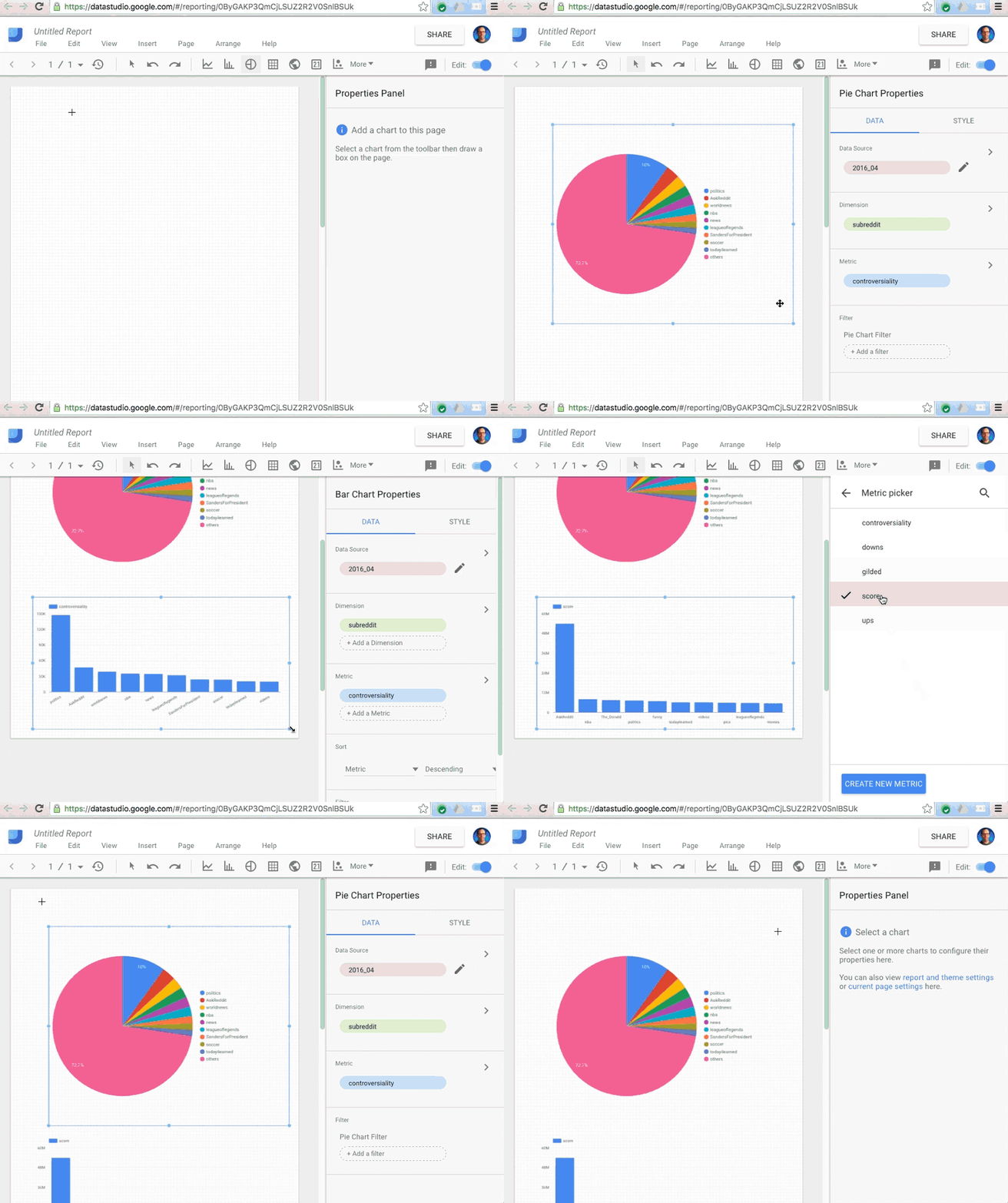
TWO VERY DIFFERENT DNAS, TWO VERY DIFFERENT PHILOSOPHIES
The major difference between the two tools, apart from the DNA of the parent company that transpires for each product, is that Google Data Studio is clearly positioned as a cloud-type tool. Power BI is available in three distinct tools (Power BI desktop, Power BI mobile and the Cloud version Power BI embedded) while Data Studio only presents itself on the Cloud. Google has even taken this philosophy of rejecting classic reporting to the point of not offering data export in Data Studio , with the aim of encouraging its users to consume dynamic rather than static data. Finally, Power Bi charges its users for the weight of data they use (the free version of the tool allows the use of up to 1 GB of data) while Data Studio has chosen to limit its users in its version standard (free) to 5 dashboards per user account (the paid version up to 1000 dashboards per user).
In Conclusion
Though it still has a way to go, Data Studio 360 seems like a promising solution. Here, we are witnessing the emergence of a new Google/Microsoft duel. Each tool is strongly influenced by the guiding principles of its parent company – and supported by a horde of loyal fans! While both tools serve a purpose, I’m sure you can guess which one we would shelve. 😉
The free version of Data Studio is now available to the public. Although it’s not quite there yet, new additions will quickly bring this product to maturity. We can’t wait!
