
Geolocation has been a major issue in any retail web strategy for 3 years, the objective is to be present on any type of platform within a radius of less than one kilometer from where your customer is. The main initiator is Google. On the one hand with its algorithm which relies more on the geographical positioning of a user in the personalization of search results, on the other hand in the greater consideration of Google Places in the search results (SERP). These two elements combined mean that organic SEO strategies must be refined by city, by neighborhood, by street. Proud owners of smart phones (with GPS) search by proximity and use applications with the geolocation function in their daily lives. For the past 24 months, geosocial applications have abounded and a cold war seems to be emerging between Gowalla, Foursquare and Facebook Places.
MULTIPLE CHECK-IN, CENTRALIZATION AND SHORTNESS OF BREATH
A year ago, I pompously announced that Foursquare was going to dominate the geosocialization market due to the uniqueness of its offer and its potential revenue model. Christophe had also drawn up an excellent balance sheet and mentioned a few business opportunities. A year later, I change my mind. Even if I use Foursquare several times a day to do my check-ins or to meet my friends, even if TechCrunch told us that Foursquare has reached 5 million users , and this in just under 24 months (21) , I am far from convinced of its long-term sustainability.
And now, last August, Facebook launched its Places service and the creation of an API for sharing check-in information with Gowalla, Foursquare and Yelp, but remains available in read-only mode. We were therefore witnessing a real democratization of geosocial with 500 million members questioned by Places updates in their news feed. According to Mobclix's ranking of applications for social networks, Facebook's mobile application ranks first among downloaded applications, ahead of Foursquare (14th) and far ahead of Gowalla (61st). An enviable critical mass that easily exceeds 5 million Foursquare users. Facebook Deals are introduced in early November and we will soon witness a full integration of Place entries into Facebook pages, all to make other players less interesting.
Also, the playfulness of Foursquare and Gowalla seems to be running out of steam. When a user checks in, he announces to his friends where he is or he affirms his social status. When he is in discovery mode, he looks for his friends nearby or consults their recommendations (tips and activities to do). On the other hand, a check-in on Facebook Places satisfies the same desire with a greater mass of “friends”: one (or even several) “likes” or comments are worth more in the eyes of a person than a town hall. Only the recommendations (tips) and activities (to do) are not present which does not promote discovery, but I imagine it is a matter of time before it is added.
To complete, on December 2, the new version of Gowalla (v3) allows the synchronization of its updates (check-in, recommendations, promotion, town hall) with those of Facebook Places and Foursquare, now asserting itself as the place gathering all its geosocial presences. After multiple tests, Gowalla does not completely synchronize the check-in but adds a virtual “come” when the spelling is not the same. We just wonder if Foursquare or even Facebook Places will return the favor. However, this news encourages followers of the 3 geosocial networks to centralize everything on its platform.
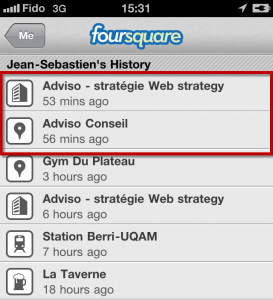
Finally, the behavior linked to the need to check-in, being the only one too connected in my group of friends, it becomes unpleasant for normal people (or non-innovators) to see his friend check-in or multiple check-ins (sometimes 3 at a time in my case), share their meal on Foodspotting or uncork a bottle of wine on Social Grapes . Normal people see it as a new form of mental illness where the desire to share everything in public and the desire for approval from virtual peers is more important to an individual than those sitting in front of him or else he experiences a feeling of emptiness in his life. I admit it I'm like that and I do my bathroom updates, it's my #Thursdayconfession.
ALTERNATIVE USES
BE A DECISION SUPPORT TOOL
The next line of battle will be recommendations , we want to take ownership of Yelp's preserves and develop as a local decision-making tool. On the other hand, Yelp has built its own network using Facebook connect and integration with Place may be possible.
BE A SAVINGS TOOL
With the excessive proliferation of group purchasing sites (see the excellent post in English by Marc-Antoine on this subject) and their local offer, one can imagine a fairly natural link between the two entities. Promotions may be offered for a limited time to people who check-in and are members of a network.
Image credits: http://gadgetsin.com/google-map-pins-coaster-set.htm