
Marketing automation tends to become more democratic as we see more and more Quebec companies adopting such tools. In the learning curve of automation platforms comes at some point the ability to apply sound data management so that they are used properly. This is how companies really get value out of their marketing automation efforts.
Today I'm discussing a few topics related to marketing automation and data. In the era of Big Data and all these buzzwords , a concept that is too often underestimated is the importance of having relevant data to take action on rather than simply having a quantity of data. It is with the idea that quality is more important than quantity in the context of marketing automation, that it becomes important to capture the right data and centralize it in order to be able to create good triggers.
1) CAPTURE THE RIGHT DATA AND MAKE IT ACTIONABLE
In developing a marketing automation plan, context is one of the most important things to consider. This is why we start such a plan by mapping the customer experience. This mapping highlights the important life moments on which there is an opportunity for automation and it is with the help of this that we can identify the actions to be automated, and, at the same time, the data to be collected. to be used as a trigger. To learn more about triggers, you can refer to the article that my colleague Robin wrote recently.
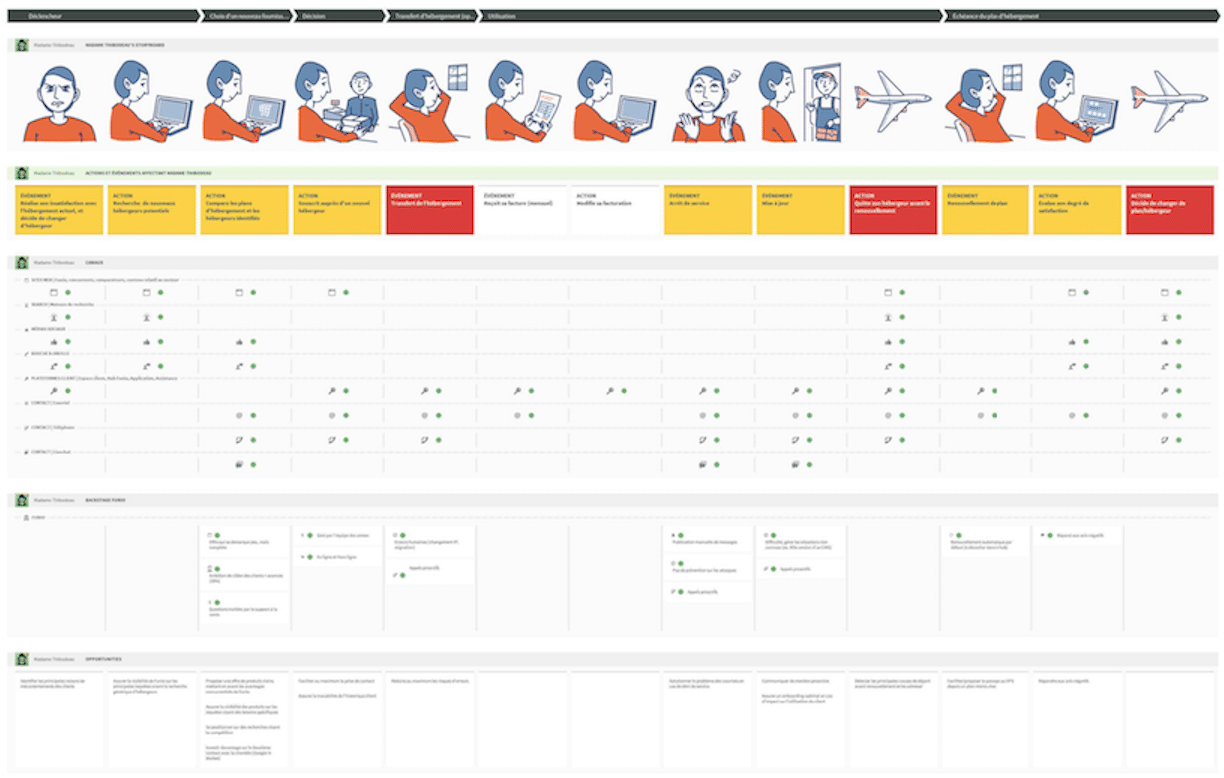
EXAMPLE OF A CUSTOMER EXPERIENCE MAP
So, if mapping the customer experience allows us to make sure we identify the right moments in life and thus capture the right data, we still have to make it easily accessible. To easily take action on good triggers, it is often necessary to bring out the information at the CRM level. Why CRM? Because it is the ideal place on which a marketing automation tool will draw data allowing the triggering of action based on user behavior.
For example, you are asked to trigger an automation if a user has not logged in to your website in the last 30 days. If the date of the last connection dates back to the CRM level, it is very easy to create an automation using this data. On the other hand, if this information remains hidden somewhere in the logs, then we are not able to draw the full potential of the data that we already have since the efforts to bring out this data each time we need it become prohibitive.
With the omnipresence of analytical tools such as Google Analytics, the challenge is therefore rarely the creation of data, but rather its accessibility. By identifying the data relevant to automation processes, we can store this data in the right places and build powerful processes with a minimum of effort.
This is why it is necessary to know how to capture and properly disseminate information in the relevant systems. It is by aligning your analytical plan and your automation strategy that you can increase the relevance of your communications while reducing the effort required to get there.
2) DATA CENTRALIZATION
Consumers often interact with brands in multiple ways. For example, it is not uncommon for a consumer to visit a brand's website, interact on social media and subscribe to the newsletter. To make automated communication more relevant, it is essential to centralize all these digital touchpoints which, let us emphasize, brands have somewhere without necessarily benefiting from them.
By using a centralized database, one has access to a wealth of information that gives a more complete picture of the customer-brand relationship. For example, rather than simply segmenting customers based on in-store purchases, one could instead do this segmentation also using non-purchase data which often says a lot about the consumer. So you might decide to create different automations for your best customers and your most engaged customers.
These data centralization tools are now readily available and there are a host of tools out there to help you get there with minimal effort. Among these tools, we can highlight Stitch Data which allows you to consolidate data from several sources or Segment which allows you to unify the data distributed in your marketing stack.
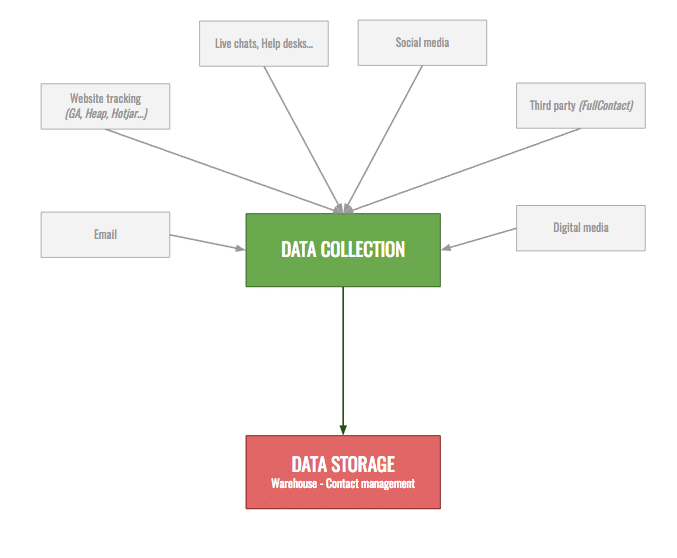
Of course, it's not always so easy to centralize information from different systems in your marketing stack. It is for this reason that we recommend favoring platforms that integrate well with each other rather than platforms with very specific characteristics. This article on the safest way to choose your marketing automation platform goes into more detail on this important aspect of martech architecture design.
3) CREATING COMPOUND TRIGGERS
Triggers are actions that start an automation process. A trigger can be as simple as visiting a pricing page that follows up with a B2B prospect, or a reminder when a visitor leaves with an abandoned shopping cart. These two triggers are called simple triggers. They are said to be simple since they require no adaptation and can be used as is.
There is a second family of triggers that are called compounds. The fundamental difference with compound triggers is that you must first create them in order to use them. Take for example a trigger often used in B2B situations, lead scoring. In this context, each prospect gets a score based on the type of interaction with the company and other key variables.
To obtain this score, we must perform a calculation and create this trigger from scratch based on the available data. More specifically, if I want to give a score that assesses the chances that a prospect will make a purchase in the next month, I can build a prediction model. To feed this model, I will need data such as the number of visits in the last month, the opening rate of newsletters, etc.
Only companies that are successful in taking control of their data will succeed in putting together compound triggers. Obviously, these triggers are more difficult to set up because of the fact that you have to link the analytical plan to the automation strategy. However, it is this type of trigger that will allow you to increase your relevance in your marketing automation efforts and that can help you increase your conversion rates.
The bottom line, then, is that marketing automation is highly dependent on your data and analytics skills.
The more you develop these capabilities, the more creative approaches you will be able to use in your automation campaigns. Take no risk and involve your analytical specialists early in your automation projects in order to extract the maximum return.
