
Following up on my colleague's article about the cookie apocalypse , I wanted to kickstart the discussion by addressing the cookie apocalypse and IDFAs from the perspective of digital measurement tools.
The cookie and IDFA apocalypse
A quick reminder of what we refer to as the cookie apocalypse: This refers to all the new web browser features that cut cookie lifespan to increase user privacy. Through its ITP feature, Apple was one of the promoters of this new trend. ITP 2.2 had a significant impact on advertisers; and web and optimization platforms because it affected the lifespan of first-party cookies (cutting it to one day). Google also announced in mid-January 2020 that it was planning to render third-party cookies obsolete by 2022. On the mobile front, in June 2020 Apple announced that users of iOS 14 will decide whether to allow apps to collect the IDFA (expected release in early 2021). To make it simple, first-party cookies (web) and IDFA (Apple mobile OS) are used for user identification in the digital measurement discipline.
Business impact
Does this growing trend affect your business? If you are a data-driven marketer or digital analyst you should definitely pay close attention to it. (By the way, many experts in the field predicted this trend a few years ago.) Without first-party cookies and the IDFA, measuring users becomes difficult.
The biggest effects of these changes are on the attribution of your digital marketing dollars. Is the volume of transactions attributed to Direct traffic in your web analytics platform really accurate? Or should 30% of this volume be credited to a Paid channel?
Being able to accurately calculate your return on ad spend (ROAS) is an important element of performance measurement. ROAS is a key metric for gaining efficiencies in your marketing operations.
We should remember that ITP2 affects Safari browsers and IDFA Apple phones. It is important to assess the size of the impact, since having 5% of your traffic coming from Safari versus 50% isn’t the same thing. With iOS dominating the mobile operating system market in some countries, it is clear that the IDFA announcement will have some effect but we won’t know exactly what until a few months’ time. Based on this assessment, you should update your digital measurement strategy to address these challenges.
Current solutions to mitigate the effects of ITP and the IDFA apocalypse
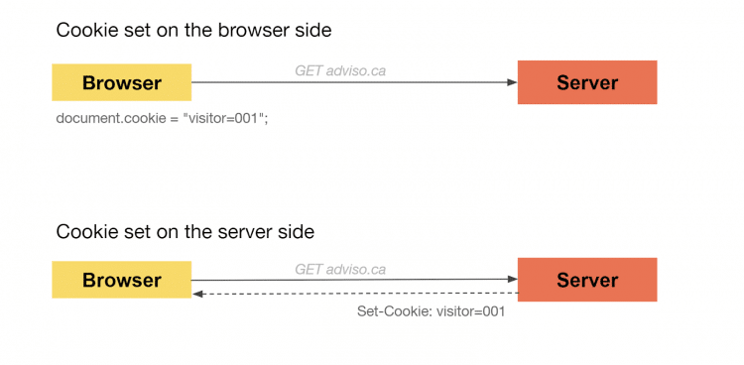
Cookies can be created on the client side (originating from a web browser) using JavaScript (a web development language) or on the server side (originating from a web server). Most modern web analytics platforms use a JavaScript methodology to track users. At the time of writing the ITP feature does not affect HTTP cookies set by a web server, but it does impact those created on the browser side using JavaScript (see above graph). One of the most reliable techniques to mitigate the effects of ITP 2.2 and 2.3 involves setting up server-side cookies (that is, managing cookies on the server side). This solution can be custom made or it can leverage a feature offered by some of the popular digital analytics platform vendors.
Google has released Google Tag Manager Server-Side with server-managed client identification, which is basically a first-party cookie managed on the server side. Adobe Analytics recommends the use of its custom solution (CNAME). Some analytics implementations are done on the server side, basically building all the tracking infrastructure on the server side.
In light of the IDFA apocalypse, mobile measurement platforms are migrating to a probabilistic approach to marketing campaign attribution. Kochava and Appsflyer have released some announcements on the subject. Apple has released its SKAdNetwork framework to help with campaign attribution.
If you feel that you need guidance on how to navigate around these challenges, don’t hesitate to contact our analytics and data science team.
