
The need for faster time to insight activation
In my previous article on actionable digital insights (i.e., digital marketing intelligence/insights), I focused a lot on insights vs. raw data. The aim was to show that data without context is meaningless. Data is valuable only once it has been transformed and put into a business context for the end user or key stakeholder. Usually, turning raw data into actionable insights isn’t a simple process (or a quick one).
Let’s use an oversimplified and exaggerated example to illustrate the potential impact of Augmented Analytics on your business:
It takes, today, five to six months for company C (fictional name) to produce good insights. The process of generating insights goes as follows:
- Data collection and validation
- Data analysis to find opportunities (insights)
- Delivery of insights to key stakeholders (Marketing and Product teams)
- Activation of insights (the action)
Let’s assume that the action taken based on these insights (integration of the findings into business processes) brings a 3% lift ($10,000) to the company’s bottom line.
Based on this process (five to six months to generate an actionable insight), you can plan for one or two opportunities during the fiscal year to use insights to impact your business (potential opportunity: 2 x $10,000 per year = $20,000).
Imagine, for one second, that you could optimize the same process to bring the cycle of insight production from five to six months to one to two months. This would mean having five to ten opportunities over the fiscal year to impact your business (potential opportunity: 10 x $10,000 per year = $100,000).
Based on this new scenario, the impact of your analytics initiatives would be amplified within your organization (faster ROI).
Here comes Augmented Analytics
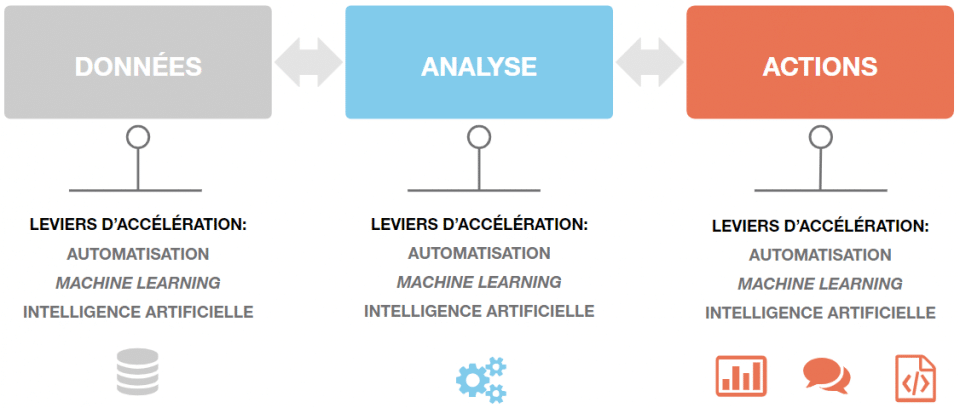
Gartner introduced this concept in 2017; in a nutshell, Augmented Analytics is the use of technology (automation, machine learning and artificial intelligence/AI) to accelerate the production of insights and adoption of analytics:
- Data collection activities (accelerate the process using automation, machine learning and AI to improve data quality)
- Analysis activities (accelerate the process using machine learning and AI to find patterns and correlations)
- Activation activities (accelerate the process using machine learning and AI to help make the insight actionable and digestible based on y
- our business context)
Already, some vendors are integrating some of these components into their platforms. There is no doubt that Augmented Analytics will impact our practice; in a digital world it is easier to collect data and automate processes, or run machine learning algorithms (based on a high volume of data collected).
With the prominence and ubiquity of cloud data warehousing solutions (Google BigQuery, Amazon Redshift, Azure Synapse formerly known as Azure SQL Data warehouse) and other real-time or near real-time data collection platforms (Amazon Kinesis, Google Pub/Sub, Azure Event Hubs & Azure Stream Analytics, Google Analytics, Adobe Analytics, Segment, mParticle), the new race to quickly find actionable insights through terabytes of collected data is on!
The rise of AI and machine learning creates a unique opportunity to put these data technologies at the service of insight generation.
Augmented Analytics won’t replace traditional data analysts, but it will enable them to reach the insights they are looking for faster, and consequently impact not only your digital performance but your business performance.
Imagine a world of digital analytics where an algorithm using text, voice, images or all three mediums together can tell your data, marketing, business or finance analysts what two factors are impacting your website’s conversion rate. It may sound crazy, but that is the aim and end goal of Augmented Analytics.
Within an extremely competitive business environment, companies that are able to integrate insights seamlessly and quickly into their business processes will gain a significant edge over their competitors (concept developed originally by Thomas H. Davenport). The power of analytics at the service of business process optimizations (business performance-driven analytics).
I personally see Augmented Analytics as a journey (focus on the vision then build your analytics roadmap). You basically need to understand your analytics maturity level today then build a roadmap to achieve your analytics goals (future state). You can start by taking baby steps, for instance focusing only on data quality (the next two to three months), performance measurement or insight generation (the rest of the year), etc.
Our team of marketing analytics experts can help you take these baby steps towards your final destination.
