
Do you already use Google Analytics 4 but find that your analytics questions are becoming increasingly complex and more strategic? Learn how Adobe Customer Journey Analytics (CJA) lets you take things a step further by providing an omnichannel view of the customer journey.
Google Analytics 4: The leading behavioural solution
Google Analytics 4 is a platform that has been widely adopted by companies of all sizes. It's a powerful solution for understanding user behaviour on the web and mobile applications. It lets you collect data, build reports, and make decisions based on digital behaviour. It's an affordable or even free solution for regular use cases.
But as customer journeys become more complex—fragmented between channels, points of contact, platforms, and devices—some organizations are feeling the need to go further. For example, they may want to:
- Unify data from multiple sources (CRM, in-store sales, customer support, etc.)
- Track a user across several sessions, devices, or environments
- Understand behaviour spread out over several months
- Answer strategic questions about the entire customer lifecycle
- Go beyond the quotas, sampling, or limitations of standard reporting
It's becoming clear that while GA4 is robust, it has limitations when it comes to covering all of the more advanced scenarios. Adobe CJA can be used in a complementary way alongside GA4 to fulfill the needs of larger companies.
Why change now?
Expectations for analytics are quickly evolving. Regulatory compliance (such as with Law 25), the pressure to generate actionable insights, and the increasing complexity of user journeys are presenting new challenges.
Here's why many teams are changing their strategy:
- Conversion time lags are getting longer, beyond the standard attribution windows
- Data are distributed across several systems, in addition to websites and applications
- Data teams want to spend less time maintaining pipelines (BigQuery, ETL, Vise) and more time analyzing
- Decision makers want to understand not just what happened, but also why it happened and how to anticipate it in the future
Google Analytics 4 is optimized to produce web and app analytics at an affordable price. For organizations that are ready to invest in a more centralized, omnichannel approach, Adobe Customer Journey Analytics can enable you to unlock your data's value more quickly by analyzing data not just from apps and the web, but also from other important points of contact in the customer journey.
Customer Journey Analytics: A new analytics standard
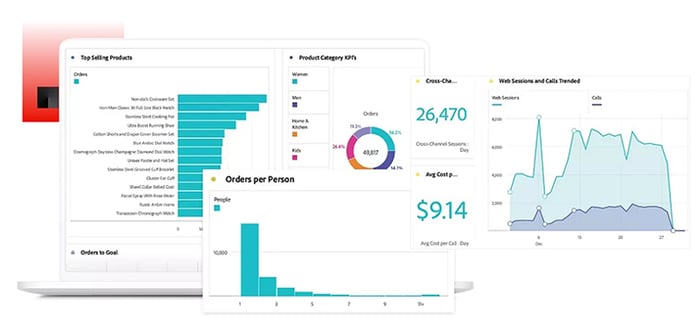 The Adobe Customer Journey Analytics platform, image source
Adobe CJA isn't just a reporting tool—it's also an analytics platform centred on the user, designed to aggregate, connect, and explore data from all points of contact.
While Google Analytics 4 is limited to web and mobile data, allowing only a partial view of the customer journey, Adobe Customer Journey Analytics exploits the data on all of your systems to offer a complete omnichannel strategy.
- Omnichannel analysis: combine data from the web, CRM, POS, support, campaigns, etc. within a single analytics environment
- Individual approach: seamlessly track a user across all channels with fewer constraints in terms of sessions and cookies
- Flexible time windows: examine behaviour during your choice of period (days, weeks, months)
With CJA, you can explore questions such as:
- What is the impact of an email campaign on conversions in the weeks after it is sent?
- What do users do after interacting with customer service?
- What is the behaviour of members of my loyalty program over the long term?
- Which channels actually contribute to conversion, beyond the last click?
Where do my GA4 data fit into all of this?
You don't need to start over from scratch. If your organization uses GA4 with BigQuery, your data can be integrated into Adobe CJA. This allows you to:
- Keep your history for year-over-year comparisons
- Test Adobe CJA alongside your other tools
- Combine your GA4 data with other sources for richer insights
This progressive approach reduces risk and facilitates the transition to a platform designed for modern analytics.
Another article you may find interesting: Why should you add your Google Analytics (GA4) data to a warehouse or data lake? And how?
Adobe Customer Journey Analytics or Google Analytics 4: Which should you choose?
Want to quickly find out whether GA4 is enough for your needs or if it's time to transition to Adobe CJA? Compare both platforms and quickly learn which is better suited to your customer journeys.
| Criteria |
GA4 |
Adobe Customer Journey Analytics (CJA) |
| Main objective |
Understand web and app behaviour |
Understand the full omnichannel customer journey |
| Cost |
✅ Free, with some additional features affordably priced |
⚠️ Very high |
| Complexity |
✅ Easy to configure |
⚠️ More complex, often with guidance from an expert |
| Data sources |
✅ Web and mobile application |
✅🚀 Web, mobile application, CRM, in-store sales, customer support, campaigns, etc. Integration with GA4 and BigQuery is possible. |
| User segmentation & tracking |
⚠️ Limited, based on sessions and cookies |
✅ Seamless tracking of individuals across all channels and devices |
| Time analysis |
⚠️ Limited standard windows: sessions, a few days |
✅ Flexible windows: days, weeks, months, years |
| Reports & insights |
⚠️ Predefined reports, simple explorations |
✅ Advanced analysis, strategic questions, and actionable insights |
| Ideal for |
SMEs and companies that want to understand digital behaviour |
Organizations with complex customer journeys that need a comprehensive perspective |
Want to go further?
At adviso, we support your transition to Adobe Customer Journey Analytics with a complete, personalized approach:
- Diagnostic specific to your analytics needs
- Planning and smooth deployment from Google Analytics 4
- Technical integration, data ingestion, and hands-on training for your teams
Contact us today to receive a demonstration and learn how Adobe CJA can transform your understanding of the customer journey and maximize the value of your data.
The article Your Next Step: Adobe Customer Journey Analytics first appeared on adviso.ca.


Uncertain times: How can (and must) B2C brands adapt?
In recent months, the political climate has shifted the concerns of Canadians from “The cost of groc …

The two aspects of loyalty program performance
Most articles and discussions on the topic of loyalty programs are essentially about their design. P …

4 MarTech trends that are redefining the future of marketing
As the digital transformation speeds up, marketing technologies (MarTech) are evolving at an unprece …