
As we know very well, the developers at Facebook are not standing still and are constantly looking for improvements to make to the platform. Some features are very successful while others are much less so and end up being removed during interface updates or sent to oblivion.
Rarely (since it's far from the norm) do some of these features resurface. But why?
Back to basics
1. ACTION STATUS
Before :
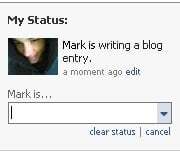
The Facebook status appeared in 2007. Some of you may remember it, but at the time it was impossible to express your thoughts with a sentence that did not start with “Jean-Frédéric is …”. The tool then had to allow the user to state the activity in which he was engaged at the moment. On the other hand, this obligation did not please French-speaking users (Jean-Frédéric is on his way to Montreal) or those who wanted to express something else and who did not dwell on the correct use of the grammar "Jean-Frédéric is wants to go to the beach”.
Several FB groups have sprung up in this time to ask Facebook to remove the obligation to use the wording "User + IS". Whether such groups actually tipped the scales is unclear, but Facebook retired the term in late 2007.
Now :
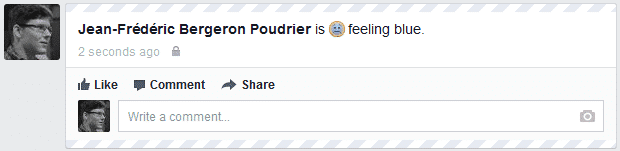
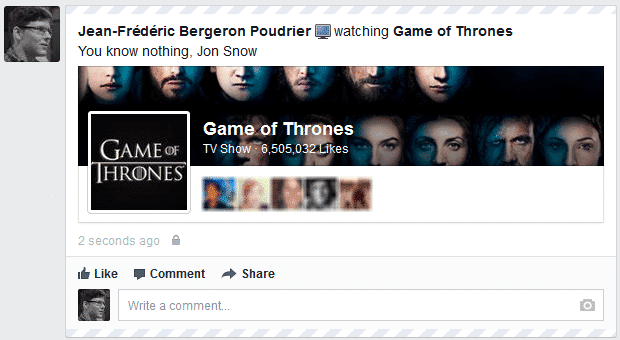
Facebook has just reintroduced certain action statuses according to a few predefined models ( feeling, watching, reading, listening to, drinking, eating, playing ). These statuses can be used in addition to the current status and already existing functions (identify other people, a place and integrate photos).
2. PRE-TIMELINE PROFILE PAGES INTERFACE
Before:
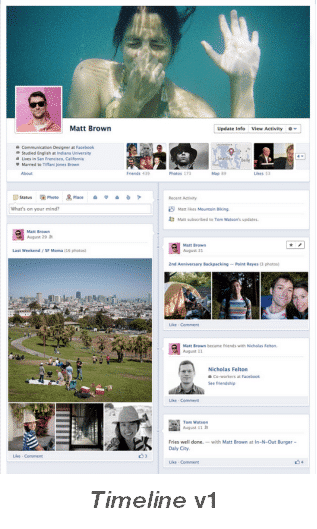
The transition from the profile page to the timeline has seen the layout of various elements centralized around the "timeline" and placed more emphasis on user-created content in chronological order than user-generated content. Facebook applications or on the discovery of users' interests.
Now:
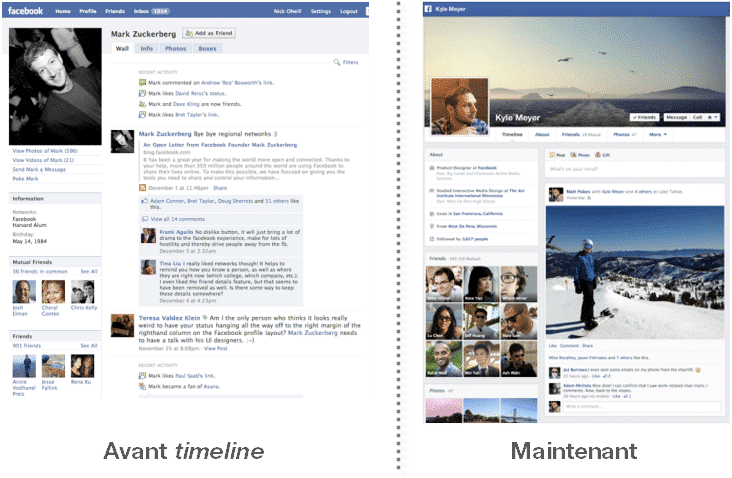
Looking at the image above, it's easy to see similar elements making a comeback in user profiles:
- Tabs return to text format (they are no longer accompanied by images)
- Content is no longer arranged around a central axis.
- The left column is reserved for informative content about the user (About, Friends, Likes, Photos) and archived content from applications (Instagram, Rdio, SoundCloud, etc.)
- The right column is composed of updates, statuses, content created by the user and messages left by his friends; all in chronological order.
Why this step back for Facebook? My assumptions:
DIFFERENT MINDSET FROM USERS
Over time, users evolve and our strategy must take this into account. We already know that Facebook wants to move closer to a similar interface on all devices , but we can bet that a ton of usage statistics were taken into consideration in the development of this strategy. They are certainly able to tell if certain features are performing well, but underutilized; or if others go completely unnoticed.
If we keep our knowledge of the profile of our users up to date, it is easier to notice if certain features become more relevant or useful over time.
BETTER ADAPTATION TO THE NEW SITE
Some features instead seem to be part of a bigger concept and seem to fit into the new interface even better than when they first appeared. Going back to the example of action statuses, the fact that we can now link our posts to branded pages now makes them a promotional tool for content that is consumed (be it music, movie, or a bag of Doritos).
What lesson to draw from this?
Nowadays, a site is still too often a static showcase that we imagine having to rebuild from A to Z when the need arose. Rather, we need to review its definition in order to make it a Web product. A web product can have several lives before it dies; it must be flexible and must also allow the withdrawal, addition or modification of content or functionalities at any time. The incremental budget required for this type of project will be easier to absorb than the budget needed to redo everything each time.
On our side, we need to have a continuous improvement plan mainly based on user data in order to be able to adjust the shot in the face of the actual use made of our product.
Whereas before we were always looking towards novelty , our reflection must first consider an optimization of interfaces and functionalities, and even reviving old tactics which are now more suitable than they have ever been.