
The AppStore, trendy, but often overrated!
Before, it was easy. With a presence of more than 80%, not counting the iPod Touch, the iPhone was THE mobile platform for which it was necessary to develop.
However, since the beginning of the year (2011), the iOS has lost its feathers in the war of mobile platforms… and in recent months, especially since March, it's been a downfall!

We then say to ourselves that it is Google with its Android that is taking market share, but, surprisingly, it is not as present in Canada as we might have thought (unlike in the United States where it has become the number 1 player passing in front of BlackBerry in January).
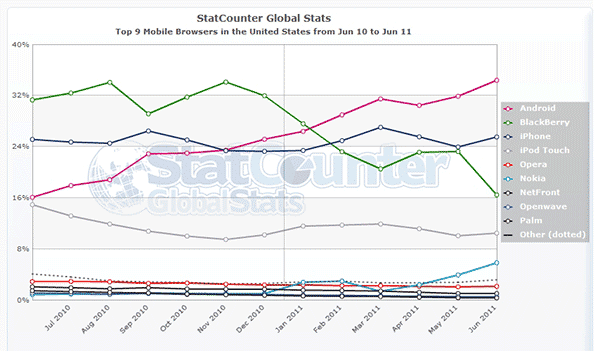
The evolution of mobile browsers in the United States from June 2010 to 2011
It's a “new”, but I should rather say old, resurfacing player: Nokia. I then asked myself the question: what did Nokia do to take over the market? Like Blackberry which is increasingly losing support from the developer community , Nokia does not have a developer community like iOS and Android. It also does not have a large amount of native application for its system.
To find out more, I finally decided to go to a cell phone seller to ask him the question. He replied: “ Nokia, which bought NavTeq in 2007, offers offline GPS navigation software free of charge ”. Thus, it is neither the applications nor the trendy design, but the primary need to be able to be guided (without paying data charges and buying only one device) that brings Nokia back into the race!
In addition, as if to sign the death warrant of the iPhone, the seller admitted to me that he would receive more commissions if he sold a smartphone other than those of Apple, because the cell companies are fed up with despotism Apple, which prohibits them from advertising other than their own and from discounts or price competition on the iPhone.
So consider validating your mobile traffic sources with Google Analytics and researching your users' needs before developing a new application for a little-used mobile platform!
Share this
You May Also Like
These Related Stories

Devices preferred by users during containment
Since the beginning of the pandemic, I often reflect on the hypothesis that this confinement has undoubtedly changed the way consumers shop and search on the web. Being stuck at home, people no longer use public transit to get to the office, no longer go out to bars, no longer enjoy a sunny day on a terrace and, consequently, use their cell phones less and their computer more. At least, that's the idea that's on my mind... THE INFLUENCE OF CHANGES IN USER BEHAVIOR When a drastic shift in consumer behavior occurs, brands need to adjust their marketing initiatives to stay consistent with this new reality. From a media point of view, this translates into the adaptation of creatives, messages, or even advertising placements. At the SEO (Search Engine Optimization) level, new content is created and existing content is optimized to respond to new queries on search engines. Redesigning certain pages of a website is also an interesting tactic to comply with changes in user behavior. In order t …

Users’ preferred devices during lockdown
Since the outset of the pandemic, I have given a lot of thought to the idea that this period of lockdown must be changing the way consumers are shopping and searching online. Because we’re all stuck at home, no one is using public transit to commute to work, we aren’t going to bars or taking advantage of sunny days out on a terrace, and consequently, we’re spending less time on our phones, and more time on the computer. At least, that’s the theory that’s been running through my mind… The influence of changes in user behaviour Whenever consumer behaviour changes dramatically, brands need to adjust their marketing initiatives to stay aligned with the new reality. From a media perspective, this translates to creative, messaging and even ad placements being adapted. In terms of SEO (Search Engine Optimization), new content is created and existing content is optimized to respond to new search queries. Redesigning certain pages of a site is another tactic to conform to changes in user behavi …
-1.png)
An Omnichannel Approach to Marketing AI
REMARKETING ADS: THE STONE AGE OF AI IN MARKETING Thanks to major self-serve advertising platforms like Google Ads and Facebook Ads as well as the advent of programmatic ad buying, marketers have been exposed to the use of AI in marketing for some time. However, the majority of machine learning related to these platforms takes place in a black box. The advertising specialist grabs a piece of JavaScript code from the user interface of the advertising platform and copies the conversion pixel to a website. After a few months of advertising campaigns on the platform, the “magic” of marketing operates and the conversion rate increases by 20% year after year. Similar “magic” happens with automation and email platforms from vendors like HubSpot and Salesforce. These platforms have a built-in AI option and allow marketers to perform scoring and qualification without the need to work directly with a data scientist. More recently, web analytics platforms from Google and Adobe , and even data int …
Repérer et valoriser ce qui compte vraiment.
Recevez nos analyses et conseils pour rester à l’avant-garde du numérique.