
 On Adviso's internal blog, we are used to very "tactical" posts on relatively advanced topics. It will be different today! I take advantage of in-house training to address the purchase of keywords in general. Those less familiar with the Adwords universe, this is for you!
1. DEFINITIONS
A. SYNONYMS
There is no need to get bogged down in the flowers of the carpet, several words can be used to designate the ads contextual to your searches on Google and other search engines:
- Pay Per Click (PPC)
- Paid search
- Paid positioning
- Paid referencing
- Purchase of keywords
However, two elements are important to distinguish: search networks (ads on search results pages) and content networks (ads on sites, blogs, etc., ex: RDS.ca).
B. Quality Score
The quality score of Adwords is a big buzz word, so you better know what it is!
The quality score is a factor that determines:
- The minimum bid for a keyword
- Ad position (in conjunction with auction)
The quality score is determined by:
- The click-through rate of the word, ad group and account
- Consistency/relevance between keyword, ad and landing page
More details on the Google Adwords quality score. For more definitions, consult the Google Adwords glossary
[HTML1]
2. NETWORKS
Here are the networks we use most frequently. (Information based on our experiences in Quebec). Not sure which network to choose? Test! The results differ depending on the industries.
- Google- 85%
- MSN – 8% (Less expensive than Google, excellent conversion rate for certain industries
- Yahoo – 3% (Less expensive than Google)
- Klix – 3% (Large content network in Quebec)
[HTML1]
3. The PERKS
Other than cost, what is the biggest difference between organic and paid SEO? Control.
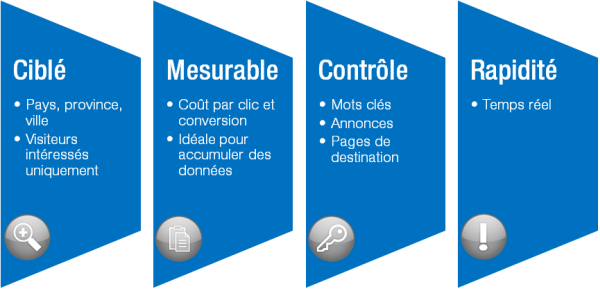
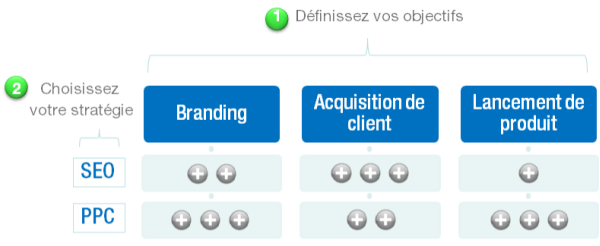
PPC is fantastic for product launches and tightly managing its conversion cost !
[HTML1]
4. THE LIFE CYCLE OF A CAMPAIGN
A. DEFINITIONS OF OBJECTIVES
It sounds obvious and simple, but it's the first question we ask every new customer.
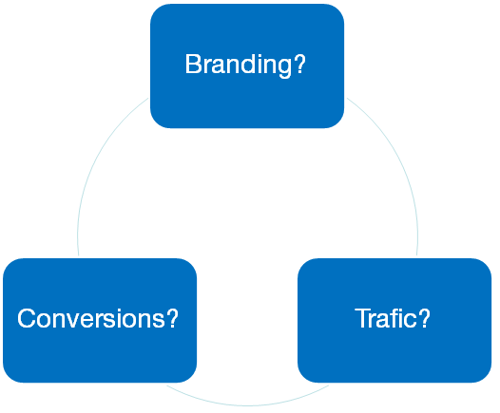
When setting goals, take the opportunity to set up your performance monitoring metrics. Don't just settle for visits, always try to implement a conversion tracking system. Are you an e-commerce site? Make sure you can count sales from your keyword buying campaigns!
B. CREATING THE ACCOUNT STRUCTURE
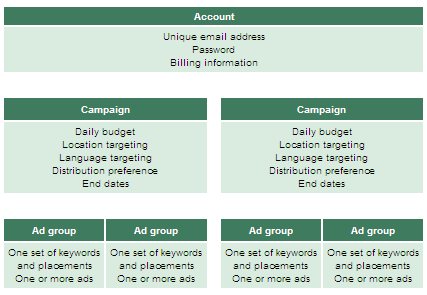
The structure of a keyword buying account is perhaps the most determining factor in the future performance of your campaigns. This is a very strategic step. Too simple a structure and you run the risk of receiving a lot of irrelevant impressions. Too complex a structure and you risk wasting a lot of time managing your campaigns.
Very often, when we take over an existing account from a client, the redesign of its structure is necessary to reach its full potential. What's important to understand are campaign-specific and ad-group-specific settings. Here is a table from Google for this purpose:
C. DEFINITION OF ADVERTISEMENTS AND KEYWORDS
The next step is defining your keywords and creating the ads. For your keywords, the easiest tool to use is Google's Keyword Tool, which has just added a long-awaited feature: the number of searches per keyword!
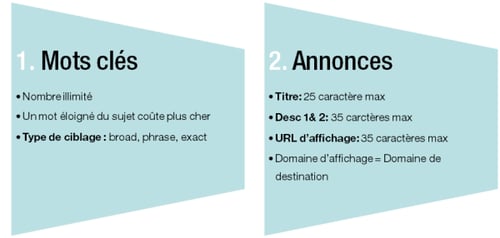
More information on the types of targeting.
D. PERFORMANCE MONITORING
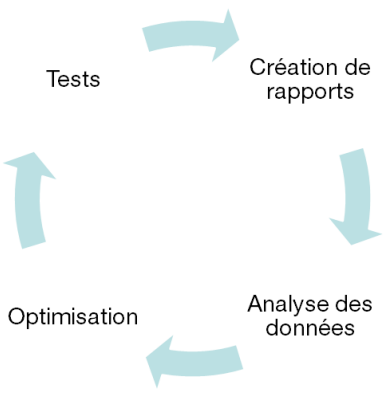
Campaign monitoring should be done continuously. Testing (ad and otherwise) is key to finding the winning recipe !
[HTML1]
5. TACTICS
The management of paid positioning campaigns is characterized by an important duality: even without experience, it is very easy to launch a first campaign. However, very advanced knowledge is required to optimize a campaign to its full potential. Please take into account that the following tactics are only a basic and not an exhaustive list of strategic approaches.
A. LANDING PAGES
Why?- Most important element for conversion
- Enter the quality score equation
Tactics:
- Clear reminder of the message (the visitor must be reassured in 0.5 seconds!)
- Use of text (avoid the use of images for your text content)
- Presence of call to action (what should the visitor do?)
- Test, test and test (A/B or multivariate)
B. ADVERTISEMENTS
Why?
- This is the message!
- The most important element for click-through rate
- Enter the quality score equation
Tactics:
- Concise (there is not a lot of room!)
- Use of keywords (if the searched word is in your ad, it will be in bold) Consistency with the search word (make sure you have very specific ad groups!)
- Using a call to action (what should the visitor do?)
C. KEY WORDS
Why?
- Without keywords… no ads!
Tactics:
- When you define your keywords, a good idea is to find words that reach your potential customers through their buying cycle (Recognition, interest, reflection, purchase)
[HTML1]
6. SUCCESS FACTORS
A. COHERENCE
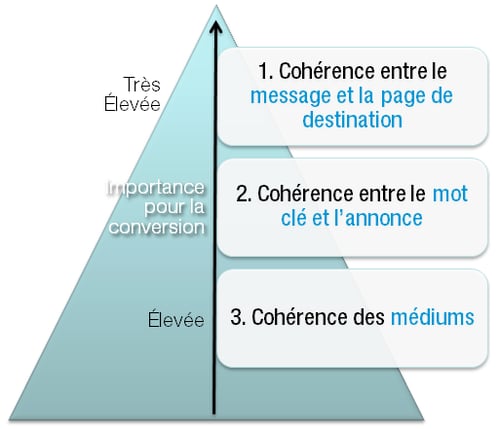
Want to increase your conversion rate? Reinforce the consistency between the keyword, the ad, the landing page and the messages across your different advertising mediums.
B. DYNAMISM
From experience, I know that if I let an account stagnate for several weeks, its performance will gradually decrease. Internet users are bombarded with information, if your ad does not stand out, it will not be clicked! Do not hesitate to use your campaigns to highlight your various marketing campaigns (promotions, branding, new products, etc.)
C. PERFORMANCE MONITORING
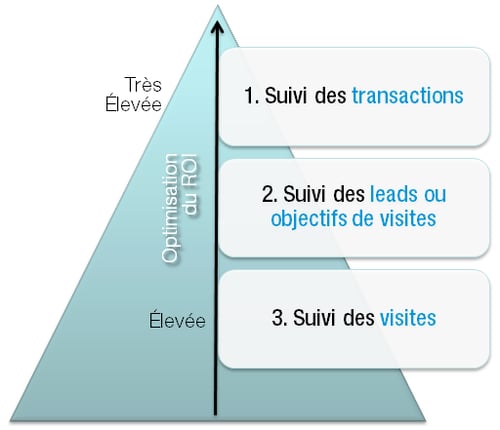
As Jean-François Renaud would say, "At Adviso, we are obsessed with conversion!" ". Don't be surprised if tracking is a recurring theme! Want to maximize your return on investment? Keyword conversion tracking is essential!
[HTML1]
Conclusion
Paid positioning is a fascinating discipline with endless possibilities! It brings better ROI than banners and is much more controllable than organic SEO.
The future is also very bright:
- Landing page testing tools are increasingly available (think Google Website Optimizer)
- Content networks are becoming more flexible (Google now allows you to choose specific site sections, e.g. the business section of the NY Times. Also, Google has joined MSN in offering demographic targeting options. )
- Video ads are coming soon! (Google and Yahoo experimented with video ads on their search results pages earlier this year)
Consult Adviso's paid positioning services.

Pushing the Limits of Google Analytics: Regular Expressions – Part 1
Using Google Analytics without taking advantage of regular expressions is a bit like listening to a VHS tape on an HD television; it works but it does not allow you to take full advantage of the tool.

Accelerate the adoption of artificial intelligence to support business growth
Have you seen the documentary The Social Dilemma on Netflix? I strongly recommend watching it. It’s about companies armed with unparalleled weapons. It’s about machine learning algorithms that are six times more likely to hit their target in terms of presenting the right offer to the right customer. Which means they can sell more. Why leave such a growing competitive advantage to Facebook and Google? This superpower is more accessible than you might think. What are the advantages of using algorithms, automation, or machine learning? By entrusting machines with tasks that humans find hard to achieve, or which are so repetitive and alienating that no person could achieve them, companies will derive several advantages. Improvement of their transformation rate This could equally be applied to the progression rate through a company’s marketing funnels. The exposure rate to the brand or the company’s products: by being addressed to customers with the highest potential of being interested. Th …

2nd Party Data, or how to take advantage of your partnerships for your digital media campaigns
MEDIA & SEM In recent years, we have seen an increase in digital advertising investments. It goes without saying since our use of the Internet continues to increase. It therefore becomes imperative for advertisers to vary their tactics in order to stand out in this highly competitive field. The majority of them are already using 1st Party Data and 3rd Party Data, but few advertisers are aware of the benefit of using 2nd Party Data. WHAT IS 2ND PARTY DATA? 2nd Party Data is literally another advertiser's 1st Party Data. Usually, this data is made available through a partnership between these two advertisers. It can be two partners offering complementary products (eg airline and credit card company), or two partners with a very similar target (luxury car manufacturer and golf club company). Following this partnership, it is possible to implement its retargeting pixels on the partner's site or to share these audiences via your DMP (Data Management Platform) in order to use them. To le …