
Text too long? Too short ? If my tweet is 110 characters, will I get more retweets than with 60 characters? Will I engage my community more easily with a shorter Facebook post? How can I be sure that I have the correct text length?
The size of the publications has always generated many received ideas and debates around the question: Should we favor short or long texts? The desired objective is always to optimize the community engagement rate.
So is there an ideal length for our social media posts?
The answer is yes ! A series of studies revealed by Buffer allow us to see more clearly, and give us the trends. Let's take a closer look at the results by social network.
FACEBOOK: STOP LONG PUBLICATIONS!
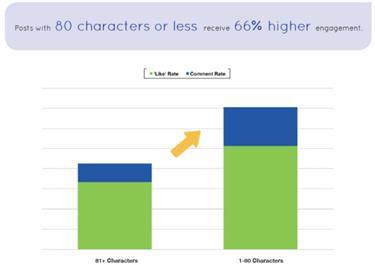
On Facebook, fashion is for short posts. According to Jeff Bullas ' study , the recommended length for posts would be a maximum of 80 characters. The ideal would be to shorten to 40 characters to obtain an engagement rate estimated at 86%.
BlitzLocal has also conducted the investigation and recommends a length of 100 to 120 characters. In addition, the study shows that the use of questions in your publications increases the rate of interactivity by 10 to 20% (see graph below).
-jpg.jpg)
While the two studies differ very slightly on the ideal length of posts, the conclusions remain the same. The longer your posts are, the less engaging they will be.
TWITTER: 100 CHARACTERS: THE IDEAL LENGTH
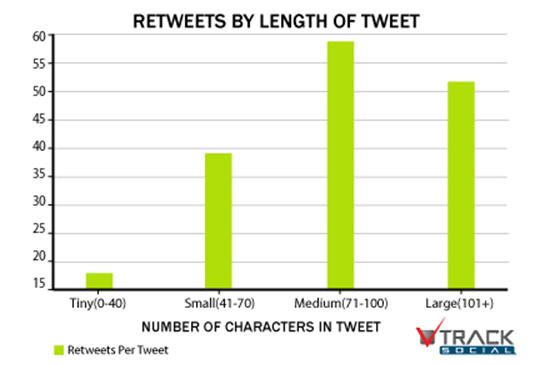
We often tend to hit the 140 character limit on Twitter to get our messages across. According to the results obtained, we find that Tweets of 71 to 100 characters obtain the highest engagement rate. This is demonstrated by two studies conducted respectively by Social Track and Buddy Media ( Twitter's best practices reference research). The advantage of this intermediate length is that it makes it easy to include links, hastags, mentions and especially photos.
GOOGLE +: HAVE A SHORT AND EXPLICIT TITLE
Unlike other social networks, a post on Google+ includes a title and a description. According to Copyblogger , it is recommended to favor short and sufficiently explicit titles; no more than 60 characters.
When it comes to descriptions, the first two sentences are the most important. Indeed, recently Google + added the "Read More" feature in its publications, displaying only the first two sentences. This is why it is advisable to write a text that will encourage the reader to continue reading your content.
BLOG POST: 1600 CHARACTERS RECOMMENDED
On the web, articles are very often skimmed over and half read. Sometimes, only the photos attract attention. According to Medium , the optimal time to read a blog post should not exceed 7 min if we want to capture the reader's attention. For this, it is recommended to have an article comprising a maximum of 1600 characters. It is also important to pay attention to the layout, a well-organized text will always be more pleasant for readers to read.
-png.png)
IN CONCLUSION…
These data are interesting tools to take into account in the daily writing of our publications, however, they must be adapted. Indeed, the calculation of the number of characters should not become a fixation and replace spontaneity and inspiration.
In addition, even if the length of the publications guarantees better visibility and improves the engagement rate, we must not forget the importance of content strategies that bring real added value to your publications.
Finally, the evolution of the codes on social networks are constantly changing, this data will therefore be likely to evolve in the future. Keep an eye on it!


Integrating Social Media into a Web Strategy: A Summary
This article is in fact the summary of a more imposing document, a presentation in fact delivered to Infopresse on February 6, 2008 in front of a room that was (too?) full of 300 people who wanted to know more about how we can obtain results in business using social networks.

[INFOGRAPHIC] Amazon: a sprawling empire summarized in 10 figures
January of 2019 marks an important turning point in the history of Amazon: Jeff Bezos’ venture has dethroned Microsoft and become the most valuable company in the world, with a market capitalization of US$797 billion. Everyone is familiar with Amazon, that “huge, fast-moving machine”. But let’s stop to take a closer look at what has become a commonplace in the market. In terms of strategic projects that deeply affect the business models of our clients, Amazon is unfortunately still too often not on the radar for many Quebec and Canadian companies. And yet, it doesn’t matter whether you’re talking about B2B, B2C, manufacturers, distributors or retailers; whether it’s small , medium or large-sized businesses; if you’re local, national or international; or if your products are convenience or luxury items, or even food-related—Amazon is there! So to start the year off, (re)discover the Amazon empire through these 10 key figures, along with some surprising, yet striking comparisons.

Infopresse360 Day on Web Analytics: Summary of Avinash Kaushik's conference
Avinash Kaushik presents his vision of web analytics. In fact, for his die-hard fans of his blog, of which I am a part, his conference is a summary of what he produces periodically. Still, Avinash is an outstanding presenter and just meeting him in person was a unique experience.