
Facebook recently launched a new tool to better manage personal data shared outside of its platform : the Activity outside of Facebook module . . Personal data is traditionally collected through the Facebook pixel, the login module, or its SDK (software development kit), which allows the measurement of a user's activity in a mobile application. . The terms “Facebook” and “transparency” being rarely used in the same sentence, it goes without saying that the news caught my attention. I decided to test this tool to see if it is not only easy to access, but also to use. This allowed me to answer a big social question: is it out of concern for its users that Facebook offers them better control of their personal data?
STEP ONE: FIND THE TOOL
At the end of the web, my first instinct was to visit the Settings section of my Facebook account. Maybe obvious to some of you, but in all honesty, do we visit this section as often as we should?
I also took the opportunity to update my profile and, above all, to check who could access my data. I was thus able to make sure that only my friends could know that I had grown up in Terrebonne (and now you too). I then instinctively clicked on Your Facebook Information , where I discovered the Off-Facebook Activity section .
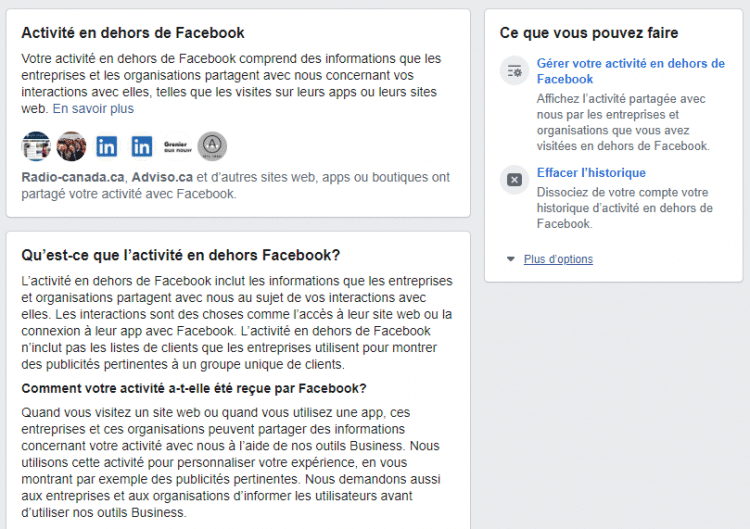
Clicking View takes me to the next page explaining what off-Facebook activity is. After a quick read (because between you and me, I especially want to know who has access to my data), all I need is a click on Manage your activity outside of Facebook to get to the end of my quest! I'm starting to be from Terrebonne-Humeur (continuation and end of the wink.)

STEP TWO: USE THE TOOL
I am promptly informed that 665 third parties have collected and shared my data outside of Facebook between July 2019 and today, while specifying that this is only a preview, and that a part of my activity may not appear here!
I won't hide from you that it sent shivers down my spine. Never mind, by pushing my exploration, I understand that, to cut ties with a partner, I must first click on their name or logo and then click on the link “Disable future activity…” with said partner. The absence of a grouped management option quickly discourages me from reviewing the 665 partners one by one. At three clicks per partner to delete, deactivating only a quarter would require almost 500 clicks! Life is too short for that. The “Clear History” option is starting to catch my eye. But do I really want to start again… TO ZEROOOOO? ( Jo Bocan pierces my eardrums! )
Not to mention that clearing the history will not prevent any future activity from happening with the partners. To ensure this complete blocking and prohibit further tracking, you must click on "Manage future activity" to access a new section where you can uncheck the "Future activity outside of Facebook" option.

THE VERDICT
Is it really worth managing your business off Facebook? Up to you. If you're ever stressing about being retargeted by an advertisement from the site you just visited, this option may be for you. Otherwise, deleting your activity will mainly impact the personalization of advertising messages. By opting out of tracking your activities, you opt out of a partner's remarketing audiences. However, you may be targeted again by this same partner, because you will inevitably remain in Facebook's third-party audiences. Between the lines: if it pisses you off to see an advertisement for a product you just bought, the withdrawal option may not be the best there is!
In conclusion, Facebook has often, and rightly, been singled out for its shortcomings in the management of its users' personal data. By offering users more control over the management of their data, the blue giant is trying, in my opinion, to polish its image and simulate a form of empathy towards its users. Overall, this new tool is far from revolutionizing the way users can ensure better control of their personal data. After all, Facebook will continue to track us in its app, and your data will still be used for monetization purposes by this platform, because that's what its owners do best!
