
 I'd like to close the discussion about using multiple targeting options for the same keyword (i.e. having keyword123 as "broad" in addition to having keyword123 as "exact") . In the vast majority of cases, this approach is unnecessary.
Here's why :
First, let's go back and consider the 2 competing theories:
1. Put very popular keywords in “broad” and “exact” to increase their performance
2. Keep only the “broad” option
So I did a test with one of our big customers to see what was going on:
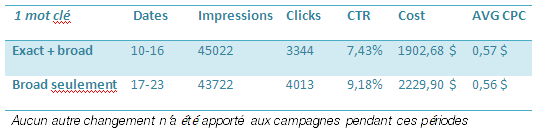
Obviously, the test was not conducted over the same period so external factors may have affected the validity of the data. The fact remains that the results are surprising: a 24% increase in the click rate when the word is in “broad” only!!! wow!
It was enough for me to contact Google for this purpose. The response I received is along the same lines as my conclusions… but for different reasons. The personal opinion of my contact at Google can be summed up in two points:
1. There is no performance advantage
2. It increases management complexity
In my own book, that concludes the question!
Note that if you used two targeting options in order to have more details on the conversion of a word, the “Search Query Performance report” can meet this need without problems. In addition, this report also makes it easy to identify keywords to exclude from campaigns when they use keywords in “broad” mode.
Finally, the last and only reason I would use two targeting options for the same keyword would be to set different bids. This could apply for clients in highly competitive industries for extremely popular words. But again here I really wonder if the increase in performance is really tangible.
Do you have any real-life experiences with using multiple targeting options for the same keyword?
Interesting fact: The “quality score” of an “exact” or “broad” word is identical because it is the exact version of the “broad” word that is used to calculate the “quality score”. Note that the difference in performance between "broad" and "exact" (CTR and CPC) is explained by the aggregation of all variations of a keyword in "broad" and not by different "quality scores".
