
April 28, 2020: The government of Quebec announces a cautious reopening of certain industries, including retail, manufacturing and construction. Although there is reason to hope that the end of quarantine in a broader sense is drawing near, we are likely to be living with some form of social distancing for months to come. For local shops and retail stores, this reprise doesn’t necessarily mean that their customer base will be returning to stores in their former numbers anytime soon. Many consumers will continue to limit their outings as much as possible.
Since the outset of the pandemic, consumers have been relying heavily on online shopping and home delivery due to health concerns and stay-at-home orders (we carried out a study that revealed an increase of 118% in online shopping in Quebec). Recently, Google put in place a number of options to make this easier for businesses, creating temporary shortcuts, most notably in terms of profile verifications, but also in terms of visibility, for example highlighting restaurants with delivery and take-out options in Google Maps.
Finally, numerous platforms and online tools such as Hubspot, Shopify, SEMrush and others are offering prolonged trial periods and packages to help companies try their products at low cost.
So, you might be asking, how hard is it to do e-commerce, anyway? Not very, it turns out. As we’ll see, there are a number of relatively simple platforms out there that allow you to use predefined templates to get a viable site up and running with a single day of solid work. And remember, given the current situation, the goal is to create a viable product (MVP) rather than a perfect product — consumers’ error tolerance has gone way up over the past weeks, as their need for services mounts.
Comparison chart
Let’s take a look at our options, and in the interest of prioritizing local products, we’re going to concentrate on two platforms – Lightspeed eCom, a company headquartered in Montreal, and Shopify, based in Ottawa, but with a Montreal office (and a very nice office, at that).
To make this as easy to follow as possible, here’s a little table outlining the options and functionalities that come with each platform.
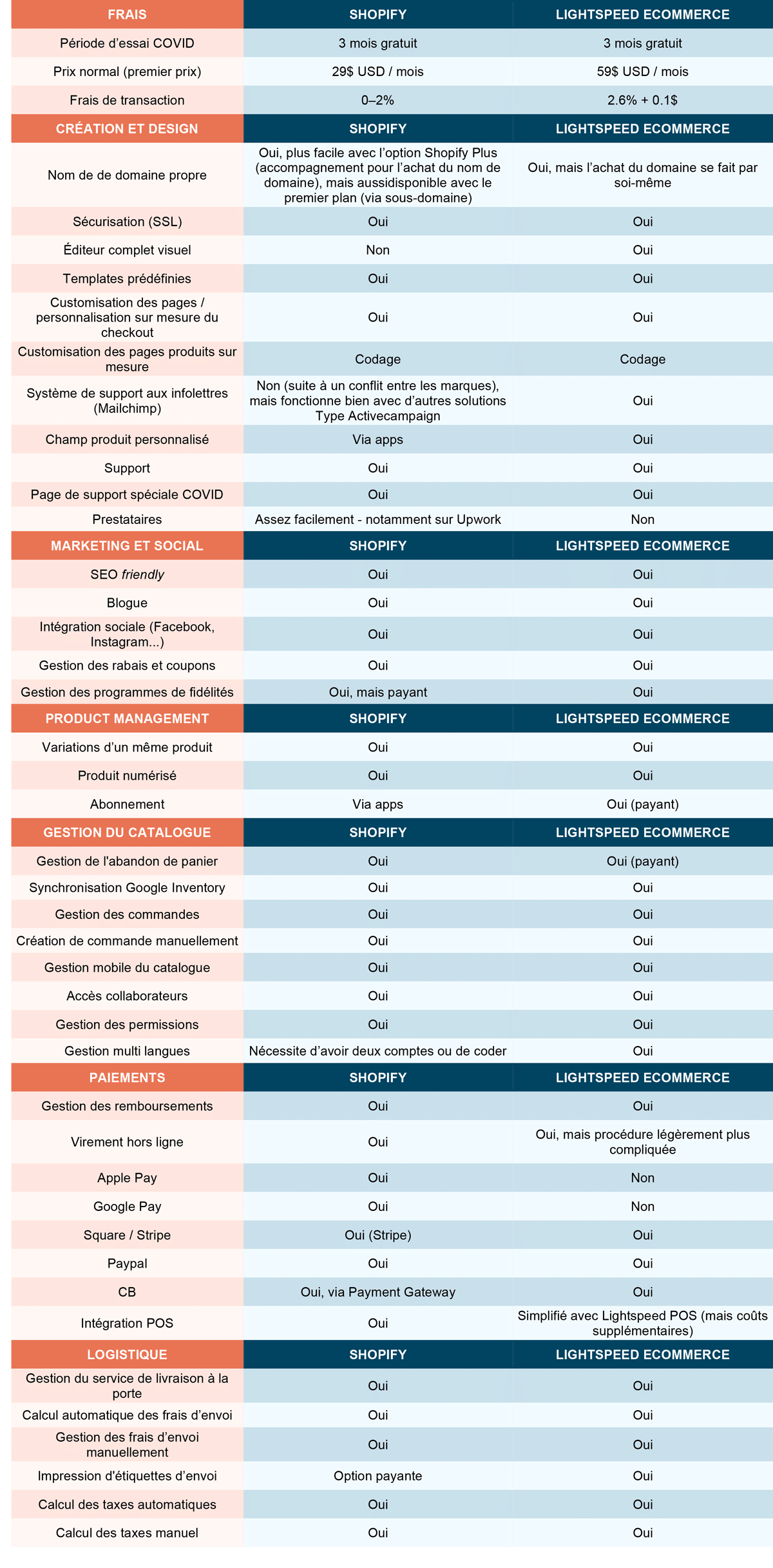
Summary
Initial observation: strictly speaking, neither platform is “better” than the other. It all depends on your activity, your goals and your initial configuration.
To summarize, I would say that Shopify is a little easier to use, and has a low barrier to entry. The difference is in its delivery terms and its products.
If I had to set up a site for rentals/memberships, or deploy a solution for local delivery or curbside pickup, Shopify is undoubtedly the best option for a retailer with a single location.
However, if I had several shops with sales terminals, and was ready to invest a bit more (not right away, but eventually) in order to facilitate the connection between my online activity, my inventory and my stores, Lightspeed eCom would be the better choice.
N.B.: I might still give an extra star to Shopify for their innovative launch of a mini-Amazon (a bold comparison, I know) during the current health crisis, with the launch of the Shop app (Techcrunch, 28/04/2020).
Bonus - How it all actually work
Because I’m so nice, I dug up a presentation from one of the many Discord chats I’ve been in since the pandemic started, presenting the steps required to create a Shopify store. You can download it here (initial source: Katie Cerar, product lead at Shopify).

NETendances: Will the Internet replace television as the main source of information?
We are pleased to join forces, once again, with CEFRIO for the launch of the NETendances report on information.

The evolution of e-commerce: putting the customer at the heart of your strategy
The e-commerce market continues to grow year after year, and Canada is no exception. E-commerce has become a necessity for Canadian retailers, partly out of a need to adapt to shoppers’ needs and partly in response to the situation engendered by COVID-19. The closure of stores’ physical locations forced business to make a strategic shift, focusing their efforts on remote points of sale. This Forbes article explains how stores using Shopify have been able to replace 94% of their in-store sales with online sales. Moreover, we spoke to you about the growth of e-commerce at the outset of the pandemic. This growth has (or should, if it hasn’t already) driven e-commerce to the centre of marketing strategies, since it’s now the only (or nearly the only) customer point of contact capable of generating revenue. More than six months after the introduction of the first health measures, which I understand to mean the lockdown and closure of physical stores, eMarketer is anticipating a deceleration …
-4.png)
The Impact of SEO in a Data Loss Context
The arrival of Law 25 in Quebec (which will be enforced in September 2023) and the disappearance of third-party cookies will impact your digital marketing efforts and the way in which you collect data.