
2017, the year of mobile? Been there, done that. 2017, the year of conversion? Maybe. Either way, if it was up to me it would be: 2017, the year of the landing page. Only 10% of Quebec companies are currently equipped with campaign-specific landing pages for their digital marketing campaigns. From that we can deduce that 90% of Quebec companies could significantly improve the performance of their marketing campaigns by working on their landing pages.
Where does this statistic come from? Well, from a “highly scientific” analysis based on our observation of the nearly 200 landing pages currently being used by our clients or for AdWords campaigns (156 ads clicked anyway). So even if the number isn’t statistically significant, it gives us an idea of the state of things on the threshold of 2017.
Here’s what jumps out after this quick analysis: 10.4% of ads lead to a well-built landing page, 12.1% lead to a pseudo-landing page, and 77.5% lead to generic website pages. What a waste!
And yet, there’s no lack of tools to quickly set these pages up: Unbounce, Leadpages and Instapages are all very accessible and easy to use, and allow you to create landing pages without writing a single line of code. Most large CMSs also allow you to create landing pages without getting too complicated.
Why is this happening? Are we too eager to put our campaigns online? Maybe we believe that putting 100% of our budgets towards digital media will give better results? Maybe we haven’t done an analysis of the financial windfall that optimizing these pages could bring about? Maybe. But maybe, we just don’t understand exactly what the advantages of a well-designed landing page are, or what that even means in the “conversion” sense of the term.
What is a landing page?
Oli Gardner and the Unbounce team did a great job of explaining this in their Academy. Rather than reinventing the wheel (or plagiarizing) here’s their definition:
Technically, a landing page is any webpage that someone lands on after clicking an online marketing call-to-action.
As a marketer, it’s important for you to get the best bang for your buck and ensure that as much traffic hitting your landing pages actually converts. So for our purposes, we’re going to define a landing page as a dedicated, campaign-specific webpage that drives your visitors to complete a single marketing goal or call to action.
By dedicated, we mean that the page has (virtually) no ties to your website, and serves only one purpose: getting your visitors to convert through a single call to action.
[This page has no navigation and is only accessible from the link in your marketing message (and sometimes through Google, but that’s not often relevant).]By campaign-specific, we mean that for each initiative or marketing campaign you run, you should have a tailored page just for that campaign. One ebook? One landing page. Two promotions? Two landing pages.
I like this definition. However, I would make two observations:
- In the first sense, a landing page is any webpage that can be reached by the user, either by clicking on a call to action within a marketing message, or by clicking on an organic link in a search engine;
- Talking both of landing page for any page that can be reached by the user AND for a dedicated landing page for a campaign brings a significant dose of confusion. For example, if someone talks about a landing page in a meeting, is he talking about a landing page dedicated to a campaign or a landing page aimed at improving navigation or a generic page of the website?
Also, it seems appropriate to introduce a new term in our marketing jargon: Campaign Landing Page. That would be a landing page dedicated to a specific campaign aimed at one goal: conversion.
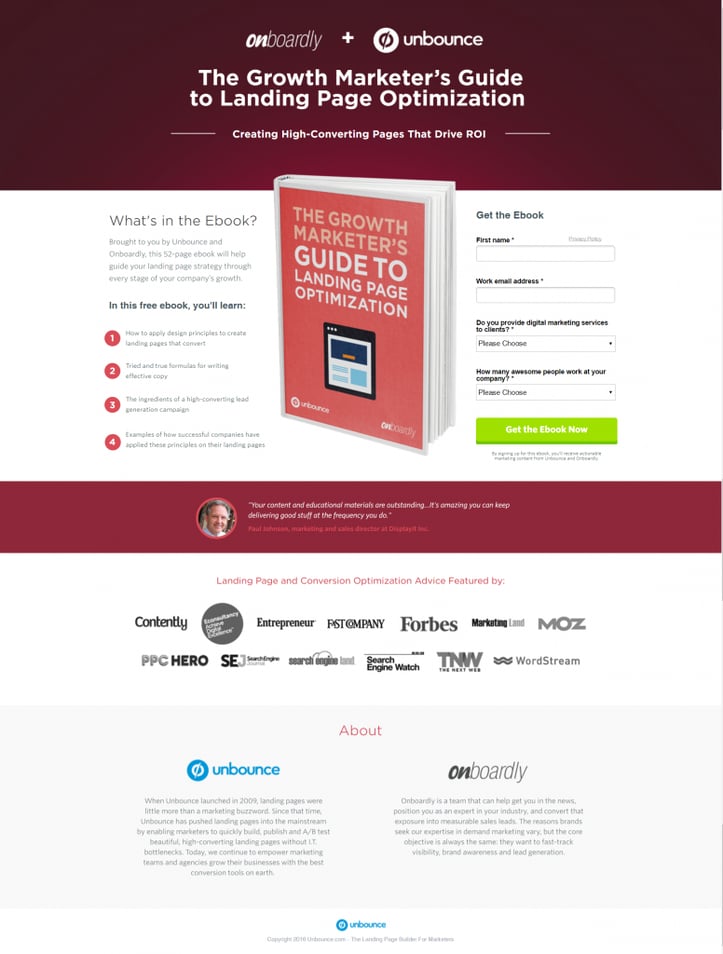
An example of a simple landing page.
This article is the first in a serie dedicated to landing pages. Coming next week: “4 reasons to focus seriously on your landing pages.”
