
Google Analytics 4 (GA4) is spearheading the new Google marketing suite and they’re not being shy about telling everyone about it: Currently all Google Marketing Platform communications are encouraging readers to install GA4 if they haven’t done so already.
We recommend starting the migration now in order to get ready for the upcoming post-cookie digital era with analytics data you’ve gathered using the platform. We’re encouraging you to start this major shift without delay, because unfortunately GA4 is not compatible with all the data you’ve accumulated on GA Universal, which has been ironically renamed “GA3” by the community as a way of pointing to its imminent depreciation.
Remember that it’s already been a year since we recommended initiating your migration towards the beta version of GA4. Today, GA4 is now in production and a new version of 360 is being offered to big organizations who need high volume and service-level agreements.
Server-side measurement becomes the norm and can save you money
For a few months now, we’ve noticed that the cost per acquisition (CPA) for digital media campaigns has been progressively increasing. Everything points to the acceleration of this trend over the next year, which will directly result in having to spend a larger budget to meer your targeted conversions.
This situation can be explained by the data loss due to the cookie apocalypse, a phenomenon we recently covered in this explanatory video detailing the context and effects of the event, in addition to offering a few solutions to help you quickly adapt.
In order to improve the performance of your platforms and best equip yourself to confront the cookie apocalypse, our specialized team in analytics and data science recommends pairing the installation of GA4 with server-side GTM and the Facebook Conversion API. Basically, this trio of recent technologies will alleviate the loss of data caused by recent changes to Safari and Firefox, and above all will constitute a new basis for a measurement and data management strategy
The change has arrived
This process with three distinctive phases will be a long one: Do not underestimate the time you’ll need to adapt your internal processes and properly train your people.
First, it’s important to install GA4 today while continuing to operate GA3 100 percent of the time in order to take advantage of the combined strengths of these two products. This will give you the time you need to transform your internal processes at your organization.
Finally, when all the conditions are ripe, it will be really easy to unplug GA3 using your tag management system.
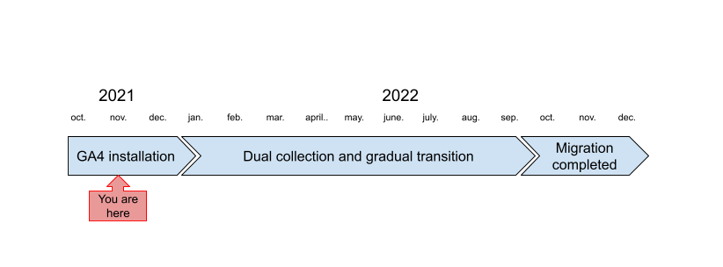
Phase 1 (Q4 2021)
Yes indeed, Q4 2021 has arrived! Even if GA Universal still has a few advantages, you’re going to quickly fall in love with GA4 given all its unique benefits. What’s more, it’s highly likely that once you’re ready to head into the second phase of your migration, GA3 will have become deprecated, without any added value, except maybe a nostalgia factor.
Phase 2 (Q1-Q3 2022)
Adviso recommends tracking simultaneously on GA3 and GA4 only for the time you need to effect a transition. During this phase, we advise that you progressively adopt GA4 amongst all teams that use this tool.
From a data engineering point of view, it’s likely that the analytics data will be used in a number of pipelines (the most standard being data visualization in your dashboard). Your planning should therefore take into account the fact that this second phase will require more time. It must be long enough to allow you to change the data sources and, often, to adapt these changes to new dataset formats.
Two big advantages to GA4 are the native BigQuery connection and the ability to perform predictive turnkey analyses, which democratizes data science for marketing purposes, such as for revenue prediction or churn probability. To operate these predictive models, the Google engines need a significant volume of data in order to train its machine learning component. The earlier you can start accumulating quality data, the earlier you can benefit from these advantages during phase 2.
But be careful! Despite the uncertainty regarding the amount of time needed for this stage, it will nevertheless be important to anticipate an approximate date for finishing up the migration and unplugging GA Universal.
Phase 3 (Q4 2022)
To optimize performance, reduce the risk of data loss and, above all, improve data governance, it will be necessary to uninstall GA3. Here are the 4 conditions that need to be in place in order to conclude your GA4 migration and leave GA Universal behind for good:
- Technology: GA3 no longer has any advantages compared to its successor (which will be the case starting in 2022).
- Data: Your GA4 installation has accumulated at least 12 months of data, enabling you to perform a classic year-over-year analysis
- Talent: You have the inhouse skills and expertise you need to make optimal use of GA4.
Processes: Finally, ensure that your human and material resources are no longer reading data in GA3 from the user interface (UI) or application programming interface (API).
Ideal timeline
With the cookie apocalypse pushed back to 2023, can’t we still wait a bit?
It’s true that Google just pushed back the termination of third-party cookies to the middle of 2023. This announcement, which only involves Google Chrome (with a 53% share of the market in Canada according to statcounter.com), will extend the life of third-party cookies, which are especially used by media platforms for retargeting and user segmentation through DMPs.
On the other hand, installations of Google Analytics that use first-party cookies aren’t affected by this decision. Nevertheless, GA4 is your best ally for collecting proprietary data for digital marketing purposes while respecting your users’ confidentiality and privacy.
Do you have to invest in the 360 version?
There’s no single answer to this question. But it’s important to think about it, because GA4 is about to shake up Google’s 360 offering with an entry-level pricing that’s drastically more affordable than before.
The range of use-cases you make of analytics data will no doubt play a part in your decision regarding potential technology investments. For example, exploiting a large volume of raw data without sampling or the activation of GA audiences in third-party marketing platforms such as Salesforce will tip the scales in favour of the 360 version.
Be sure to stay informed through our newsletter to learn more about the new version of GA360.
In the meantime, the free version of GA4 brings a host of benefits within reach. If you’re convinced that it will be part of your organization’s future and you want to get started, we would be happy to guide you through the process.
