
Have you heard of TikTok, the app now huge with Gen Z?
One of the top ten downloads in the app store for 2019, this modern version of Vine allows users to easily create 15-second videos set to music. First launched as Musical.ly, the app was initially intended to capture lip synching performances. It was then bought by ByteDance, at which point it became the app we currently know and love. Today, TikTok is used to create all kinds of videos (funny, dance, etc.) 15 seconds long. Thanks to the hashtags associated with each one, a video can quickly go viral and wind up in the platform’s main news feed, where it reaches huge numbers of app users.
TikTok by the numbers:
- 66% of the platform’s users are under 30 and 41% are between 16 and 24;
- 90% of users use the platform every day;
- The app is available in 155 countries;
- To date, only 4% of marketers are using it.
Because of its unique nature, TikTok presents brands with new opportunities to stand out from the competition, especially since there are currently so few commercial players active on the platform. However, before jumping into the app, you need to ask yourself whether the type of content published on it is aligned with your positioning, and whether the characteristics of its users line up with your audiences. For example, TikTok is an ideal platform for brands like Pepsi, Maybeline and even Clean&Clear.
TikTok ad formats
So far, advertising on TikTok is only possible in some parts of the world. In Canada, advertisers need to get authorization from a representative to get access. If you’re eligible, there are several formats to choose from: the brand takeover, the hashtag challenge, branded effects and native advertising.
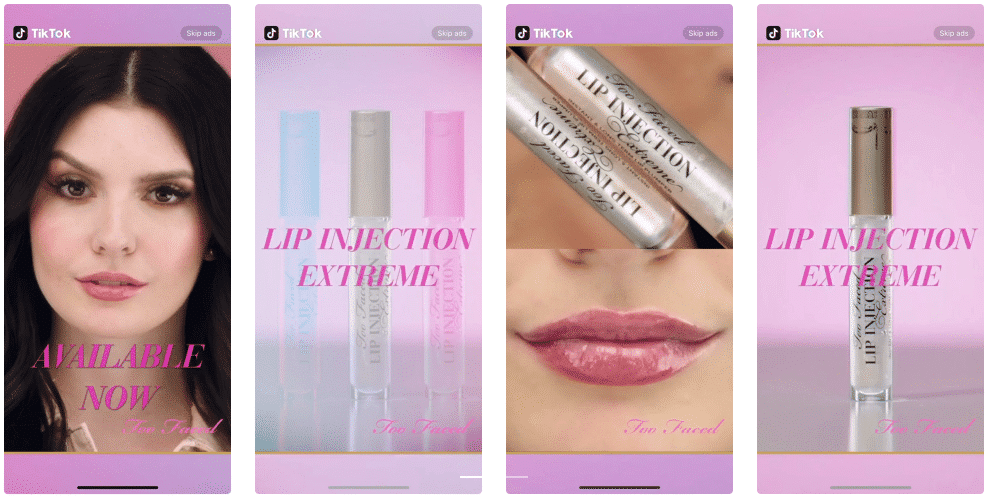
The brand takeover allows advertisers to serve users a post the moment they first open the app. It’s a tactic that aims mainly to increase brand awareness. The example below shows a brand takeover from Too Faced. According to TikTok, this ad generated excellent results, with a click rate of 18%.
You can also launch a hashtag challenge by selecting a specific hashtag. The price tag is $150,000 for six days.
For almost a week, TikTok users are invited to publish a video of their own on a very specific theme, using the hashtag promoted by the advertiser. There’s always a chance the challenge will go viral and generate a lot of engagement and excitement around the hashtag in question.
To make the most of a hashtag challenge, the wisest course is to promote it using a combination of several of TikTok’s ad formats in parallel. For example, case studies have shown that using a brand takeover to support a hashtag challenge can exponentially increase its effectiveness and performance. It’s a format with high click rates, that can also lead to an increase in subscribers to the advertiser’s page, which is obviously beneficial for organic content initiatives.
That said, it’s important to proceed with caution, because giving users free rein to express themselves in association with your brand’s hashtag can be risky. The way they participate and the content they publish is totally out of your control. You’re leaping into the void, in a sense, though if it helps at all, the result of this type of strategy is almost always positive.
An example of a hashtag challenge that worked well, is the Chipotle #GuacChallege. The goal of the hashtag was to promote their guacamole giveaway and it generated an exceptional engagement rate. In short, it was a major brand-awareness win for the American fast food chain.
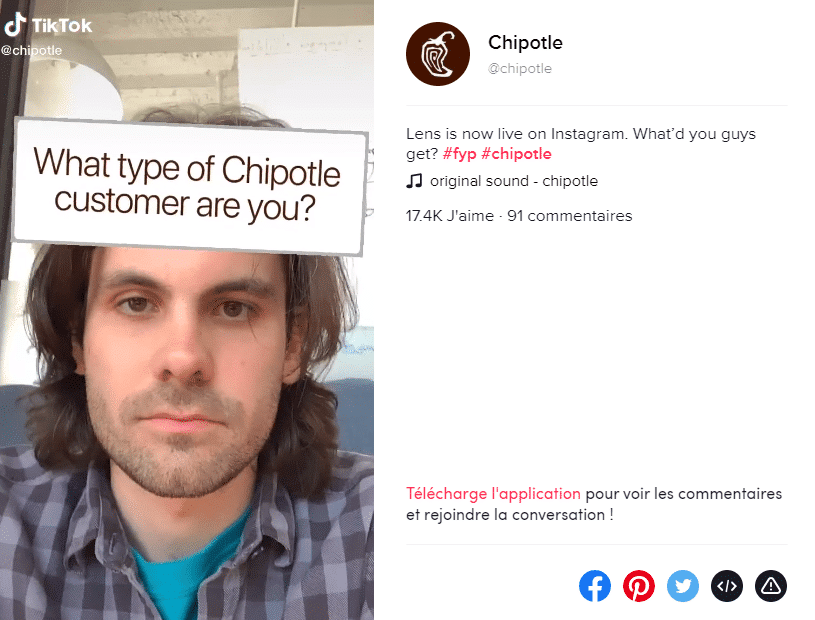
Another ad option is the branded effect (also called a branded lense or branded filter), similar to what you’d find on SnapChat, that lets the user add effects promoted by a brand to a video. Once again, Chipotle is a great example of the success a tactic like this can generate.
Finally, TikTok offers advertisers the opportunity to do native advertising. The cost per thousand impressions is about $10, relatively costly when you compare it to Instagram, which averages closer to $8, but it allows you to advertise on the platform with a smaller budget than you’d need for a hashtag challenge. It’s an interesting option for a brand looking to target consumers in the consideration stage, when they’re thinking about making a purchase. It’s also a good tactic for getting a foothold in the platform, when you’re trying to establish a presence. That said, you can’t expect to see the same level of hype that can be sparked by a takeover or a hashtag challenge.
Building an influencer strategy
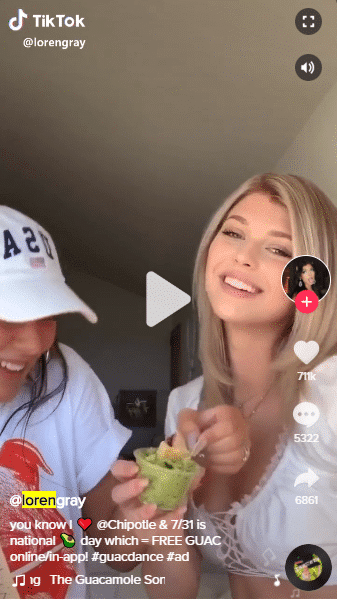
Sometimes hired to help promote a hashtag challenge, sometimes to talk up the benefits of a product, influencers are already very active on TikTok. Below, you can see @LorenGray — the most followed personality on the platform — participating in the Chipotle #GuacDance hashtag challenge.
Also, unlike the ad strategies listed earlier, that still aren’t offered everywhere in the world, partnerships with influencers have no geographic restrictions, allowing you to extend the range of a campaign even further.
If your brand is active on TikTok, think about building a strategy that involves influencers. It’s a good way to connect with Gen Z, since studies have shown that Gen Zers trust the personalities in their news feeds more than the brands.
Create branded content
Because advertising has its limits, it’s important to plan to publish organic content if you want to properly position your brand on the platform.
As we saw with the #DollyPartonChallenge, where a number of well-known public figures each published four profile pictures, labeled LinkedIn, Facebook, Instagram and Tinder showing the image they wanted to project on each, your content strategy shouldn’t be identical for all the platforms you use. On TikTok, the goal is to produce highly authentic content, that’s less structured than traditional branded content. The principle is simple: if the relationship proposed by the brand doesn’t feel sincere, new generations want nothing to do with it.
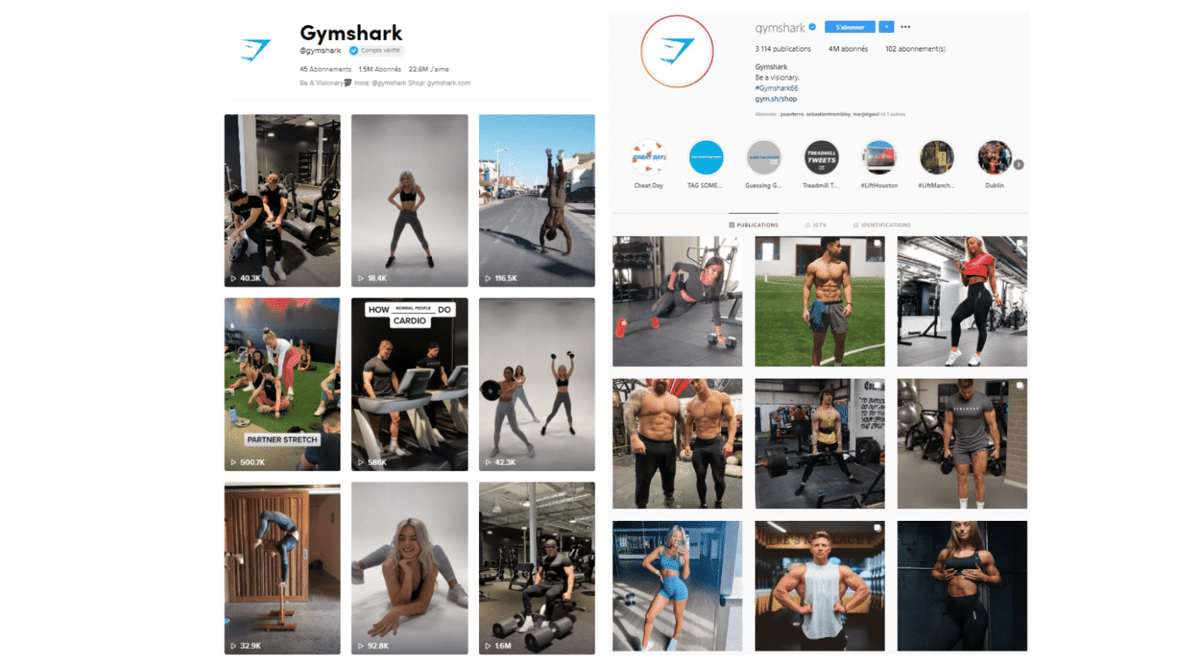
The strategy used by @GymShark is an excellent example of a brand positioning themselves advantageously on the platform. The brand produces playful content about training, but features their clothing line in the videos. The tone of the content is funnier and more authentic than what they post on Instagram, which is more aspirational in nature.
Looking for advice on reaching Gen Z? We’ve demystified it all for you here!
How do all your other social platforms figure into all this?
Will the arrival of TikTok influence the rest of your social media strategy? Not necessarily. You should, however, show you are able to adapt by making an effort to position yourself appropriately and differently on each social network. The key to success is to treat your collection of social networks like an ecosystem, where content is interrelated, but where each platform plays a very specific role.
Are you ready to play the sincerity card to reach younger generations?
Get ahead of the curve and adapt your digital strategy right away. Whether it’s with ads, partnerships with influencers or through the creation of organic content, positioning your brand on TikTok will help you stand out from the competition, and increase the reach and effectiveness of your marketing campaigns.
Finally, reaching Gen Z on a platform they use routinely use by employing a savvy blend of spontaneity, humour and sincerity will allow you to begin a relationship with them on a new basis, without recourse to traditional advertising; a golden opportunity to get close to them and form relationships marked with the authenticity they crave.
