
We talk a lot about web 2.0, social networks and user-generated content. Along with the gargantuan growth of the Internet and in a world where distances are being abolished, it seems that people have a greater need to localize (as opposed to globalize).
It is in this niche that web 2.0 intervenes by creating spaces in which it is humanly possible to find information that interests us, to to get involved, to share and to be heard and, quite simply, to have the feeling of belonging to a group. A group that although potentially international allows users to feel less suffocated by the growing mass of society.
The web creates needs and attitudes while responding to more or less explicit social demands. Thus, for several years now, the web has also been undergoing a green shift to respond to the growing interest in environmentalist considerations.
These considerations have an increasing place in the traditional media (who hasn't seen an advertisement for a biodegradable product, a news item on global warming or pamphlets on fair trade coffee) and are beginning to make their mark on the web. .
Of course, without a guide it is extremely difficult to find one's way on the web and, although search engines such as Google have transformed the search for information, it is still very difficult for users to find one's way between sustainable development, ethical trade, fair trade and responsible attitude. It may be easy to get a list of ethical drinking results in Google, but how do you choose the right resource and how do you know which of those results will be the most credible and relevant?
This is why in recent years (and especially from 2006), many “green” information portals have appeared. Here is an exhaustive list of some recent discoveries:

“Created in May 2000… Enviro2B is a site entirely dedicated to public and private actors concerned with the environment: businesses, local authorities, organisations, associations, scientists, students, job candidates,”. Among the few sites on this blog, this one seems the least credible, but it may simply be because of the advertising for chichou (a dating site) or even weight watchers… which are not really products that the 'one expects to find on an ethical-sounding site.
Ethiquette.ca , launched around 2005, this site aims to identify fair trade businesses in Quebec.
Info durable is a comprehensive portal on sustainable development in Belgium. Although focused on the environment in Belgium, it has articles dealing with international subjects such as oil and greenhouse gases. This site was launched at the end of 2005.

Launched in 2007, Econo-ecolo is “a non-profit site promoting eco-citizenship. » This site brings together numerous articles whose aim is to raise public awareness of a more responsible attitude.

Abcvert , launched in 2007, positions itself as a kind of yellow or rather green pages. Its main content seems to be a directory of French companies with ethical or environmental leanings. It also has some articles and informational files.

The Journal of Sustainable Development is a webzine launched in 2007 whose content deals exclusively with the environment.

Ecolo-info , launched in 2007, is, among other things, a blog but above all a plug-in for the browser which, via a navigation bar, provides easy access to information on sustainable development.
The list could still be long because this kind of sites are really booming and we have to face the facts that I couldn't list them all in this blog. To complete this list, here is a last informational site and three search engines:

Ekopedia (2005) is a site that clearly positions itself as the environmental Wikipedia.
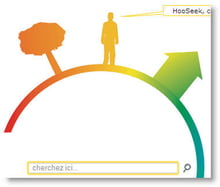
Unlike ekoolos (2006) which is a search engine that only indexes sites dealing with environmental topics, the last two engines, veosearch (2007) and hooseek (2008) (read an evaluation of hooseek) are meta engines that stand out for their social involvement by redistributing a certain part of their turnover to non-governmental companies.
So these are good indications of the Internet's green orientation. However, this orientation does not stop there, companies like Ecohosting offer to go further by offering green hosting (their servers are powered by wind energy but, of course, they have generators in the event of a problem to guarantee the online presence). On the other hand, the green trend also concerns many lucrative companies which try to improve their brand image by launching products with an environmental tendency. Examples include Cascades and its recycled toilet paper, Exceldor (industrial chicken breeder) which is launching new, more easily biodegradable packaging and even greenisuniversal.com , the green facade of the NBC universal broadcast network.
In the years to come, this trend should therefore be monitored both for information portals and for lucrative companies which will have to respond to growing pressure from the public.
