
It's usually when the time comes to choose your marketing automation platform that the puzzle begins.
Should I trust with eyes closed the tools that make the most noise, like Hubspot or Marketo ? Should I bet on the big historical players, like Eloqua or Pardot? Or on the contrary, start with promising challengers like ActiveCampaign or Autopilot?
Well, it depends! Not what you expected, is it? Wait, it will clear up...
The decision depends on your needs, the size of your company and its complexity, the strategies you want to put in place, the importance given to marketing in your organization, etc. But above all above all, it will depend on the other technological tools that you already use (or that you will use soon).
Because for us at Adviso, the number one criterion in choosing a platform is its ability to integrate with your existing tools . Your marketing automation platform being a central point of your marketing stack , just like your CRM, it is essential that it plays well with the other tools you use.
Starting of course with your CRM, so that these two platforms can communicate well with each other:
- Do you use Microsoft Dynamics as your CRM? Maybe ClickDimensions would be a good option, unless Marketo is better in terms of features.
- Do you use Salesforce as your CRM? You'd probably be better off going with Pardot (which is owned by Salesforce), unless you prefer the user-friendliness of Autopilot (which natively integrates with Saleforce).
- Don't have a CRM yet? Then ActiveCampaign could be a good option, unless you want to turn to the very complete Hubspot right away.
Integration with your CRM is therefore a very important factor, but the other integrations available natively with the tool should also be carefully considered, as they will save you a lot of headaches and discussions with your developers. Other integrations to consider include your e-commerce platform (ActiveCampaign for example integrates deeply with Shopify, while Dotmailer or Bronto are good choices for Magento), your customer support tools (Hubspot works wonderfully with LiveChat while Drift integrates better with the Salesforce suite) or your advertising tools.
To go further, I would even say that one of the factors of primary importance would be the integration of this tool with Segment, which represents a central node in the management of data, which is itself the fuel of any marketing automation. This ability to integrate qualifies the main market players (Hubspot, Marketo , Pardot, ActiveCampaign, Autopilot, Eloqua), but disqualifies certain outsiders such as Dotmailer or ClickDimensions.
Finally, the features offered by the platform you pre-select should only come later in your thinking. Because if a feature is missing from a platform that has good integration capabilities, it's a safe bet that you will find additional tools that integrate well with your marketing automation (ActiveCampaign and Unbounce or Autopilot and Instapage if we take the example of landing pages builders ).
This is how an important change in our industry is taking shape: the shift from “ software-first” to “ stack-first”. The massive arrival of new niche players in marketing technology in recent years has made the idea of a marketing stack more attractive than that of an all-in-one software. The best are better together, they say; this is why a marketing stack composed of several tools that excel in their field will be more flexible and more specific than an all-in-one software living in autarky.
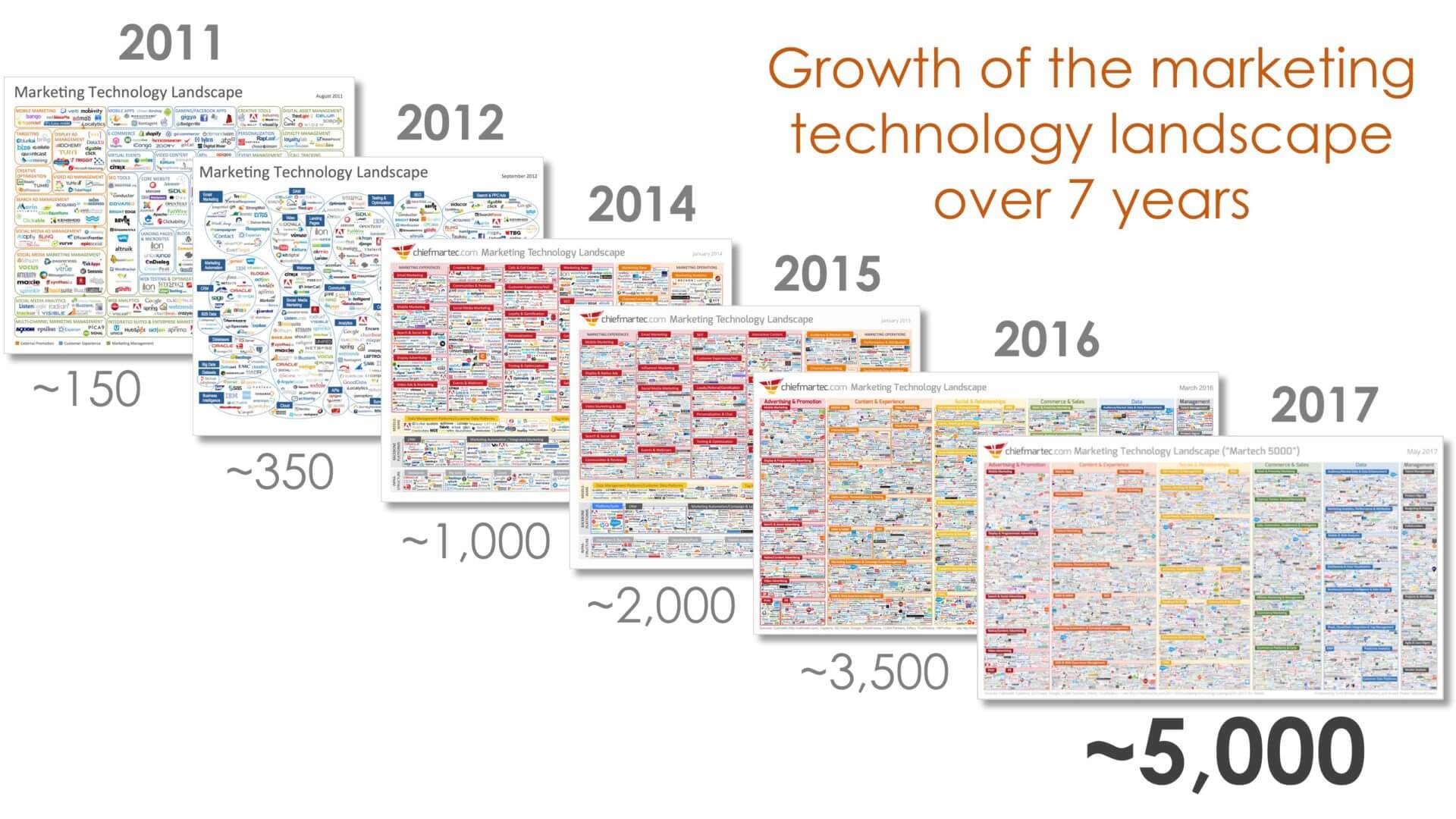
We are even ready to lose some functionalities in favor of a better “integrability” of these specialized technologies. Think for example of PowerPoint vs Google Slides; yes, Google Slides has fewer features than PowerPoint, yet its integration into the Google ecosystem and its SaaS model has allowed it to catch up with Microsoft's software in a few years (I haven't found any recent market shares, but the search trends are very telling).
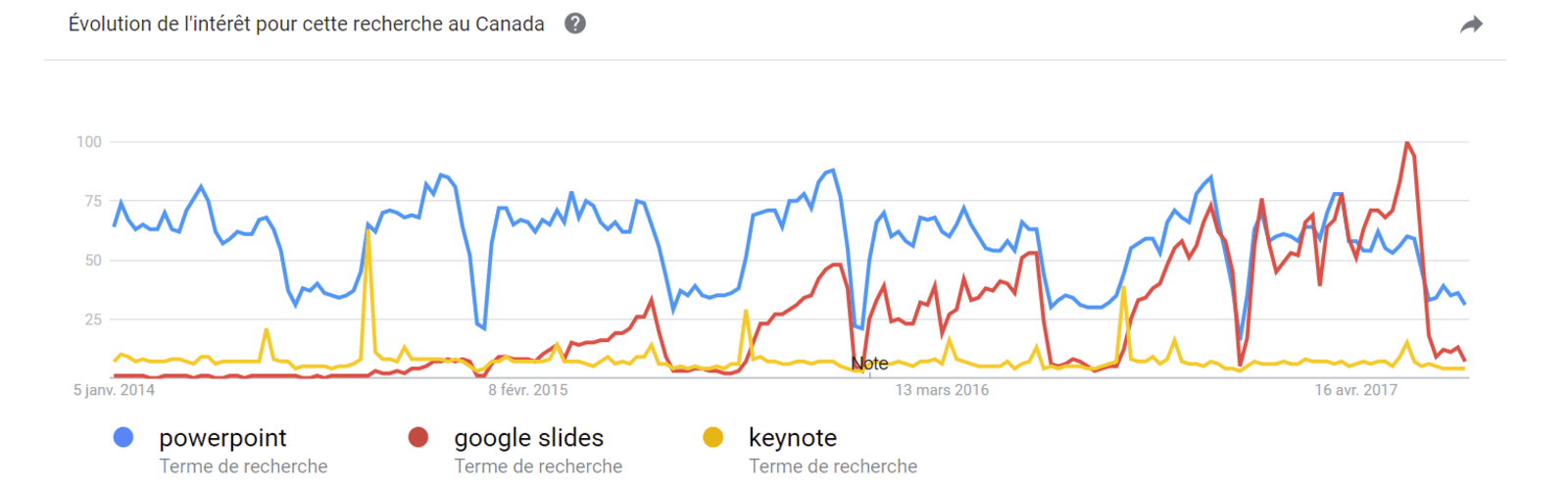
EVOLUTION OF INTEREST IN THE MAIN TOOLS FOR CREATING PRESENTATIONS, IN CANADA SINCE JANUARY 1, 2014. HOWEVER, GOOGLE'S LAG BEHIND MICROSOFT WAS ENORMOUS THREE YEARS AGO...
To return to marketing automation, we should finally note the appearance of tools specialized in connections or integrations of other already existing tools, most of the time with the possibility of automating actions between them. Zapier is the best known, but Automate.io , Stamplay , Tray.io or PieSync offer interesting new features. The integration possibilities are therefore increased tenfold, even if native integrations must always be preferred: sky is the limit!
In the end, I won't tell you whether you should choose Hubspot or Pardot or Autopilot. Because, of course, "it depends". But one thing is certain: by intelligently selecting your marketing automation based on its integrations, you will certainly be able to build a marketing stack that runs like a Swiss watch, and that delivers impressive results.
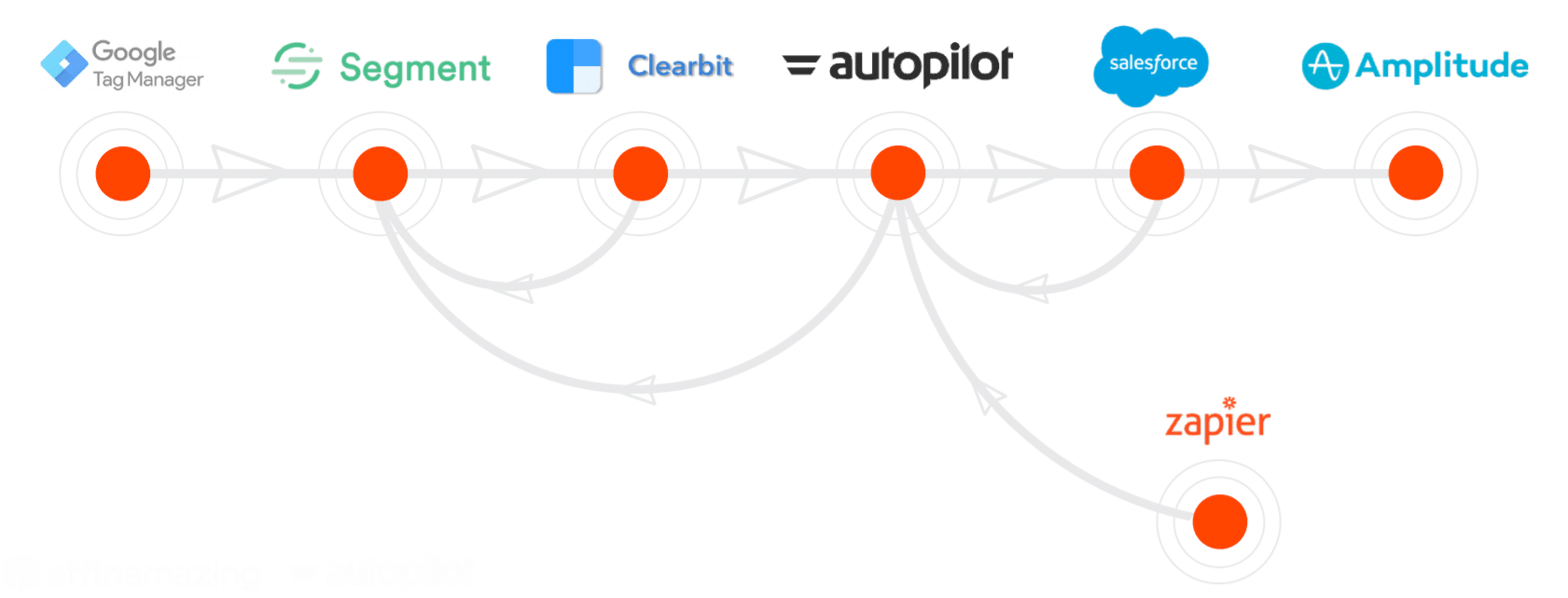
AN EXAMPLE OF A PERFECTLY INTEGRATED MARKETING STACK. TOOLS THAT INTEGRATE WELL WITH EACH OTHER ALLOW YOU TO GREATLY REDUCE THE DEVELOPMENT TIME REQUIRED TO INTEGRATE THEM. THUS, YOU MAKE YOUR MARKETING TEAM MORE RESPONSIVE, MORE FLEXIBLE AND MORE AUTONOMOUS. EASE OF INTEGRATION IS THEREFORE CRITICAL TO THE SUCCESS OF YOUR MARKETING.
