
Have you ever seen a Facebook ad or content in English while your browser and Facebook interface are in French?
If the answer is yes, don't panic, as this is a phenomenon that affects a multitude of users on a daily basis. Before commenting “IN FRENCH PLEASE!” or contact the Office québécois de la langue française, it is important to fully understand the different factors that can cause content or advertising to appear in the language of Shakespeare. Indeed, the Facebook algorithm considers a multitude of factors influencing the language of dissemination to users. Here are the main elements that come into play when it comes to language targeting on Facebook.
NAVIGATION INTERFACES
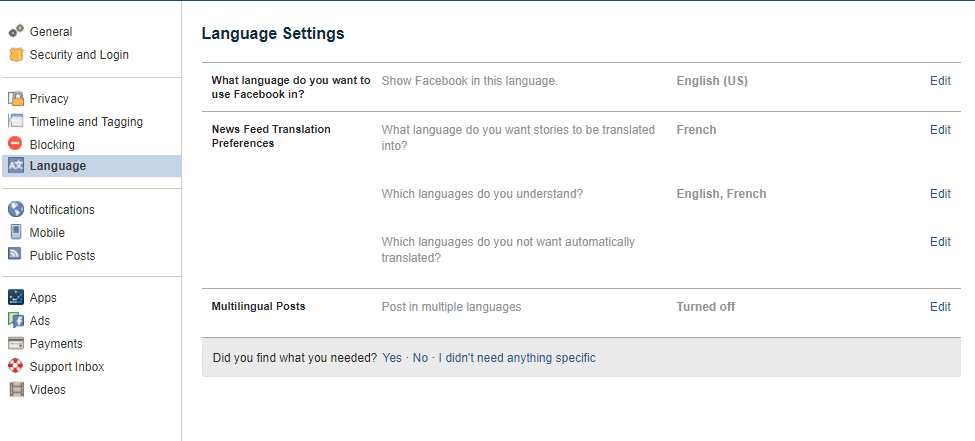
The first element taken into account by the Facebook algorithm is the navigation interface. The two main interfaces are those of your web browser as well as the Facebook interface itself. Indeed, if your Facebook is in French and your web browser is as well, you will be much more likely to be exposed to content in French. The algorithm will automatically take into consideration that you are a French-speaking user. In case you have an English-French combination, the likelihood of having English content will tend to increase.
THE LANGUAGES LISTED IN THE PROFILE
Facebook, along with Google, is a data collection champion. Despite the fact that the data is anonymized, the platform knows a lot about us. Whether through engagement with content, the last time you identified in a restaurant (we double the collection if your tartare ended up on Instagram) or even on the information found in your user profile , Facebook will be able to classify you into audiences based on these different criteria. These are also taken into account in the definition of the content that will be suggested to you on the platform. A very important element that is taken into consideration is the languages that you have entered in your profile. If you identify that you speak French and English, the algorithm takes into consideration that you are likely to understand content broadcast in your secondary language. Before adjusting your profile, there is still one very important element to cover and to which the algorithm places great importance.
COMMITMENT TO CONTENT
Every day, millions of users like, comment and share content on Facebook. This engagement we generate on Facebook is an important element in delivering content to your News Feed. If, for example, you liked a video shared by a friend and this video comes from an English-speaking page, we influence the algorithm. Think of all the Facebook pages you've liked over the past few years, or liked or shared content that was in English. This information will have an impact on the next content that will be broadcast to you. With the rapid expansion of video, which we often view on muted, it may not be realized that we are engaging with English-language content.
In conclusion, Facebook's algorithm uses a combination of factors that can influence the delivery of content to your News Feed . Given the historical and demographic reality of Quebec and Canada in general, we are among the users most likely to be exposed to this phenomenon. Unfortunately, there is no miracle solution in order to have content offered that will be exclusively in our mother tongue. Only Facebook remains to adapt their algorithm to fine-tune the distribution of its content in markets with a high proportion of bilingualism.
