
Content updated March 18, 2020.
Today, almost all digital projects take place in a context where stakeholders play a major role in getting things done. Projects are increasingly sensitive to the actions and decisions taken by several internal and external stakeholders. Project stakeholders may include, for example:
- a project team,
- agencies,
- designers,
- programmers,
- managers, strategists,
- editors,
- media providers,
- client,
- platform users,
- etc
In digital, where everything goes very quickly and where projects are often started at high speed, we see that the management of stakeholders at the start of the project is sometimes forgotten. However, it is intimately linked to the success of the project. Stakeholder analysis and identification are key activities in order to define everyone's requirements and expectations with regard to the project and its activities.
One of the challenges for digital project managers is to fully understand the level of digital understanding of the project team. The involvement required from a stakeholder can be difficult to grasp if this resource has less experience in the digital world. It is up to the project manager to identify these challenges and ensure that tools are in place to manage the understanding of the entire team in order to establish a balance between the reality of the project and the desired output .
In this article, I will walk you through 4 processes for managing stakeholders in managing a digital project that will help you establish best practices for the success of your project.
4 STAKEHOLDER MANAGEMENT PROCESSES
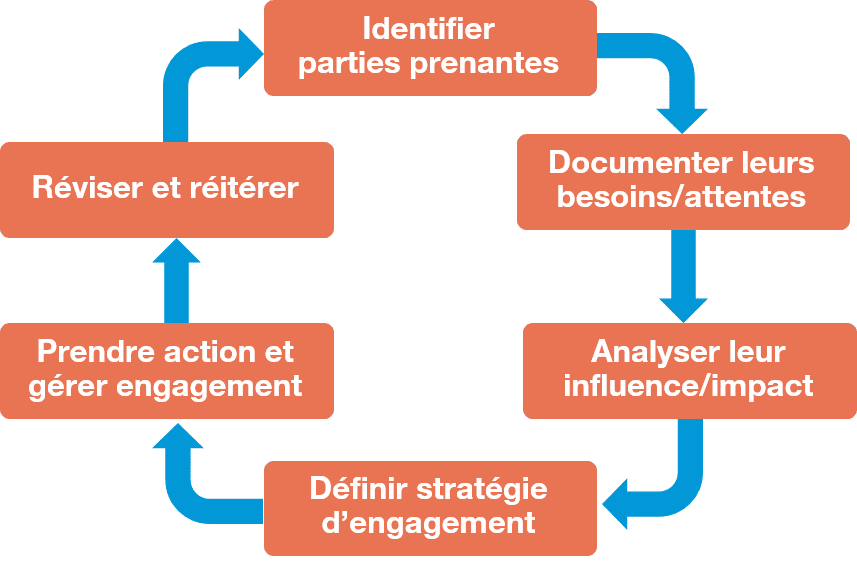
The 6th edition of the PMBOK describes this field of knowledge in 4 processes:
- Identify stakeholders
- Plan stakeholder management
- Manage stakeholder engagement
- Control stakeholder engagement
IDENTIFY STAKEHOLDERS
During this step, any individual, group or organization that may have a direct or indirect impact on the project must be identified. Think beyond internal stakeholders; it is important to also include the users and consumers of the final product. User research can be a good way to take the user into account in decision-making processes. Including the opinion of our users allows us to see the strategy in the longer term, rather than being limited only to the realization of the current project.
It is then important to document and share the information with each of the stakeholders and to ensure that everyone is comfortable with the responsibilities of their role. Another way of working could be to let the team choose their roles and review everything afterwards.
The RACI is a tool that will help you identify the roles of project members:
| LEVEL OF COMMITMENT | DESCRIPTION |
| Responsible for execution and follow-up | These people are responsible for carrying out or monitoring the progress of tasks, without necessarily being the decision maker. |
| Accountable /ultimate decision maker | The role of the A's is to approve and validate actions; each project task must be approved by them. |
| Consult /advise if necessary | They are generally experts who have expertise in a specific subject. They are often called during the project for advice. |
| Inform about the progress of the project/deliverable | These people must be informed even if they do not have a decision-making role in the project, because it is possible that they will be impacted by a change. |
PLAN STAKEHOLDER MANAGEMENT
After identifying the key roles of each, strategies must be established to effectively manage the involvement of the identified stakeholders during the life of the project. Depending on the roles of each, it is necessary to be able to make important information accessible at the right time via predetermined communication channels.

You can, for example, plan meetings in your schedule and identify who will be involved in each meeting. For example, a President could be an “I” (as referred to in the RACI model), as they will not necessarily be involved in advancing website strategy on a day-to-day basis, but will be informed at key decision-making moments. Planning for stakeholder involvement throughout the timeline will prevent you from receiving regular follow-up and progress requests, in addition to custom update requests that will reduce project effectiveness. Agree on the level of reporting required.
MANAGE AND MONITOR STAKEHOLDER ENGAGEMENT
After the first two stages, many have the impression that the project is complete. Surprise! This task is iterative, so global monitoring must be carried out continuously with stakeholders and remember to update documents and adapt management strategies as appropriate.
It is also very important to promote in the team an appropriate involvement in the project activities so that everyone collaborates in this planning. The task is therefore not only to plan, but to implement and communicate our approach well throughout the project.
IN SUMMARY
The goal of stakeholder management is to anticipate and manage the expectations of project stakeholders and end users, while reducing negative impacts and improving support. Depending on the scope of the project, it is normal that the time and scope of the activities may vary. On the other hand, I maintain that it is important to address this issue at the start of the project, and to discuss it with the project team. Failing to take into account certain important stakeholders, the project risks generating delays, additional costs, unforeseen issues, scope changes and even cancellation. You have the power to reduce these risks from the start of your project!
Do you have a good tool to help you manage your project stakeholders?