
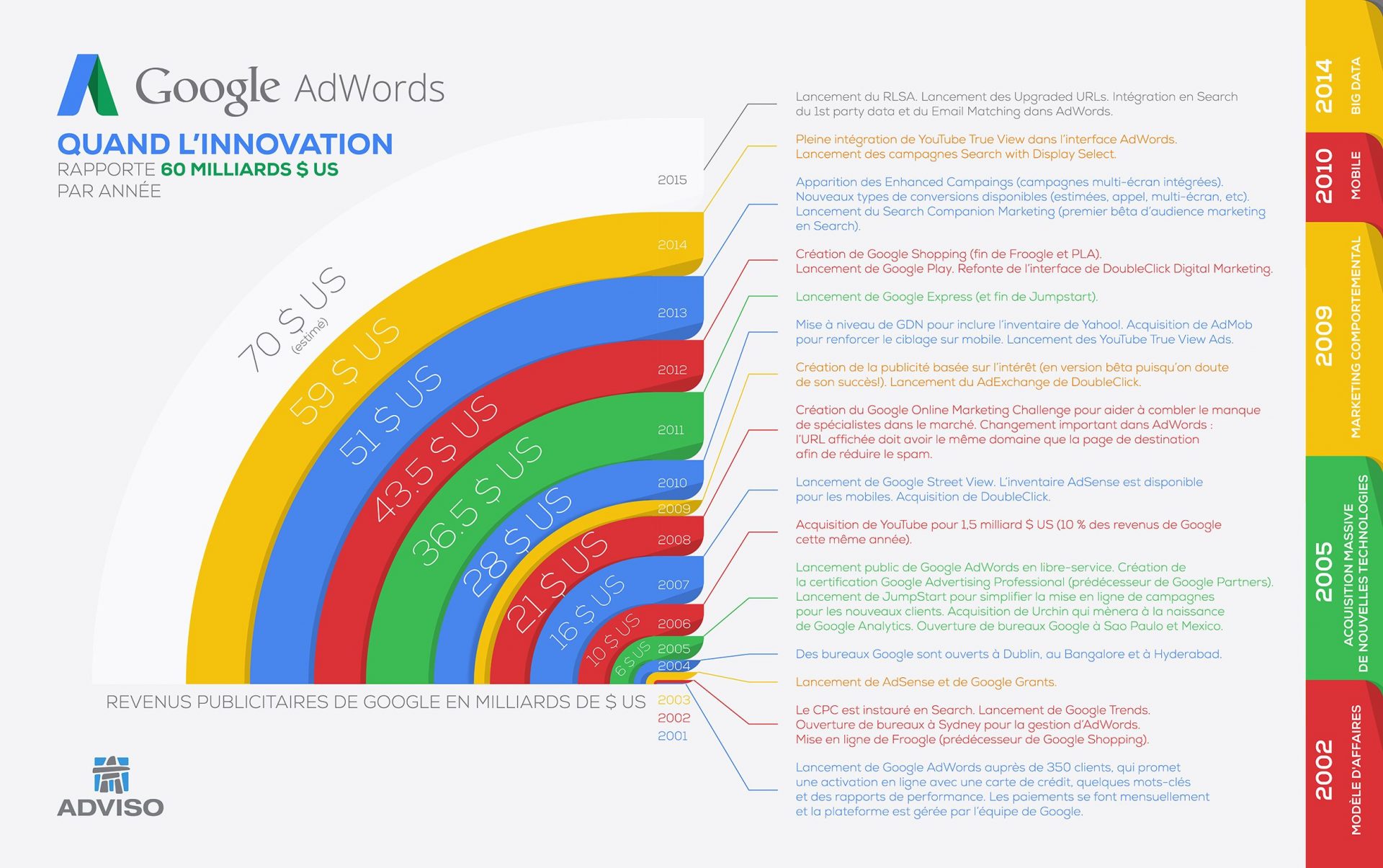
In 1995, a 22-year-old college student named Larry Page considered graduate school at Stanford. Sergey Brin, aged 21, welcomes him and shows him around the campus. In 1996, these two young men worked together on the BlackRub search project , the first content indexing engine that quickly took up too much bandwidth on Stanford's local servers. In 1997, Sergey and Larry founded Google and marked the beginning of a new digital era. Today, October 23, 2015, we celebrate the 15th anniversary of Google AdWords, Google's index monetization platform. Fifteen years after the creation of this content index which makes it possible to find Web sites quickly, Google now reports US$60 billion in revenue per year.
Why is the Google model so strong? Were Larry and Sergey the only visionaries of the last 15 years? Of course not! Which reminds me of an article from Les Affaires that caught my attention with its sensational title: Why Your Brilliant Idea Is Worth Nothing. In short, it is not the value of an idea that guarantees its profit, it is rather the way in which the company is managed and the realization of its projects. What characterizes Google is this innovation rooted in the company's DNA and its desire to acquire companies that already have ideas and technologies instead of trying to replicate them. Three years after the founding of the search engine, the first AdWords representatives arrived on duty and approached their first 350 customers. The company then sells spaces to be more visible in the index. We are very close to the Yellow Pages business model.
BUSINESS MODEL
The following year, 2002, Google tried a new business model based on that of Overture. We then go from a CPM display to a CPC display. From now on, the advertiser only pays when a visitor is really interested in his ad. This is where a pace of innovation and openness begins that will not slow down in the decade to come.
CONTENT IS KING
In 2003, Google realizes that content is king and allows any publisher to generate income by creating its Google AdSense service, just before the explosion in popularity of blogs in 2004 – 2005, which will therefore become powerful communication tools. social.
MASSIVE ACQUISITIONS OF NEW TECHNOLOGIES
In 2005, Google acquired Urchin and launched its public platform ( self-serve)Google AdWords. For the 3rd time in 5 years, Google is rewriting the rules of online marketing and AdWords brings in US$6 billion in the first year. In 2006, still in a policy of rapid innovation in emerging technologies, Google acquired YouTube for US$1.5 billion, which is equivalent to 10% of its annual revenue. The television industry laughs at this transaction. According to them, free hosting of videos (of cats and other cute animals, what's more!) is not profitable. However, when Google will launch YouTube True View Ads in 2010, approximately US$10 billion in additional revenue will enter their books after 4 years of research & development and US$1.5 million of initial investment. . In 2007, DoubleClick was added to the large Google family. But the program everyone is talking about at this time is above all that of Google Street View, which completes the already interesting offer of Google Maps (particularly interesting for those who always arrive late!). The year 2007 also marks the moment when I manage my first major CPC campaign with Via Rail Canada and make my debut in the world of digital advertising.
BEHAVIORAL MARKETING
In 2009, Google was inspired by the work of BT (Behavioral Targeting) pioneer George John (who worked for Yahoo! and founded Rocket Fuel, among others) and tried to include this revolutionary new approach to behavioral marketing in its platform. We are then interested in the digital information provided by Internet users and we try to deduce their interests. This is how Interest Based Advertising was born . Result: it is no longer necessary to target a person who is looking for a car on a dealer's website; it is now possible to target her anywhere in the Google Display network since she has demonstrated her interest in buying a car through the search terms used or the links consulted!
MOBILE
In 2010, Google invested in mobile advertising and launched its first Nexus phone. The industry is changing rapidly and the touchpoints with a once PC-only internet user are now spread across a multitude of screens and locations. In 2013, Google launched the enhanced campaigns service to better serve Internet users in their multiscreen journey, now represented by mobile, tablet, PC and laptop.
BIG DATA INTEGRATION
In 2014, a short episode of madness accompanies the launch of Search Companion Marketing , which unwittingly allows the entire industry to engage in a war to acquire customers from its direct competitors at very low cost. To counter this problem, Google offers a version where advertisers have less competitive power with each other. Thus are born the Search with Display Select campaigns , a hybrid between a display campaign based on the fields of interest of Internet users and a search retargeting campaign . In 2015, Google invested so that data or at the heart of campaigns, with tactics such as Remarketing List for Search Ads (RLSA), integration of 1st party data and Email Matching . After its big mobile shift in 2010, Google continues to ride the wave of digital marketing and is integrating more and more Big Data into it . In order to better support the future growth of its many activities joining fields of interest that go far beyond its search engine, Google is renamed Alphabet after 17 years of existence. It thus becomes the owner of Google and other innovations created by Sergey and Larry's team.
This short story of Google's evolution is intended as a moral, especially in the context of the Startup Weekend which is fast approaching: don't be cold-eyed with your ideas! Google X Lab offers one day a week where employees can invest their time and ideas in creating personal projects, which has led to the birth of some of Google's major innovations, and many more! As a company, invest in innovation and provide a platform for your employees to unleash their creativity!
For more details visit: http://www.google.ca/about/company/history/
.jpg?width=40&height=40&name=Pascal-Philippe-Bergeron_433%20(1).jpg)