
A year ago I posted an article defining the terms mission, objective, strategy, and tactic. It’s a piece I’ve often referred back to when I want to explain the difference between these terms, but I realized we were missing a condensed version. I wanted something I could print and put up at my desk so I could see the main ideas at a glance.
This realization brought about two results: A detailed table, and an infographic representing the elements in a hierarchy. It’s up to you to decide which version you’ll post at your desk!
Here’s the infographic
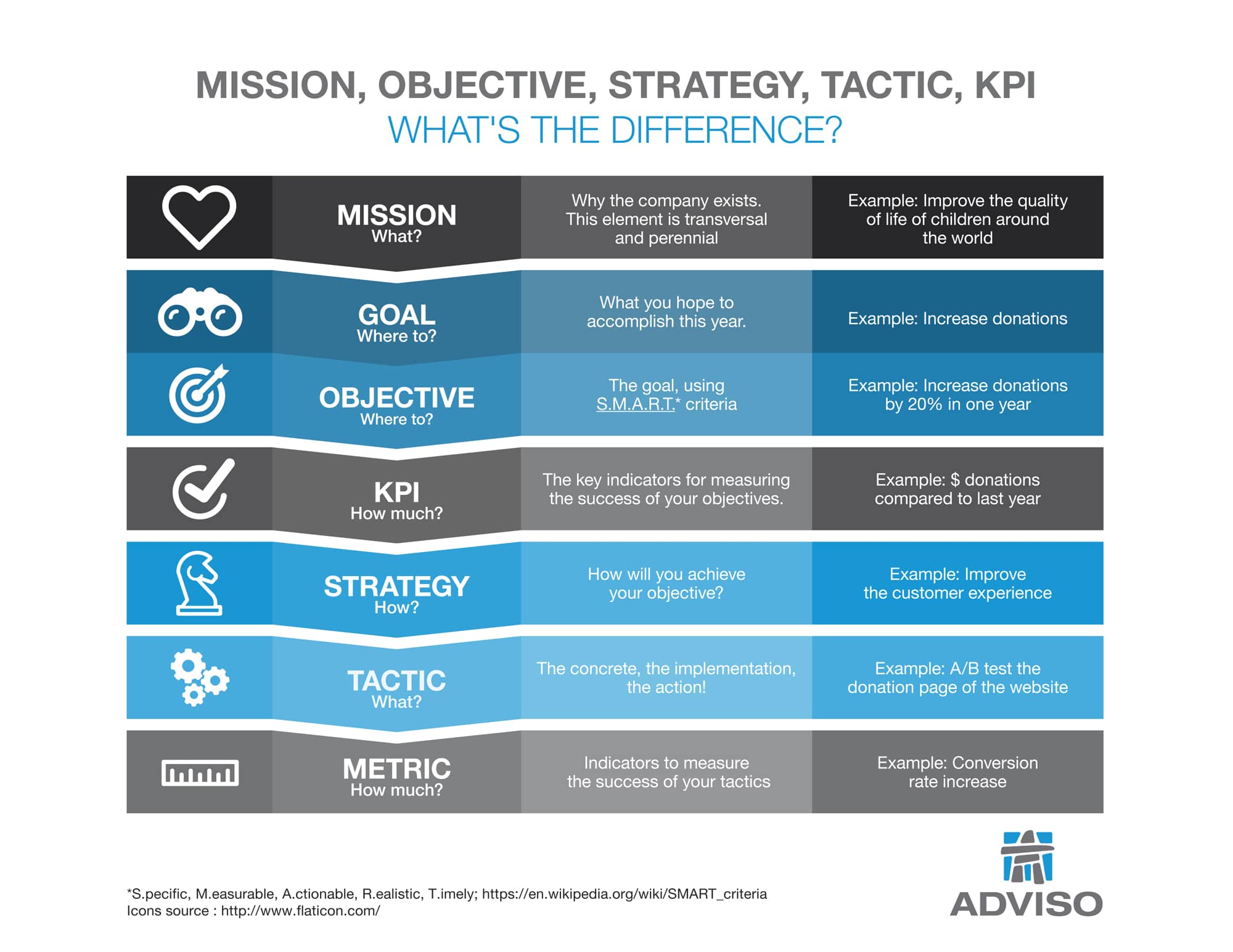
CLICK HERE TO DOWNLOAD IN PDF
HERE IS THE TABLE VERSION
TERM |
SUMMARY |
DESCRIPTION |
OMNICHANNEL MISSION 1 PER COMPANY |
Why ? |
Why the company exists. It is a transversal and perennial aspect. E.g.: Improving the quality of life of children around the world |
GOAL |
To where? |
What we want to accomplish this year Acquisition, Retention See / Think / Do / Care Ex: Increase donations |
OMNICHANNEL |
To where exactly? |
The goal but with a S.MART target * Ex: Increase donations by 20% over one year |
|
How many? |
Key indicators to measure the achievement of objectives. Segment Ex.: – Amount of donations compared to last year $ – Conversion rate |
|
How? |
How are we going to achieve the goal? Consistency between owned, earned and paid media. Funnel stages Analyze and prioritize E.g. Improve customer experience |
TACTICS |
What? |
It is the concrete, the putting into practice, the action! The tactics are linked to the strategies Several tactics per strategy Ex: Carry out an A/B test on the donation page on the website |
METRICS |
How many? |
Indicators to measure the accomplishment of tactics – Acquisition – Behavior – Conversion Ex.: – Number of visitors abandoning the process at each stage – Increase in conversion rate – Increase in average donation amount |
* S.pecific, M.easurable, A.ctionable, R.ealistic, T.imely
CLICK HERE TO DOWNLOAD IN PDF
SCOPE: THINK OMNICHANNEL!
As you can see, I added in details like scale (omni-channel/channel) for each item. Today, it’s no longer relevant to come up with separate channel strategies, since consumers don’t differentiate between channels. If the experience is bad in one channel (web, store, radio ad, call centre call…) it’s the overall brand image that’s affected.Scale: Think omni-channel!
In terms of defining objectives though, it’s up for debate whether they should be defined with an omni-channel approach, or channel by channel. Digital, for example, might contribute to part or even the entirety of an objective.
For instance, imagine three merchants, each of whom earns $10 million in online sales. Merchant A makes 60% of its sales through digital channels, while merchant B makes all its sales online, and merchant C only makes 3% of sales online. Even though their online revenue is the same, and they share a common business goal (generate online sales), these three merchants probably have very different digital strategies, tactics, and objectives.
A company’s business objectives might equally be broken down into campaign objectives and web objectives. The ideal still being to keep an omni-channel perspective for as long as possible, in order to keep things coherent.
Hierarchy of Objectives, Strategies, and Tactics
The ideal is to design the strategy and tactics around the goals and objectives of the company. But in working on marketing plans and strategic planning for redesigns, I’ve come to realize that some strategies and tactics respond to multiple objectives.
For example, an organization might have objectives about awareness – building brand awareness in a new territory, with a new target market… – and lead generation. In this example, the strategy of responding to user needs would meet two objectives:
- Objective #1 – awareness: By providing users with useful content, we improve awareness of the brand, mainly through search
- Objective #2 – lead generation: We might provide a piece of useful content in exchange for personal information: name, last name, title, phone number, email…
Moreover, a strategy generally has a longer shelf life than the tactics put in place, and the objectives that evolve with the company.
I’ll conclude with two bits of wisdom that I think are key to all this:
- Coherence:
- Between channels
- Between the objectives, strategies, and tactics put in place
- Between expectations and resources deployed!
- Measurement: Measuring, testing, and adjusting is still the most effective way to achieve your objectives, especially given the opportunities for measurement available on the web today.
Which version do you prefer? The table or the infographic?
