
Good news, as announced by our press release , we are now part of the very select club of authorized resellers of the Premium version of Google Analytics!
Many Web advertisers only remember the fact that this version is paid, but few know its real capabilities that make the tool a leader in its category. We were convinced by certain capabilities of Google Analytics Premium that make the difference in a world where data is (or should be) at the heart of decision-making.

Let's start by undoing a cliché that has a hard life: the Premium version of GA is not a pale improved copy of the standard version!
This version certainly resembles the standard version in appearance, but it is significantly more powerful and has exclusive features.
WHAT YOU MUST REMEMBER
Here are the main advantages of the Premium version:
- Non-sampled reports
- Stored data belonging to the customer
- Data -driven dynamic attribution model
- Reports grouping data from different properties
- 10 times more custom dimensions
- Personalized and unlimited assistance
For more details on the points mentioned, here are the following 2 tables .
GOOGLE ANALYTICS STANDARD VS. GOOGLE ANALYTICS PREMIUM
| Standard |
Premium |
Difference |
|
| Reports |
sampled |
Not sampled |
Veracity of data |
| Updating data |
Every 24 hours |
Every 4 hours |
Near real-time reporting |
| Custom Sizes |
20 |
200 |
10 times more custom dimensions |
| Guaranteed maximum number of hits per month |
10 millions |
20 billion |
2000 times more hits guaranteed |
GOOGLE ANALYTICS PREMIUM EXCLUSIVES
| Description |
|
| Data-driven dynamic attribution model |
Using Shapley's value (probabilistic method) to determine the contribution of each campaign during a conversion |
| Multi-site and multi-app view ( Roll-up reporting ) |
Reports grouping data from different properties |
| Technical support by phone and email |
Personalized advice, dedicated team of experts |
| 24/7 emergency assistance |
If needed |
ATTRIBUTION: FROM PREDICTION TO COUNTER THE LAST CLICK THEORY (DATA DRIVEN ATTRIBUTION MODEL)
Allow us to focus on a feature that particularly excites us at Adviso. We know that attribution is a recurring problem that gives advertisers, salespeople and marketers (marketers) headaches. It's hard to come up with a perfect method to attribute credit to each channel that contributed to the sale or conversion.
Even the features to create a custom attribution model bring a bias to the analysis. Indeed, the visitor can click on (or simply see) different campaigns, organic or not, before the purchase decision. Of course, it becomes a real headache to isolate the investment that really made the difference.
Google Analytics Premium offers a dynamic attribution model that evaluates thousands of channel combinations to find the real synergies. The model is based on a very powerful algorithm and making use of the enormous data processing capacity of Google. The algorithm uses mathematical principles of the Shapley model , allowing us to transform our way of designing our attribution model from a probabilistic model.
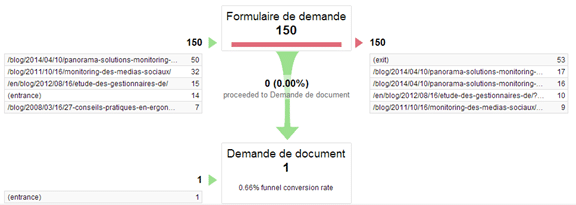
This is why it should not be based on the last impression or the last click only, hence the principle of attribution based on data (Data-Driven Attribution). Pleasure ? These few visuals will help you understand better.
HOW IT WORKS?
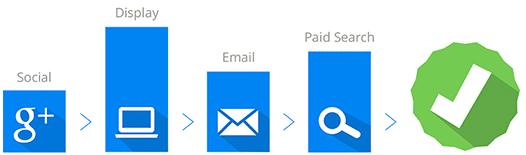
1. The algorithm will study the conversion path (aka Journey of the customer ) of each visitor on the site, whether it ends in a purchase/conversion or not. Then, based on a prediction of the channel's impact on final conversion, it will assign a value to each of your marketing channels at each touchpoint level.
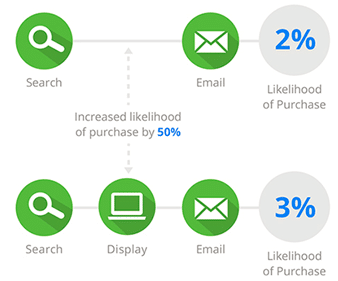
2. The probabilistic model then defines a conversion rate for all visitors coming from a particular conversion path, then compares this rate to another coming from the same set of visitors but having a different conversion path.
3. To view the Shapley model results on the attribution model, Premium users should refer to the “Model Explorer” report
-png-1.png)
4. All that remains is to compare the result with the default attribution model, adjust the combination and test.
Thus, attribution based on the Shapley model helps you overcome the problem of the last-click method. By testing different campaign combinations, you'll see which investments actually impacted your results, without the biases of a fixed attribution model. You no longer have to predict your attribution model, Google Analytics Premium does it for you based on your business reality.
