
Over the past few years Snapchat has been reproached for being stingy with information about its business direction, and advertising on the platform was nearly inaccessible. But the news that’s come out about the platform over the past few months, in particular a recent article in Adweek, is finally shedding some light on where the company is headed.
In recent weeks, for starters, we learned that Snapchat had passed Twitter in active users, with 150 million people using the platform every day.

Then last week it was announced that the Millenial-approved app was coming to Canada, opening a Toronto office to increase ad revenues in the region. Advertisers will get better support and increased opportunities, including, among others, Canadian content adapted to our market.
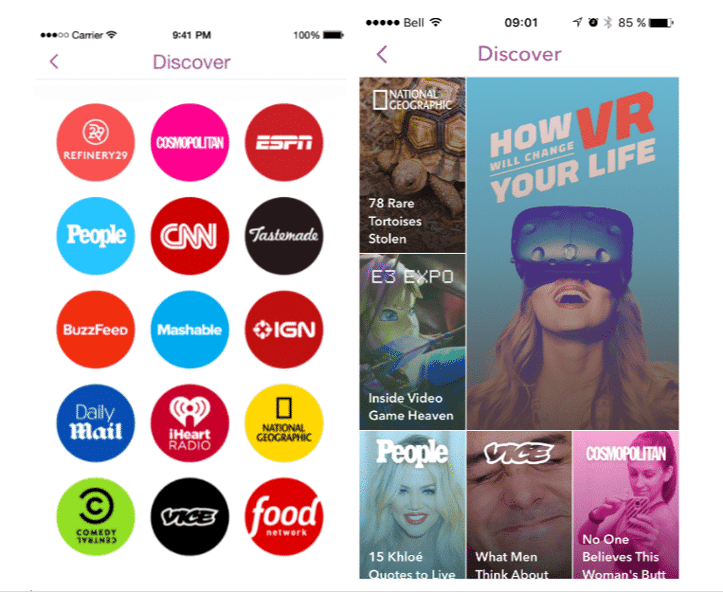
At about the same time, an update of the app gave users a redesigned Discover section with a brand new interface. With its catchy titles, there’s no doubt this is an attempt to increase the visibility of content and catch the attention of users who don’t usually look at this section.
And let’s not forget the recent app update that introduced autoplay for Stories, leaving room for the possibility of adding advertisements between stories. In short, all this is leading us to believe that over the past few months, Snapchat has slowly been preparing the ground to deploy its ad strategy.
API Launch and Third Party Suppliers
Until now, ads on Snapchat were deployed in a slow drip, reserved for a selection of handpicked companies. In light of the announcement made this week thouh, including the launch of its (highly anticipated) API, Snapchat will not only be democratizing access to advertisers, but revolutionizing the formats we’re familiar with.
To do this, we’ve learned that, among other things, Snapchat has allied itself with partners who have a particular expertise in developing software for the purchase, optimization and analysis of ad campaigns. To meet the company’s specific needs, creative partners have also been added to the mix, meticulously selected to work with the Snapchat format, the famous interactive vertical that we currently see on the Discover platform. Like Instagram did before making advertising available on its platform, Snapchat asserts that ads will be integrated in a very controlled way, in order to preserve the authenticity that made it so successful in the first place.
Available Ad Formats
Snapchat is betting on three ways of advertising on the application: sponsored geofilters, sponsored lenses, and content ads, which we will most likely be seeing more and more of.
Geofilter
For now, geofilters are the most accessible format on the platform. They are self-serve, and offered at accessible prices. For its 5th edition this year, C2MTL made several geofilters available when participants arrived within the geographic bounds of the event.

This format offers advertisers the opportunity to associate themselves with places and events, thereby reaching a qualified audience at a very acceptable cost. For example, a company that wants to reach Millenials might create a geofilter for a particular event they want to be associated with, like OhMyFest!, a festival that will bring together Quebec’s most influential YouTubers, and where participants are very likely to be using the application.
The sponsored lens
Since it first appeared on the scene, this format has revolutionized interactive advertising. Snapchat describes it best on its ad page: The most playful way to make an impact. So true!
Lenses have quickly become one of the most popular options on Snapchat. From the face swap to the dog filter, they plunge the user into an augmented reality whose success can probably be explained in part because the lenses are so well executed.
Sponsored lenses soon followed, and during the last Super Bowl, Gatorade hit its mark (scored a touchdown?) by sponsoring a themed lens that was seen 100 million times during the big game. The lens added eye black on users’ cheeks, and made it look like Gatorade was being poured over their heads. On more of an everyday level, Starbucks recently sponsored a lens that we got to try out in the office.

Content ads
This format allows advertisers to tell a dynamic story. Media partners of Discover are already using this narrative interface that moves users from top to bottom and left to right to consume content, and combines static images and videos. Snapchat calls this technology 3Vi, for Vertical Video Views and Interactive. According to the application, the swipe up rate for snap ads is five times higher that the average clickthrough rate on comparable platforms. As a bonus, a call to action button will appear once the content has run through.
Interesting fact: since this type of navigation emerged, we’ve seen other platforms follow suit. Case in point, a few months ago Facebook launched a similar product: Canvas. This product, like Snap Ads, exposes mobile users to immersive content combining carousel images, video (regular and 360 degree), animation, as well as calls to action and links to products and services.

By all accounts, the deployment of this expertise in vertical video promises to disrupt the way we create and consume information, and presents a challenge for design professionals who still see the use of the vertical plane as an amateur mistake.
Above all though, between all the strategies we’ve seen over the past months and the major partnerships announced this week, Snapchat has firmly staked its place in the ad market with an approach that’s perfectly geared to its audience.
Do these new developments rattle you, or do they motivate you? Tell us about it!
To follow office life at Adviso on Snapchat -> Adviso
To follow office life through our team member Catherine’s eyes -> mllecat
Thanks to Yannick Proulx, Digital Media Strategist, for his participation in the writing of this article.