
Here is a summary of the Infopresse conferences of the Web Strategy and Creativity Day that took place on November 9, 2011 at the Ex-Centris, with comments from the Adviso team that was present, Antoine Théorêt-Poupart and Thoma Daneau.
Antoine Desjardins of Tink
Antoine told us about the evolution of trends and technologies this year and the fact that companies should not always take the technological turn of the moment . He explained that the trap, often, was to see the latest technology being so boasted that after having appropriated it, the companies realize that it is in no way profitable for them .
Antoine presented 2 cases during the day: Bombardier and St-Hubert. The iPad application presented by marketing for Bombardier's aerospace division proved to be very interesting. The company needed to maintain buyer enthusiasm from sale to delivery; a process that can take up to five years. On the other hand, its profitability was not optimal since it served only one department. The challenge was to find a use for all departments. Now, from design to maintenance, the application affects all departments at Bombardier, allowing it to be a good ROI for the company.
The St-Hubert case mainly corresponded to the redesign of the order taking process on the Internet. To maximize efficiency, make it easier for repeat visitors, allow suggested menu additions, efficiently distribute orders to rotisseries, enable group orders, and more, Tink has completely changed the way you place orders by lines for St-Hubert. The efficiency has reached such a point that petanque players can now have St-Hubert delivered right to Parc Lafontaine!
Twist Image's Paul McEnany
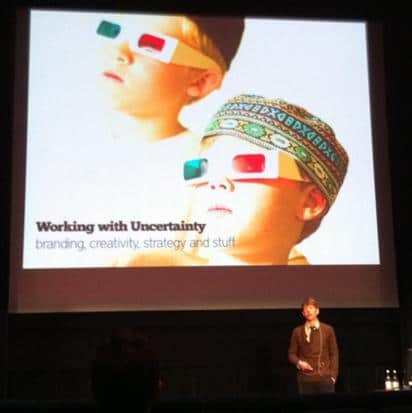
Paul McEnany's theme was work and the uncertainty that agencies face when it comes time to create .
To illustrate this principle of uncertainty, Paul McEnany spoke of the feeling of control that one can feel when managing campaigns with Clicks-Through-Rate: "It makes us feel like we are in control [even if we know it's not working.]”
A principle that is, we believe that Creative Destruction , brought by McEnany, is important: “ The most resilient companies are actively contributing to their destruction and reinvention ”. It is by always trying to reinvent yourself through destruction that you can become a stronger and more creative company.
A campaign should stop focusing on new technologies and new media. The important thing is to understand that if a tool like the QR code is considered a new technology, but is not used by the average consumer, it will prove useless in a campaign, despite all the promises do the marketers. Before using a new technology that shows promise, you have to ask yourself if the customer will be able/interested in using it.
One of the important lessons that Paul McEnany was also trying to pass on is: “ Follow the DIS principle ”. Do Interesting Shit and people will be interested in you and your product.
Gregory Baret of Nurun
Grégoire Baret came to talk to us about innovation and people's new reality. The new consumer thinks :
- I know everything about everything!
- I am everywhere and nowhere!
- I don't own anything… but everything belongs to me!
- I have superpowers!
We can only approve of these remarks if we consider that the individual believes himself to be a connoisseur simply by having Wikipedia at hand. "You shouldn't take the consumer for an idiot, it's your wife". Man is made a mutant thanks to the digital. He can do more things.
Grégoire then approached the theme of 360 degrees from a negative point of view: it is not because an individual is bombarded from all sides on all sides that he will feel more committed to the brand.
The brand must be positively involved in its life. Several examples of positive hacking were put forward. A positive hacking is to “Identify the flaws to make progress, through the creative use of technology”. Take for example Volkswagen which measured the speed of motorists using a radar in order to reward those who respected it.
Following a panoply of examples given by Grégoire, each more sympathetic than the other, the message was clear:
- Digital is a means, not an end
- We need to get out of old narrative patterns (stop trying to make new out of old)
Gaëtan Namouric – BleuBlancRouge: Have we become robots?
Gaëtan Namouric, an outstanding speaker, offered us a reflection on the future of advertising and creation. This critical reflection was based on the history of advertising over the past 30 years.
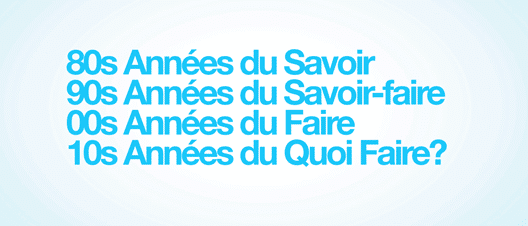
Paul McEnany's theme was work and the uncertainty that agencies face when it comes time to create .
To illustrate this principle of uncertainty, Paul McEnany spoke of the feeling of control that one can feel when managing campaigns with Clicks-Through-Rate: "It makes us feel like we are in control [even if we know it's not working.]”
A principle that is, we believe that Creative Destruction , brought by McEnany, is important: “ The most resilient companies are actively contributing to their destruction and reinvention ”. It is by always trying to reinvent yourself through destruction that you can become a stronger and more creative company.
A campaign should stop focusing on new technologies and new media. The important thing is to understand that if a tool like the QR code is considered a new technology, but is not used by the average consumer, it will prove useless in a campaign, despite all the promises do the marketers. Before using a new technology that shows promise, you have to ask yourself if the customer will be able/interested in using it.
One of the important lessons that Paul McEnany was also trying to pass on is: “ Follow the DIS principle ”. Do Interesting Shit and people will be interested in you and your product.
Gregory Baret of Nurun
Grégoire Baret came to talk to us about innovation and people's new reality. The new consumer thinks :
- I know everything about everything!
- I am everywhere and nowhere!
- I don't own anything… but everything belongs to me!
- I have superpowers!
We can only approve of these remarks if we consider that the individual believes himself to be a connoisseur simply by having Wikipedia at hand. "You shouldn't take the consumer for an idiot, it's your wife". Man is made a mutant thanks to the digital. He can do more things.
Grégoire then approached the theme of 360 degrees from a negative point of view: it is not because an individual is bombarded from all sides on all sides that he will feel more committed to the brand.
The brand must be positively involved in its life. Several examples of positive hacking were put forward. A positive hacking is to “Identify the flaws to make progress, through the creative use of technology”. Take for example Volkswagen which measured the speed of motorists using a radar in order to reward those who respected it.
Following a panoply of examples given by Grégoire, each more sympathetic than the other, the message was clear:
- Digital is a means, not an end
- We need to get out of old narrative patterns (stop trying to make new out of old)
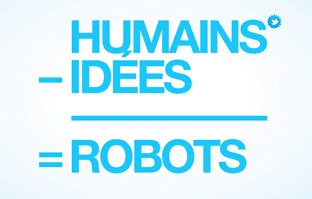
Gaëtan Namouric – BleuBlancRouge: Have we become robots?
Gaëtan Namouric, an outstanding speaker, offered us a reflection on the future of advertising and creation. This critical reflection was based on the history of advertising over the past 30 years.
Todd Alchin – Ikon3/Droga5
Todd Alchin came to show us the Jay-Z and Bing Decoded campaign he had been working on. This campaign was awarded a Cannes Lions Grand Prix in the outdoor advertising category.
This campaign was marked by the number of hours they had to invest in the creation and in the logistics of immediacy. As shown in the image below, each page of Jay-Z's book had to be dissected in order to find him the best place and the best medium to display it.
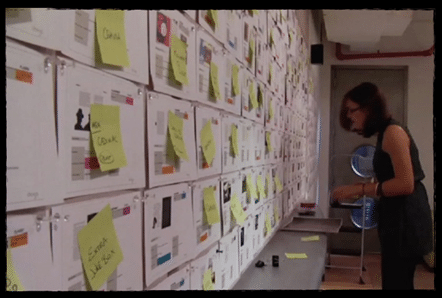
As you can see, simplicity was not in order.
-3.png?width=472&name=112111_1512_Rsumdesconf5%20(1)-3.png)
Thoma Daneau and Antoine Théorêt-Poupart


Journée Infopresse sur les moteurs de recherche 2008 : Summary of Brent Csutoras’ conference
For those who don’t know, Brent Csutoras is a highly regarded independent consultant specializing in social media and search engine marketing from San Francisco. Some of his most famous work comes from the Weirdasianews.com blog which made Digg’s homepage three times in the past 36 days (the blog has 17 stories with 1000 diggs and more).

5 steps to go from conversation to conversion
It is within the framework of Infopresse Day on the theme of the participatory web that Jean-François Renaud presented the conference entitled: Moving from conversation to conversion . In other words, how to ensure that your online presence achieves the business goals you have set for yourself. In short, a conference that combines social strategy planning and performance measurement. So it's around 5 big steps that is the presentation that I summarize for you in this post, but above all I suggest that you skim the article: Social media marketing: how not to skip steps before continuing your reading. As this article says, make sure you have an effective web presence and list your strategic web assets before starting any social strategy. If so, let's jump into the summary of the 5 crucial steps that will take you from conversation to conversion.

Opinion: Planning for the future when the present is uncertain
I don’t have to tell you that we are living through a unique period in time. The COVID-19 has effectively disrupted human behavior in just about every sphere of our daily lives. Work? From home. Socializing? Through screens only. Shopping? Almost exclusively online, or in a crazed frenzy.