

Optimizing a website's TITLE tags is one of the most important steps, if not the most important step in an SEO strategy. It is therefore essential to apply in writing them. The TITLE tag is not only the most considered page element by Google: it also occupies a prominent place in the search results page. So, you need to optimize your TITLE tags so that they are optimal for Google, but inviting for the user. You have to know how to balance between a positioning objective and click through.
This article discusses 3 techniques for writing TITLE tags.
1. Pure SEO optimization
It is best if the order of the keywords included in our tags are exactly the same as the keywords included in the user's search phrase. Obviously, Google will tend to prioritize titles with keywords written in the same order as those included in the user's search phrase. However, we can get good results for unordered sets of keywords. For example, a broad targeting search on “Cellular battery” generates the same number of searches as “Cellular battery”. By default, Google will generate similar results for both sets of keywords.
For maximum SEO optimization, I suggest constructing the TITLE tag with two-word terms rather than attempting to construct a perfectly structured phrase. Note that 94% of searches made on Google contain more than 2 words, of which 28% contain 2 to 3 keywords.
http://www.onestat.com/html/aboutus_pressbox45-search-phrases.html
Example:

We have 6 keywords + 5 two-word terms, so 11 opportunities.
In addition, we can add keyword matching to opportunities. Thus, two words present in a TITLE tag can be considered by Google even if they are not juxtaposed, although the effect is less strong. For example, battery + rechargeable or phone + battery
2. Click-trough optimization
The optimization of the "click trough" consists in building attractive titles for the user and incentive to click. The rationale behind this strategy is that it takes more than just showing up in search results, it also takes a click to generate an organic visit. On the other hand, the inclusion of conjunction words decreases the opportunities to insert strong trending keywords. So there is less of an SEO opportunity, but the click-through rate will increase, which can be particularly important if the site occupying the first result is entrenched (eg Wikipedia). It should be noted that the presence of the brand positively influences the click-through rate, since it attracts attention and reassures the buyer.
Example:
Buy a new battery for your cell phone | Mark
3. The winning combination
The combination of the first two solutions allows a balance between positioning and click through. First, avoid words with conjunctions (le, la, les, vos, etc.). Second, look at the combination of keywords.
Example:

We now have an understandable and impactful sentence. Additionally, we have a minimum of 5 keyword combinations as well as 8 relevant individual words.
In closing, here is a table that summarizes the strategies:
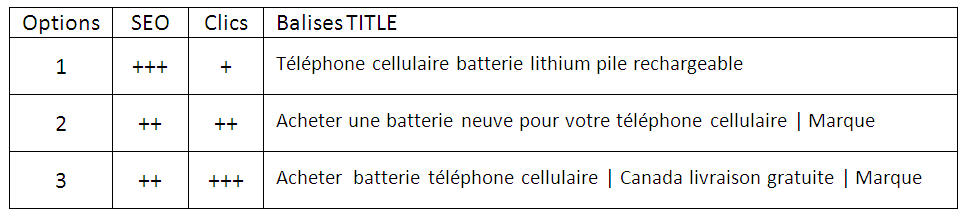
The method for writing TITLE tags should be chosen based on your goals, the technical limitations of your website, and your site's current position in search engine results. Thereafter, you must identify the most relevant keywords and build optimized phrases from these keywords. Track the performance of your tags and feel free to modify them as needed

iOS 9 signals the end of mobile applications
In parallel to smartphones, the rise of mobile application stores like Apple’s App Store and Google’s Play Store has been the biggest change in the technology sector in recent years.
Why Data-Enabled TV is the Biggest Thing Since Programmatic Ads
Some tend to believe that television is a medium in decline. But looking at the figures with a little more attention and hindsight, we come to a completely different conclusion. Learn more in this background analysis. When you think of traditional delivery channels like print, TV, radio and OOH, TV seems to be the least affected by the shift in advertising budgets to digital. The major brands continue to inject large portions of their budget into television advertising. Nevertheless, this reality is undergoing a rapid metamorphosis, for several reasons. First, as many of you know, 2017 was the first year in history that digital advertising beat TV in terms of media spend by marketers. In fact, that's exactly what eMarketer predicted back in 2016. But keep in mind, the numbers above can be deceiving without proper context and a more comprehensive analysis. Any digital marketer who expects to see clients start moving dollars from TV spots to 300×250 desktop banners has another thing comi …

Tool – ‘window resizer’ for Firefox
What is the resolution of your screen or screens if you are lucky? Designers and site developers very often have a screen superior to ordinary mortals. It should be remembered that the most popular screen resolution is still 1024 x 768. It is important when designing a site to test the visual in this resolution to see the elements that are visible ‘above the fold’.