
Search Engines: The Key Step Before Making a Purchase
Before purchasing a product, North Americans prefer using search engines to gather information*. More than half of consumers (54%) use the search bar, rather than searching on Amazon (43%), going directly to a retailer's website (43%), talking to their friends (28%), or browsing social media (26%).
Adviso, a firm of experts in digital strategy and marketing, chose to analyze the visibility of various Canadian furniture retailers in this crucial stage of the buying journey. Whether they are buying online or in-store, Canadian and Quebecois consumers research online before purchasing furniture, as these are high-involvement products.
We quantified the visibility share of national and international retailers in the Canadian market, specifically in the Quebec market. With a sample of over 100,000 keywords searched in Canada by consumers actively looking for new furniture, we were able to answer our questions and observe how our retailers defend themselves against foreign players. As Google captures nearly 90% of online searches in Canada, we focused our efforts on this search engine.
*PwC, “June 2023 Global Consumer Insights Pulse Survey”, June 26, 2023
Methodology
To assess a player's visibility compared to its competitors, we typically use the share of voice in organic searches.
This type of metric helps website owners better understand their competitive landscape for each product or service segment. Additionally, this approach allows them to identify content opportunities by segment.
In this case, we have chosen to apply our share of voice approach to an entire industry to precisely determine who is capturing the largest share of online searches. You will find our detailed methodology at the very end of this article.
Which retailers are the most visible?
Although the traffic generated by search engines is assessed for Canada, the vast majority consists of traffic from Quebec.
-2.png?width=9680&height=6592&name=D%C3%A9taillants%20les%20plus%20visibles%20%20Qu%C3%A9bec%20en%20fran%C3%A7ais%20(1)-2.png)
For searches in French, IKEA is by far the most successful and undoubtedly plays a significant role in the furniture purchasing journey for consumers. Among Quebec-based companies, Tanguay and Structube compete for the second position. Several Canadian retailers have no visibility in French.
-2.png?width=9680&height=6592&name=D%C3%A9taillants%20les%20plus%20visibles%20%20Canada%20anglais%20(1)-2.png)
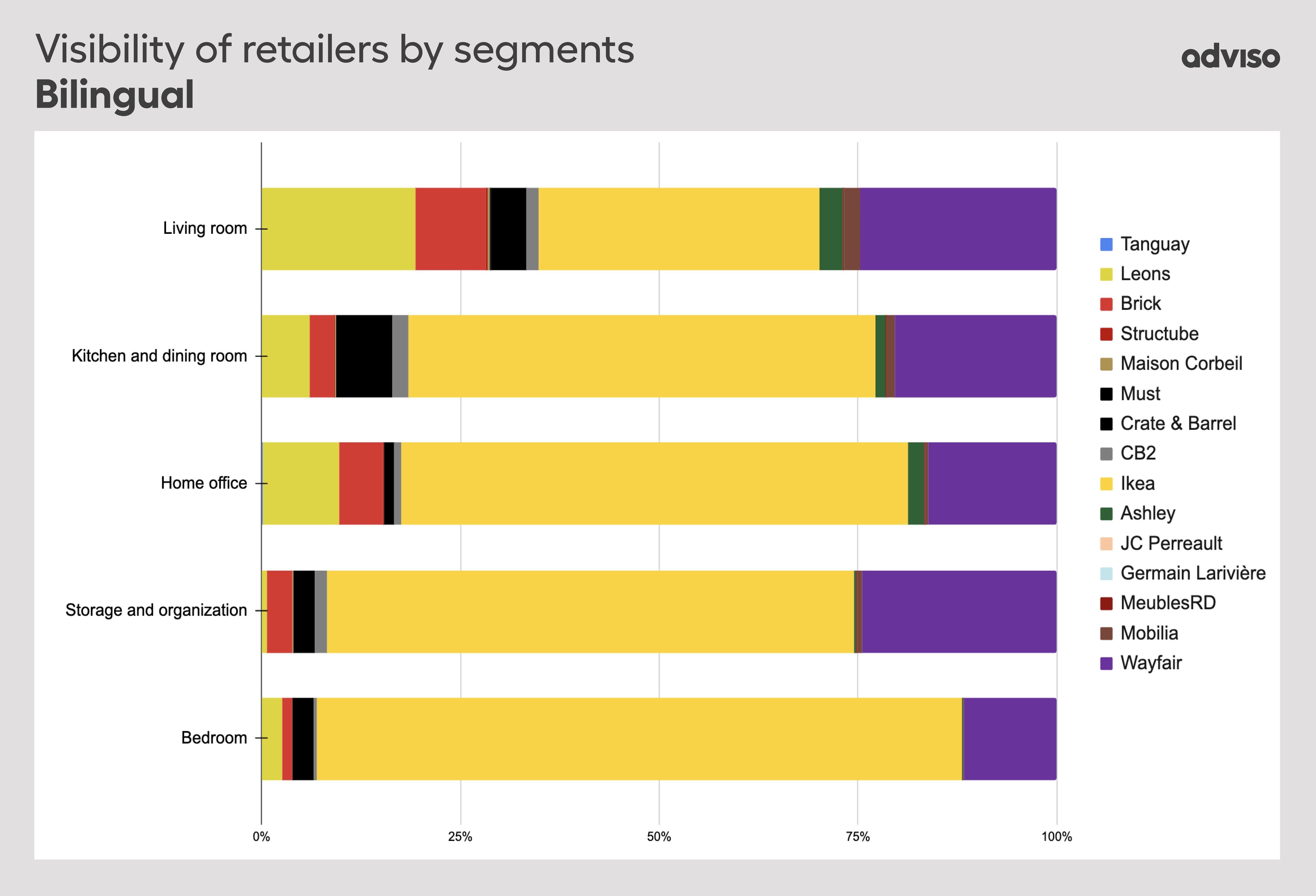
IKEA also dominates in English for all the segments we have analyzed (living room, kitchen and dining room, bedroom, home office, and storage, and organization). In the second position, we find Wayfair, one of the newest players in the furniture market.
In the top 5 English keywords in Canada, we also find Leon's, The Brick, and Structube. Although they are not as dominant as IKEA or Wayfair, these retailers still receive good organic traffic on their respective websites.
Retailers primarily based in Quebec obtain a negligible share of the English traffic from search engines. This is quite minimal considering that nearly one in five Quebecers speaks English at home (Statistics Canada).
Trend by Product Segments
On average, the product segments analyzed in French are growing by 6.2%. The only product category experiencing a decline is home offices. As for English keywords, all segments are decreasing, except for the bedroom, which has increased by 10% compared to last year.
Best Practices
Our analysis has allowed us to identify common practices used by retailers that are the most visible in search engines. Here are some of them:
Content Quality: The most important ranking factor of all, high-quality content that addresses consumers' search intentions. For example, IKEA has enriched its pages by adding tips related to consumer queries. This change seems to have benefited IKEA significantly, unlike the websites of many other retailers that merely display product lists under each category.x
Domain Authority / Inbound Link Profile: Retailers like IKEA and Wayfair have highly authoritative domains because they are well-known internationally. Smaller retailers looking to improve their website authority must implement a systematic plan to increase their site's authority.
Technical Optimization: A key element for any website, especially for e-commerce sites. From a technical standpoint, what has the most impact is the website's indexability, loading speed, robots.txt file, site map, and more. We have noticed that many e-commerce sites neglect internal link structure. However, when used strategically, internal links can significantly boost the authority from essential pages to a site's fundamental pages. For example, you will find internal links to product category pages on IKEA's How-To site.
Why isn't Amazon included in this analysis?
While we mentioned at the beginning of the article that 43% of North American consumers consult Amazon when in the purchasing process, it may seem odd not to find this giant in our analysis. This is because it is very difficult to isolate the categories evaluated on the Amazon Canada website. However, our analysis leads us to believe that the giant is on the podium of websites that attract the most organic traffic, both in English and French.
Conclusion
In conclusion, major international furniture retailers such as IKEA and Wayfair dominate the Anglophone market compared to Canadian retailers. In the Francophone market, some Quebec-based furniture retailers gain a significant share of traffic and visibility, but IKEA remains the undisputed leader.
Furniture retailers looking to improve their visibility during the information search phase at the beginning of the purchasing process must proceed methodically. How? By starting with identifying opportunities to create, eliminate, or revise content that will have the most impact for each segment. A content audit will help achieve this goal.
Some crucial choices will be necessary to succeed in gaining a place in increasingly crowded search result pages: selecting strategic segments and focusing on them, as well as allocating resources dedicated to optimizing content, analyzing consumer trends, and producing relevant content aligned with the company's growth ambitions.
Many companies have already embarked on this shift. Now, it's essential to surround yourself with competent experts to stand out. At Adviso, we can accompany you and accelerate the implementation of an optimal content strategy that will propel you on search engines.
Detailed methodology : Share of voice
1) La collecte de données
The two objectives of this phase are to identify the important segments to analyze and gather all necessary data (keywords, search volumes, cost per click (CPC), competition, traffic potential, positioning, etc.) on the most visible domains. Specifically, you should:
-
Identify the segments to analyze
-
Select the companies to analyze
Export all keywords from the selected domains for each of the companies for specific segments. The important metrics needed for analysis are:
-
Keywords from all sites
-
Search volumes for each keyword and estimated traffic for each site (this data is available specifically for Canada on a monthly basis)
-
Exclude brand searches from the analyzed keywords
2) Data Transformation
The objective of this phase is to establish parameters to exclude brand searches and filter all terms that we want to include for each of the segments, so that the exported keywords are grouped into the appropriate segments.
3) Data analysis
The objective of this phase is to analyze the data and identify Google visibility opportunities for the companies studied. This is made possible in this phase, as all the transformed data from phase 2 is compared in a summary table to identify :
-
The percentage of estimated traffic based on the context of the company studied in terms of competitors per segment;
-
The positioning of each company by keyword (rank);
-
The monthly traffic of each company;
-
The number of keywords included in each of the segments.
4) Limitation of Our Data
-
Provincial data is difficult to access and compare. Therefore, the search volume is national (Canada);
-
Larger players that do not specialize specifically in furniture sales, such as Amazon and Walmart, had to be excluded;
-
Our trend data is based on the top 1,000 keywords that generate the most traffic for each segment.
