
The performance of your Facebook campaigns is slow? Are your campaigns not performing as well as they should? Looking for tips to optimize your Facebook campaigns? You are in the right place!
Here are 8 tips to optimize your Facebook campaigns like a #pro!
1. MUTUALLY EXCLUDE AUDIENCES FROM YOUR CAMPAIGNS
Normally, you should have some of these audiences in your ad sets : ● Remarketing ● Custom Audience ● Look Alike ● Interests
Consider excluding audiences in each of your ad sets. For example, for the Look-Alike , Remarketing audiences and your Custom Audiences must be excluded. However, it is essential to never exclude your prospecting audiences in your Remarketing Ad Sets . Users would thus be excluded from all of your targeting.
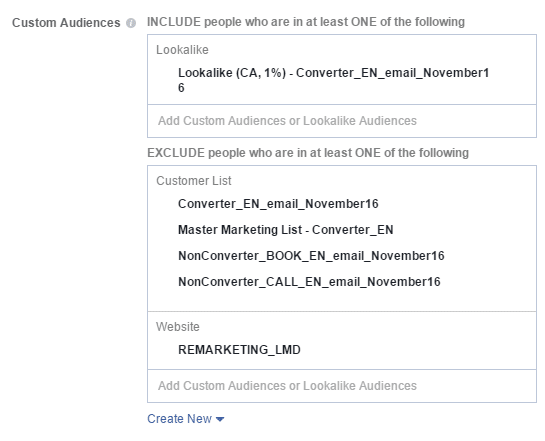
This allows you to have better control of the message and the frequency at each stage of the consumer journey.
2. DIVIDE MOBILE TRAFFIC AND DESKTOP TRAFFIC
Isolating mobile traffic and desktop traffic is beneficial for several reasons.
This allows:
1. Adjust ad text, based on placement. On the mobile, there is less space, so avoid having too much text, otherwise it will be cut off.
2. Quickly observe the performance of the two investments and make the necessary adjustments
3. Establish a separate budget, according to the performance of each of the investments
3. SEPARATE THE NEWSFEED AND THE RIGHT SIDE AD
Facebook tends to prioritize newsfeed traffic over right column traffic . It's a shame, because right column traffic performance is often very competitive! For this reason, I recommend isolating both. The benefits of doing this are the same as for point #2.
4. ANALYZE THE RESULTS OF MOBILE OPERATION SYSTEMS
Is it possible that Android or iOS users react differently to your products and/or services? If so, maybe you should show them a different ad? Maybe you should allocate a different budget or block an operating system altogether.
5. ANALYZE THE RESULTS OF AGE AND GENDER GROUPS
Does an age group offer better results? Do women convert more than men? Men aged 45-54 watch your videos more?
Segmentation by age group not only allows these results to be isolated and optimized accordingly – pausing age/gender groups or isolating ad sets , but it also generates business intelligence. valuable business. For example, maybe you thought that 25-34 year old men were your target audience, but in the end they don't react well to your product while 35-44 year olds are very receptive to what you offer. If necessary, you can modify or adjust your strategy based on this information.
6. ANALYZE THE RESULTS BY HOURLY BLOCK AND BY DAY
Do you invest part of your campaign budget during times of the day or on days when users are less receptive? If so, you should consider pausing those periods or days! Here's how:
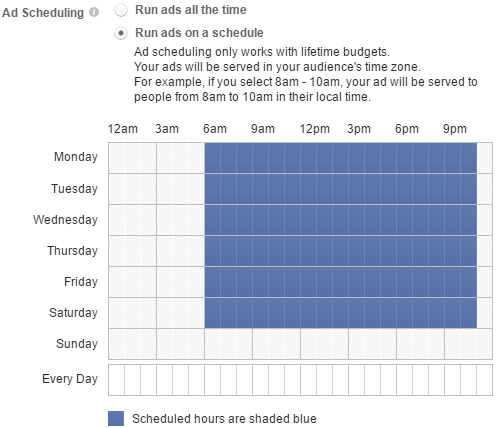
Note that you must use a “Lifetime” budget to be able to use this option.
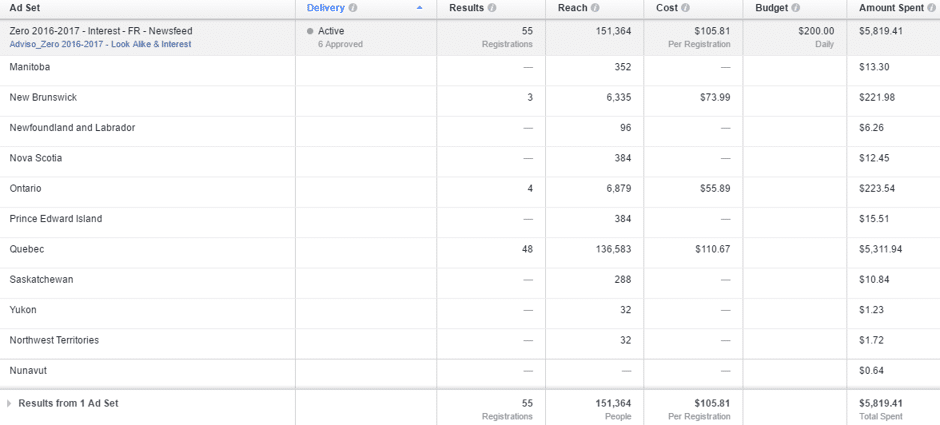
7. ANALYZE PERFORMANCE BY REGION
Performance can vary greatly from region to region. It can therefore be advantageous to separate the ad sets, even if there is no imperative to do so for budgetary or regulatory reasons.
8. TEST THE PLATFORM OPTIMIZATION MODES
It's your lucky day. There is a very interesting new tool for testing in the platform: a/b tests!
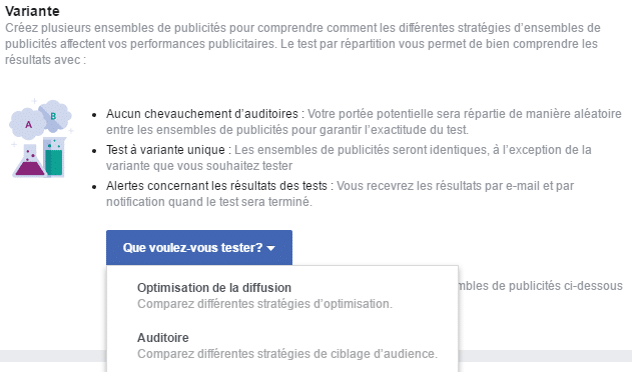
This allows for reliable test results without overlapping audiences. Say goodbye to in-house a/b testing!
There are currently three levels of testing available:
1- Optimization of distribution
2- Audience
3- Placement
As this subject is very broad, my next blog post will be entirely devoted to this subject. Stay tuned!
With these 8 optimization tips, you can quickly improve the performance of your Facebook campaigns. Although simple, these tips are efficient and effective. Too often in digital media we tend to over-analyze, when the quick wins are within reach. Why not use it?
I also urge you to take online courses from Facebook's e-learning program, Blueprint , which is a great resource. Finally, why not get certified as a Facebook specialist? I invite you to read my article on this subject!
Good optimizations!
