
We've been talking to you about marketing automation on this blog for several times, and yet we've never shown you what it looks like in practice. So we're catching up today, by showing you many of the automations we've implemented in recent months. Take inspiration from these “workflows” to automate your marketing, increase your efficiency and grow your revenue faster.
AUTOMATION MADE EASY
Before getting to the heart of the matter, let's try to simplify what automation is. Basically, an automation is made up of two main elements: a trigger and an action.
The trigger is the primary condition that, if met, will start the automation. The action will be the consequence of turning on the automation. It is possible for a single trigger to cause multiple actions in a single automation.
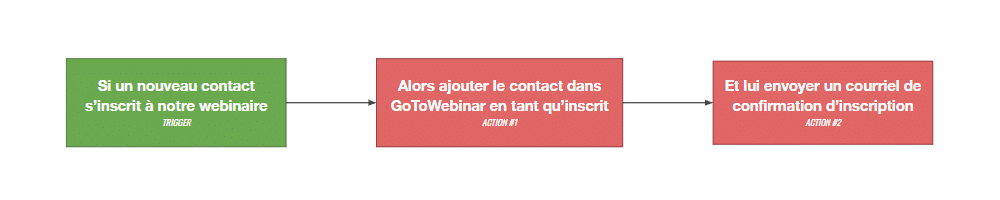
Between the trigger and an action, different elements can be inserted in order to better control the triggering of the action. For example, a delay, so that the action does not trigger immediately, or a secondary condition allowing the automation to be divided into two branches.

Actions ultimately represent all those tasks you do on a daily basis to deploy your marketing strategy. Tasks that are often repetitive, and which would benefit from being automated to free up your time for activities with higher added value.
As for the triggers, which are the starting point of any automation, it is relevant to divide them into three main groups: those based on time, those based on an action and those based on a behavior.
TIME-BASED AUTOMATIONS
Time-based automations are the easiest to set up, as there is no complexity in setting up the trigger. It's not surprising that most email marketing platforms offer this kind of automation.
Here are some examples :
- If it's the birthday of one of your contacts, then a greeting email is sent to them. Required: have the contact's birthday.
- If your contact has been your customer for a year, then a thank you email is sent to themRequired: have the contact's first purchase date.
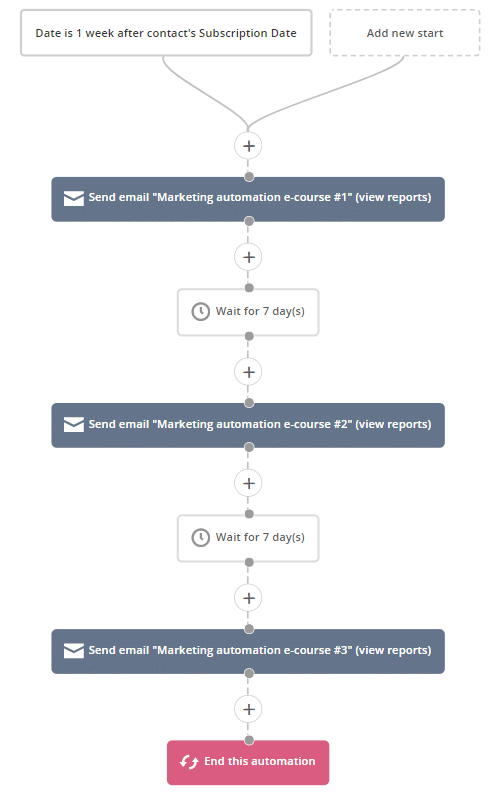
- If an email is sent on day 1, then a second email can be sent on day 7, then a third email on day 14.Required: have "delay" functionality.
ACTION-BASED AUTOMATIONS
Automations based on a contact action require more functionality to be able to implement them. These are automations that are conventionally offered by most marketing automation platforms, because they do not present any particular difficulty except good integration capabilities; moreover, these automations are also beginning to appear on certain email marketing platforms (MailChimp, CampaignMonitor, etc.), a sign that they are becoming more and more democratized.
Triggers can be: form submission, page visit, email interaction, adding to cart, manual status change, etc.
So here are some examples of automations, categorized according to the part of the purchase journey they support:
CONVERSION
- If a contact adds a product to their shopping cart, but does not complete their order, then a reminder email ( abandoned cart ) is sent to them.
- Required: have an integration with the e-commerce platform.
- Also works for a product seen by the customer even if it has not been added to the cart.
LEAD NURTURING
- If a contact registers for your webinar, then they are added to the list of registrants in GoToWebinar and receive a registration confirmation email (as well as registration reminders closer to the webinar).
- Required: capture webinar registration (via a form or an integration) and have an integration with GoToWebinar.
- If an opportunity is marked as "lost" in the CRM by a rep, then a series of nurturing emails are sent to the lead to attempt to convert them later.
- Required: have a CRM layer in the platform or integration with the CRM (or lead management tool).

LOYALTY/COMMITMENT
- If a contact subscribes to your newsletter, then they automatically receive a welcome email.
- This email can include a welcome message (reminding your USP and the added value of this newsletter…), the details of its subscription (eg: frequency of reception) and key articles from the blog to start reading right away.
- Required: capture the subscription to the newsletter (via a form or an integration).
- If a lead becomes a customer, then he receives several onboarding emails to present him with all the features of your product and increase the chances that he really uses it.
- Required: have a CRM layer in the platform or integration with the lead management tool.
- If a project has just ended, then a satisfaction questionnaire is sent to the client.
- Required: have an integration with the project management tool.
- If a contact has not opened your newsletters for more than 6 months, then an email is sent, asking them to confirm that they wish to continue receiving your informational emails.
- Required: monitoring of email openings.
- If there is no confirmation within 30 days, then their email is removed from the mailing list.
RETENTION
- If this inactive customer reacts positively to a reactivation email (see example below), then an email from customer support is automatically sent to him to offer help in using the product (eg: coaching call).
- Also works in the lead nurturing stage: if an inactive lead reacts positively to an activation, then a sales email is automatically sent to him…
SALES
- If a lead visits a key page on your website (e.g. “Pricing”), then an email is sent to your sales team.
- Required: Track website visits.
BEHAVIOR-BASED AUTOMATIONS
Contact behavior-based automations go way beyond action-based automations, as the trigger here becomes a series of actions or inactions. Collecting these actions requires an ability to integrate with the different tools where these actions are taken, as well as an ability to manage these actions, associated with a particular contact.
This is where the “contact management” brick, one of the three main pillars of a marketing automation platform, takes on its full importance.
As a reminder, the three pillars of a marketing automation platform are: a centralized contact database, a marketing engine for creating content and automating processes, and a comprehensive measurement and analysis tool.
Triggers can be: changing the value of a custom field, receiving an event from a third-party tool, adding a tag associated with a contact, etc.
Here are some examples of these automations:
LEAD NURTURING
- If a contact opens a promotional email, but does not convert to the proposed offer, then they are added to a remarketing list in Facebook.
- Required: track visits (and conversions) on the conversion page (via tracking pixel) and have an integration with Facebook.
LOYALTY/COMMITMENT
- If a contact views multiple content on a particular topic on your site, then a series of emails covering that topic is sent to them (additional articles, relevant pieces of content, etc.).
- Required: Track website visits and assign tags to contacts based on their visiting behavior.
RETENTION
- If a contact interacts with your campaigns or website in the last 30 days, then they are identified as "Engaged".
- If this contact has not interacted with your campaigns or website in the last 30 days, then they are identified as "Disengaged". And if he hasn't interacted with you in the last 60 days, then he's identified as “Inactive”.
- Required: track interactions on campaigns and website and have the ability to tag contacts based on the data collected.
- If a customer becomes "Inactive", then he receives an email presenting him the news and inviting him to come back and take a look at your product/service.
- Required: Track connections on your website.
- If a customer is identified as "happy" (ex: having answered 7+ to the last NPS survey), then he receives an email offering him an exclusive advantage (ex.: discount on next subscription) and offering to publish a product review /service on a dedicated site.
- Required: have an integration with the tool for sending surveys, tracking responses, and the ability to add tags to contacts based on their behavior.
- Also works if the customer is identified as “unhappy” (ex: NPS <7); then a series of re-engagement emails are sent to him to regain customer satisfaction (ex: tutorials, case studies, coaching sessions, etc. – depending on the reason for the dissatisfaction).
- If a customer refers a contact who becomes a customer himself, then a -25% discount is applied to his next invoices.
- Required: have a CRM layer to link different contacts and a connection with the ERP or the invoicing tool to apply the discount.
SALES
- If a lead is identified as “hot”, then they are assigned to a representative and a notification is sent to this representative to contact this lead as soon as possible.
- Required: follow the behavior of contacts through their conversion journey and have a "scoring" system.
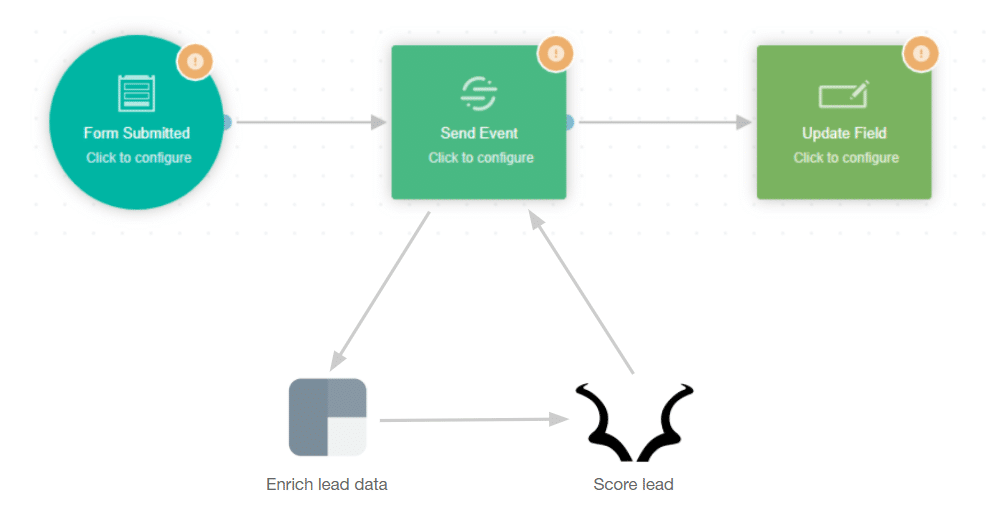
- If a new lead is collected, then its data is automatically pushed towards data enrichment and "predictive scoring" platforms to instantly know if this contact represents a sales potential.
- Required: have an integration with these tools.
Automations based on contact behavior are the foundation of modern relationship marketing. They are what make it possible to build and maintain a direct conversation with a contact, by personalizing messages according to the context, therefore by sending the right message at the right time and via the right channel, instead of sending the same message to a multitude. of different people.
Finally, the more automated marketing becomes, the more personalized it becomes for the contact with whom you have a relationship.
